


In 2026, global IT spending is projected to reach $6.31 trillion, a 13.5% year-on-year increase, according to Gartner's latest forecasts. This acceleration points to an undeniable reality: technology is no longer a cost center; it has become a growth driver. However, simply investing more is not enough. Without a solid strategic IT partnership, these colossal budgets risk being wasted on misaligned projects, unsuitable solutions, and schedule overruns. This is why more and more organizations are seeking vCIO support capable of orchestrating this complexity.
Whether integrating an ERP, automating processes, or deploying artificial intelligence, the quality of your technology partner determines the success of the project. Large organizations want to be more strategic with their main partners to optimize costs and drive transformation programs, combining the consolidation of major partnerships with the specialization of external resources. This dynamic redefines the relationship between businesses and IT providers, going far beyond a simple supplier/client transactional model.
Why the Traditional Supplier Relationship is No Longer Enough

For decades, IT operated on a transactional model: a specification sheet, a service delivery, an invoice. This linear framework worked well for stable environments. However, it falls short when technologies evolve quarterly and regulatory requirements multiply.
Forty-nine percent of surveyed companies state that they will increase their engagement with smaller, niche vendors for specialized products, even though the total number of vendors remains largely stable; this dual movement reflects a qualitative adjustment rather than a broader expansion of their vendor list. The message is clear: organizations want fewer interchangeable providers and more long-term, committed partners.
A true strategic IT partnership implies mutual commitment. The partner understands business challenges, anticipates risks, and co-creates the technology roadmap. They do not just deliver; they invest in operational success. This shift radically changes the dynamics of every project.
The Pillars of a Successful Strategic IT Partnership
Not all partnerships are created equal. Those that generate long-term value are built on solid, measurable foundations aligned with business strategy. Here are the core pillars to look for before committing.
Alignment Between Business Goals and Technical Capabilities
The first criterion of a high-performing partnership is its ability to connect business strategy to technical choices. IT project management is shifting toward business value creation, with rigorous management of costs, vendors, and key competencies; IT decision-makers are thus becoming strategic players, aiming to balance innovation, operational performance, and energy efficiency. Your partner must demonstrate this dual capability: mastering technology and understanding your business.
Shared Governance
A partnership without clear governance drifts. Joint steering committees, shared performance indicators, and precise allocation of responsibilities are essential. The adoption rate of vendor contract management best practices stands between 40% and 50%, according to the KPMG/Silicon study, which reveals a significant margin for improvement. Formalizing governance from the start protects both parties.
Transparency and Ownership of Deliverables
Vendor lock-in is a major risk. 67% of large enterprises and 56% of mid-market companies express concern about the risk of technological lock-in, according to the same KPMG "Trends of IT 2025" study. A good partner guarantees code ownership, data portability, and exhaustive documentation. These clauses are not mere legal details; they dictate your future freedom.
Aligning Your IT with Your Business Strategy
One of the most frequent criticisms leveled at IT departments is their disconnect from ground-level realities. A strategic partner bridges this gap by acting as a translator between operational needs and technical solutions.
Concretely, this alignment involves several steps: understanding the organization's global vision, mapping critical processes, diagnosing existing systems, and then building a coherent roadmap. Every technology initiative must map back to an identified business goal and be accompanied by shared success metrics.
70% of organizations declare that AI is already a strategic priority, according to Wavestone's Global AI Survey, yet nearly half lack any structured method to measure the value generated. This paradox perfectly illustrates the need for a partner capable of connecting technical ambition with results measurement. Without clear metrics, even the most ambitious investment remains a blind bet.
When the stakes involve an ERP system, the question of choosing the right ERP solution becomes critical. A strategic partner helps you decide between off-the-shelf and custom software based on your actual constraints, rather than current trends.
The Risks of a Poorly Calibrated IT Partnership
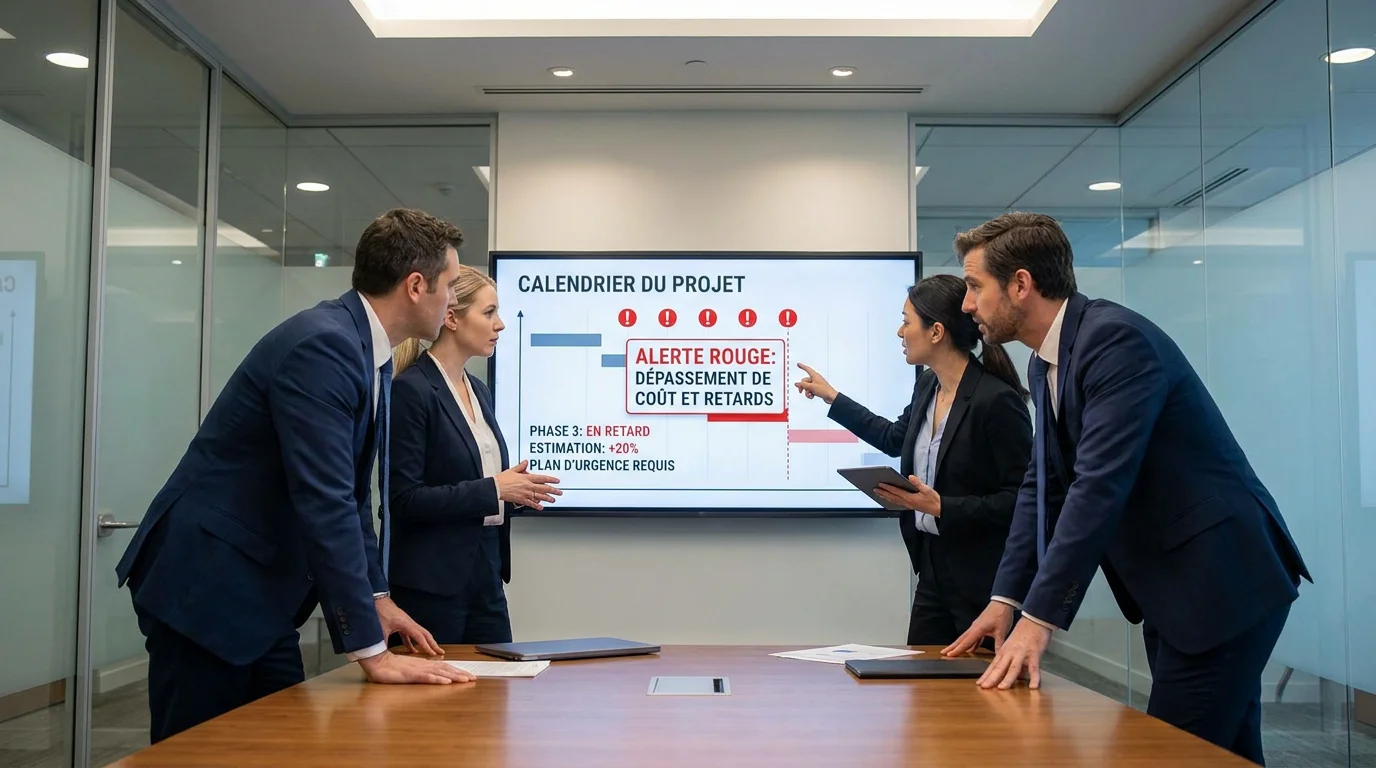
The consequences of choosing the wrong partner are measured in lost months, blown budgets, and missed opportunities. ERP projects are particularly vulnerable: according to industry data, 42% exceed their deadlines, and 23% to 45% exceed their initial budget.
These overruns are never purely technical. They stem from a lack of mutual understanding, loose governance, or a provider selling skills they do not actually possess. A provider who unconditionally promises everything is rarely a good sign.
Another common risk is architectural fragmentation. For businesses, multiplying partners requires tighter contractual governance and controlled technical integration to prevent architectural fragmentation. A strategic partner focuses on global consistency, whereas a simple vendor just delivers an isolated module.
AI and Cloud Are Redefining Expectations of IT Partners
Following a 10.5% growth in 2025, the year 2026 confirms an underlying trend: IT is no longer just support, but a strategic engine for transformation and competitiveness. Artificial intelligence and cloud computing are the main drivers of this shift.
AI remains at the center of IT developments in 2026, but the paradigm is shifting: we are moving from isolated pilot projects to systematic integration into core business processes. This transition requires partners capable of deploying operational AI with clear governance and concrete, measurable AI use cases for SMEs.
On the cloud side, major providers are responding by offering regional clouds, "trusted" variations, and country-by-country partnerships; we are no longer talking about a one-size-fits-all model, but a gradual shift toward localized IT, often described as "geopatriation," according to Wavestone's analysis. This growing complexity reinforces the need for a partner who understands sovereignty, GDPR compliance, and data security issues.
SMEs and Mid-Market Companies: How to Structure Your IT Partnership
Large enterprises often have in-house IT teams capable of managing their partners. For SMEs and mid-market companies, the situation is different. The lack of internal resources makes the choice of partner even more critical.
Here are the key steps to structure an IT partnership adapted to your size:
- Existing System Audit: map out your tools, data flows, and critical processes before making any commitment.
- Priority Definition: identify two or three high-impact projects instead of spreading your resources thin.
- Partner Selection: choose a provider that combines technical expertise and business understanding, with a dedicated point of contact.
- Clear Contracting: demand code ownership, a fixed budget, and precise delivery milestones.
- Ongoing Management: set up regular committees and shared KPIs to measure progress.
The global digital market is expected to grow by +4.3% in 2026, reaching 74.3 billion euros according to the Numeum/PAC Observatory. In this recovery context, SMEs and mid-market companies that properly structure their technology alliances gain a sustainable competitive edge. Digitizing your SME in 2026 relies on this methodical approach.
Selection Criteria for a Strategic IT Partner
How can you distinguish a true strategic partner from a classic service provider? Several objective criteria can help you decide.
| Criterion | Classic Service Provider | Strategic Partner (e.g., SapAngel) |
|---|---|---|
| Business Understanding | Limited to the specifications sheet | Dual functional and technical expertise |
| Code Ownership | Variable, often restrictive | 100% owner (code and data) |
| Project Lead | Multiple contact persons | Dedicated point of contact, business expert |
| Budget Commitment | Time and materials, frequent overruns | Fixed price, delivery in 3 months |
| GDPR Compliance | Self-declared | Hosted in Europe, auditable logs |
| Vendor Independence | Tied to a single vendor | Multi-vendor (SAP, Microsoft Dynamics 365) |
These criteria are not exhaustive, but they cover the most frequent friction points in digital transformation projects. The partner's ability to commit to results rather than just means makes all the difference.
Cybersecurity and Compliance: The Partner's Key Role
80% of cloud incidents occur due to poorly managed permissions, identities, or configurations, according to a study cited by Tenexa in its analysis of 2026 IT trends. This figure highlights a frequently overlooked point: security is not just about tools, it is also about partnership governance.
Very often, attackers do not even target the central IS; they enter through a subsidiary or a partner. A strategic IT partnership must therefore integrate cybersecurity at every step: access management, data encryption, regular audits, and regulatory compliance (NIS2, AI Act, GDPR).
For organizations operating across Switzerland and France, these requirements are even more complex. A partner with local roots, European hosting, and auditable processes offers a concrete guarantee in the face of these growing obligations.
Ultimately, a strategic IT partnership is not a luxury reserved for large corporations. It is a prerequisite for success for any organization looking to turn technology investments into measurable results. The 13.5% increase in IT spending in 2026 is not a temporary spike, but the sign of a lasting transformation. In this dynamic, surrounding yourself with a partner who combines technical expertise, business understanding, and a clear contractual commitment becomes a decisive competitive advantage. Our approach is built on a dedicated point of contact, 100% code ownership, and deliverables in 3 months at a fixed price, to secure every step of your transformation. To concretely evaluate your needs, schedule a scoping call with our vCIO team and lay the foundations for a partnership that drives value.
Frequently Asked Questions
What is the difference between an IT service provider and a strategic IT partner?
A service provider executes a one-off specifications sheet. A strategic partner is committed to the long term, understands your business objectives, and co-creates the technology roadmap. They share risks and measure their success based on the results achieved.
How long does it take to see the benefits of an IT partnership?
The first operational gains usually appear within three to six months, depending on the complexity of the project. For example, our custom software is delivered in 3 months at a fixed price, allowing you to quickly measure the return on investment.
Is a strategic IT partnership relevant for an SME?
Absolutely. SMEs often lack internal IT resources, making the partnership even more critical. The key is to choose a partner that tailors its support to your size, providing a dedicated point of contact and clear contractual commitments regarding costs and deadlines.