

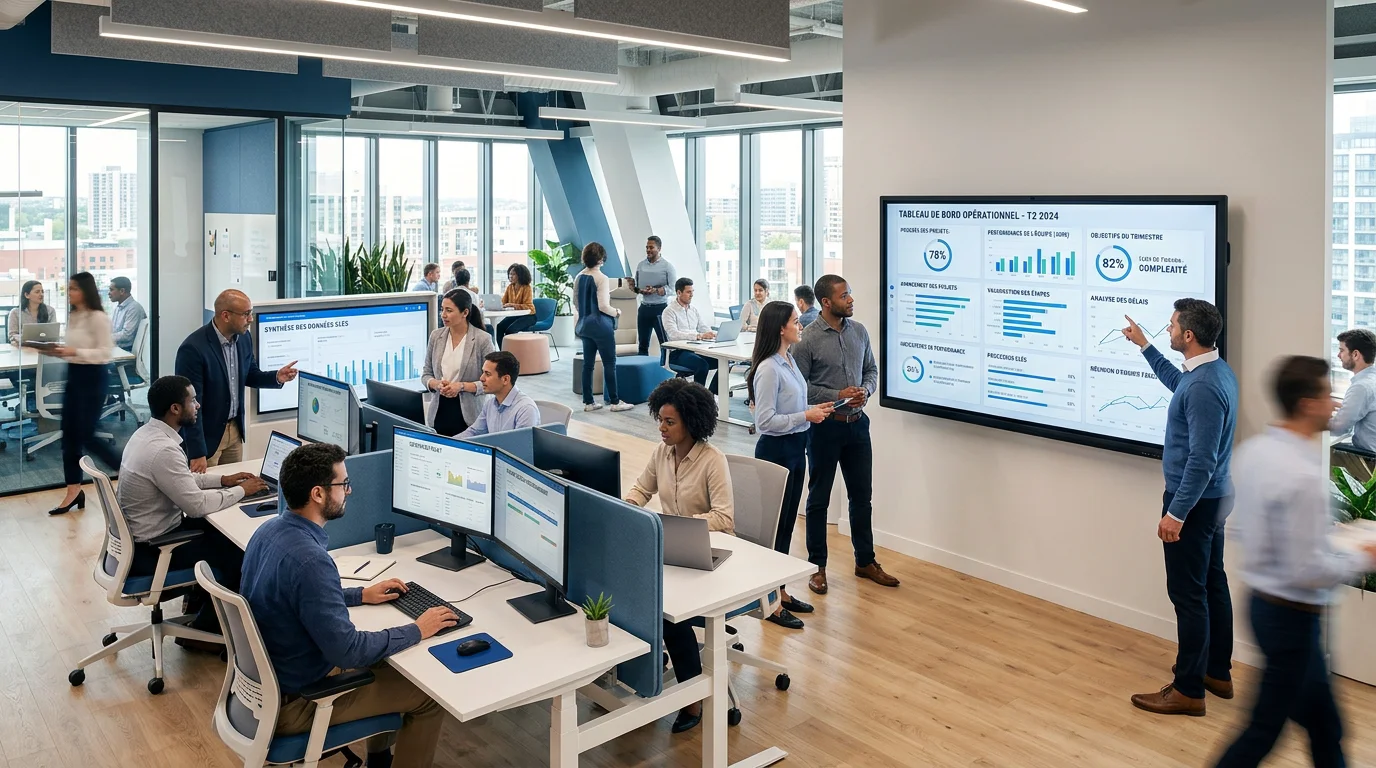
One in four companies continues to manage its business without leveraging its own data. This delay is costly, as it blocks the path to productivity gains and automation. To objectively assess your situation before investing, our digital performance audit identifies the levers that will deliver real ROI for your organization.
SME and mid-cap digitalization is no longer a side project: it is a matter of survival and competitiveness. However, progress remains slow. According to France Num, the proportion of companies that have started their digital transformation has grown from 72% in 2017 to 76%, representing about one percentage point per year. This insufficient pace weakens structures that nevertheless play a major role in the economy.

Why Digitalization Has Become an Imperative for SMEs and Mid-caps
SMEs and mid-caps form the core of the French economic landscape, producing 49% of the national value-added. Their ability to modernize their tools therefore largely dictates the country's competitiveness.
Awareness is real. 58% of SME and mid-cap leaders believe that artificial intelligence is vital to their company's survival. But intention is not enough. 43% of SMEs and mid-caps still do not use data analytics to steer their business, depriving them of the foundation necessary for any advanced modernization.
In practice, digital transformation delivers three measurable benefits: reducing repetitive tasks, making processes more reliable, and better leveraging information. These gains are not a matter of comfort. They determine profit margins, commercial responsiveness, and resilience in times of crisis.
Digitalization or Digital Transformation: Clarifying the Terms
Two different concepts are often confused. Digitization involves adopting tools: a website, email, office software. Digitalization of business processes goes much further: it rethinks how work flows, is approved, and is measured.
This distinction is crucial. Digitalizing a dysfunctional process only amplifies its flaws. Before choosing tools, you must map your workflows, build consensus among teams, and validate the actual added value. The tool always comes after the business process design, never before.
Priority Areas: Processes, ERP, and Data
Where should you start? The quickest wins usually come from cross-functional processes: quotes, invoicing, dunning, expense reports, and inventory management. These tasks consume hours every week and are prime candidates for automation.
Enterprise Resource Planning (ERP) software remains the backbone of this transformation. According to Insee, 47% of French companies report using an ERP system, a share slightly higher than the EU average of 43%. The cloud is accelerating this adoption. According to Eurostat, companies use the cloud for finance and accounting (51.6%), ERP resource management (25.9%), and CRM customer relationship management (25%).
Choosing an ERP shapes your IT system for the long term. To avoid scoping errors, our ERP expertise for SMEs helps you select a solution tailored to your actual workflows, without costly over-specifying.
A Step-by-Step Methodology for Project Success
A successful digital modernization project follows a clear trajectory. Here are the essential steps:
- Assessment: map your processes, evaluate your digital maturity, and identify high-impact pain points.
- Strategy: set measurable short-, medium-, and long-term goals aligned with your business roadmap.
- Prototyping: test a process on a small scale (proof of concept) before any large-scale rollout.
- Phased Rollout: pilot, evaluate, and then expand to the entire organization, connecting your existing systems via APIs.
- Change Management: train teams and explain the concrete benefits for each individual to ensure adoption.
Every decision must be justified by a clear return on investment. Calculating the total cost of ownership (TCO) of your processes, both before and after digitalization, prevents you from investing in technology for technology's sake. Change management is not an afterthought: it is the factor that separates profitable projects from abandoned ones.
Avoiding Budget and Timeline Overruns: The Sensitive Case of ERP Projects
This is where many companies stumble. ERP projects frequently exceed their timelines and budgets. In our experience, around 42% of ERP projects overrun their announced schedules, and 23% to 45% exceed their budget. These overruns rarely stem from the technology itself: they come from poor scoping, a lack of internal resources, and neglected change management.
The risk is twofold for an SME or mid-cap: draining scarce resources and becoming overly dependent on an integrator for the slightest update. To secure the timeline and control costs, our ERP implementation approach focuses on a controlled scope, rigorous project management, and complete ownership of your code and data.
When your organization relies on a complex environment, our SAP consulting combines technical expertise with functional understanding to align the tool with your critical business needs, rather than the other way around.

Data: The Essential Foundation Before AI
Many executives want to adopt AI without laying the groundwork first. However, AI is only as good as the quality of the data feeding it. A company committed to digitalization is five times more likely to use AI, and a company that analyzes its data is 2.5 times more likely to do so.
This digital gap is measurable. According to Insee, the share of European companies using at least one AI technology was 13% in 2024, with France falling below average at 10%. The same gap exists in overall digital intensity, where only 23% of French companies showed a high or very high index in 2024, compared to over 55% in Scandinavian countries.
The lesson is simple: first structure your processes and data, then deploy targeted intelligent assistants. Generating quotes, analyzing customer exchanges, or automating reminders then becomes reliable and cost-effective, because the AI relies on clean, centralized information.
What Human Resources are Needed to Lead the Transformation?
The primary barrier is not financial; it is human. SMEs and mid-caps often lack internal IT resources to scope, make decisions, and manage projects over the long term. Recruiting a full-time Chief Information Officer (CIO) is rarely justified at this scale.
This is precisely the need met by our fractional CIO service for SMEs/mid-caps: high-level expertise, mobilized in the right amount, with a dedicated specialist who understands your industry. This formula avoids vendor lock-in while maintaining a coherent path across strategy, tools, and change management.
Comparison of Digitalization Approaches
| Approach | Timeline/Budget Control | Code and Data Ownership | Business Alignment & Support |
|---|---|---|---|
| Standard software vendor / Licensing | Variable, risk of overrun | Vendor lock-in | Generic |
| In-house development | Depends on IT resources | In-house | Based on available skills |
| Our SapAngel support | 3-month delivery at a fixed price | 100% proprietary | Dedicated point of contact, dual expertise |
Conclusion
The digitalization of SMEs and mid-caps is no longer optional in 2026. The key figure remains striking: 43% of companies still manage their operations without leveraging their data—a direct disadvantage against better-equipped competitors. The right approach is methodical: formalize your processes, establish a reliable data foundation, roll out progressively, and only then scale up automation and AI. Every euro invested must translate into a measurable gain. By combining pragmatism, data ownership, and long-term business alignment, your transformation will deliver on its promises of growth and peace of mind. To scope your project with an expert who stays by your side for the long haul, discover our fractional CIO service and secure every step of your journey.
Frequently Asked Questions
How long does the digitalization of an SME take?
It depends on the scope. Custom business software can be delivered in a few months, whereas a complete ERP overhaul typically takes six months to over a year. A phased rollout limits risks.
Should you start with an ERP or with automation?
Start with the most time-consuming processes, often quoting, invoicing, and reminders. Automating these tasks delivers quick wins and paves the way for a core ERP system.
How do you digitalize without an in-house IT team?
An SME can rely on a fractional CIO. This approach brings scoping and management expertise in the right dosage, without the cost of a full-time hire, providing a dedicated point of contact who follows the project over the long term.