
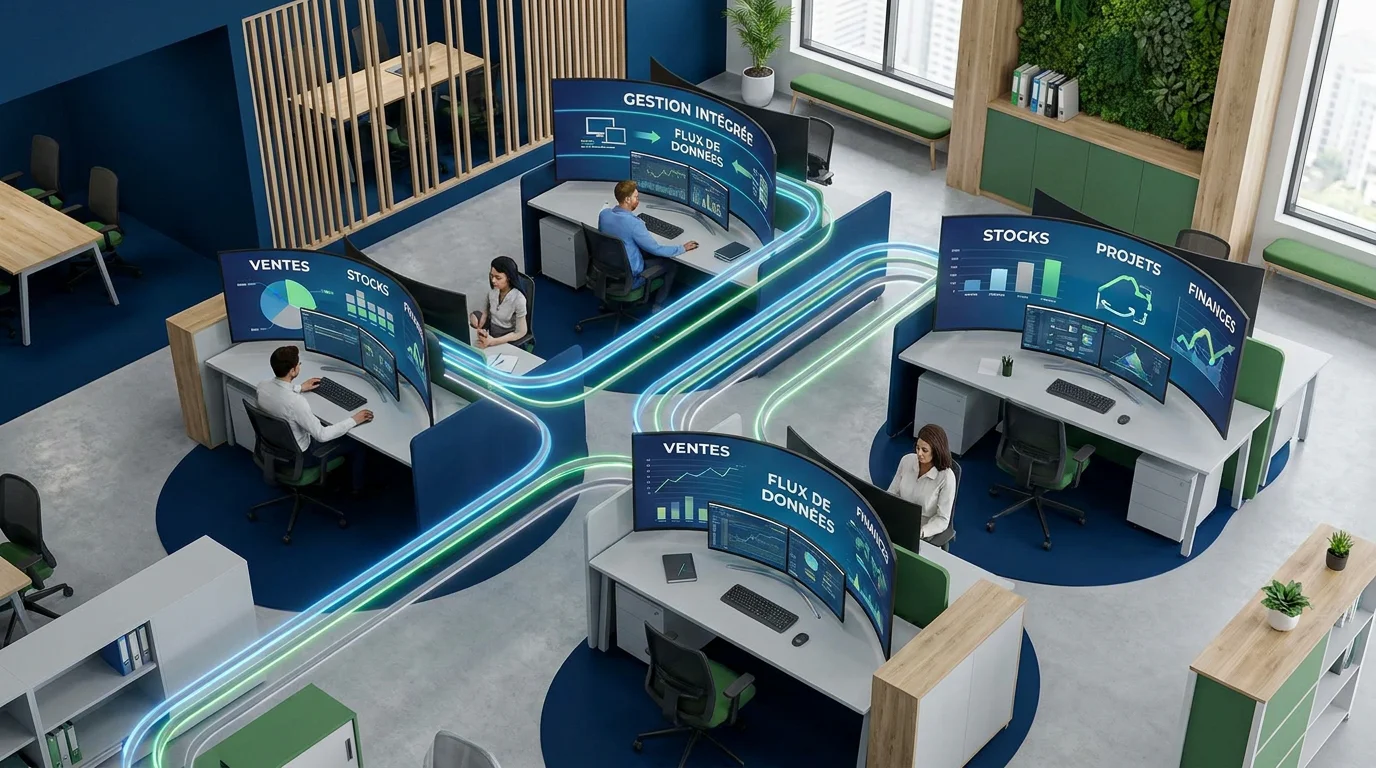
In 2025, the global ERP market was estimated at $71.62 billion according to Mordor Intelligence; it is projected to reach $78.15 billion by 2026. Meanwhile, 72% of new ERP projects in France are now deployed in the cloud. Behind this acceleration lies a simple truth: running an SME with scattered spreadsheets and siloed tools costs time, money, and competitiveness. Facing this reality, choosing an ERP for SMEs becomes a critical strategic lever.
However, you still need to find the solution that fits your size, industry, and ambitions. Before comparing offers, it is essential to understand what an enterprise resource planning system can truly deliver, and which criteria differentiate a profitable investment from a failing project. If you are torn between a standard solution and custom development, our guide on custom ERP vs. off-the-shelf ERP: which one to choose for your SME? will shed light on the advantages of each approach.
What Is an ERP and Why Is It Vital for an SME?
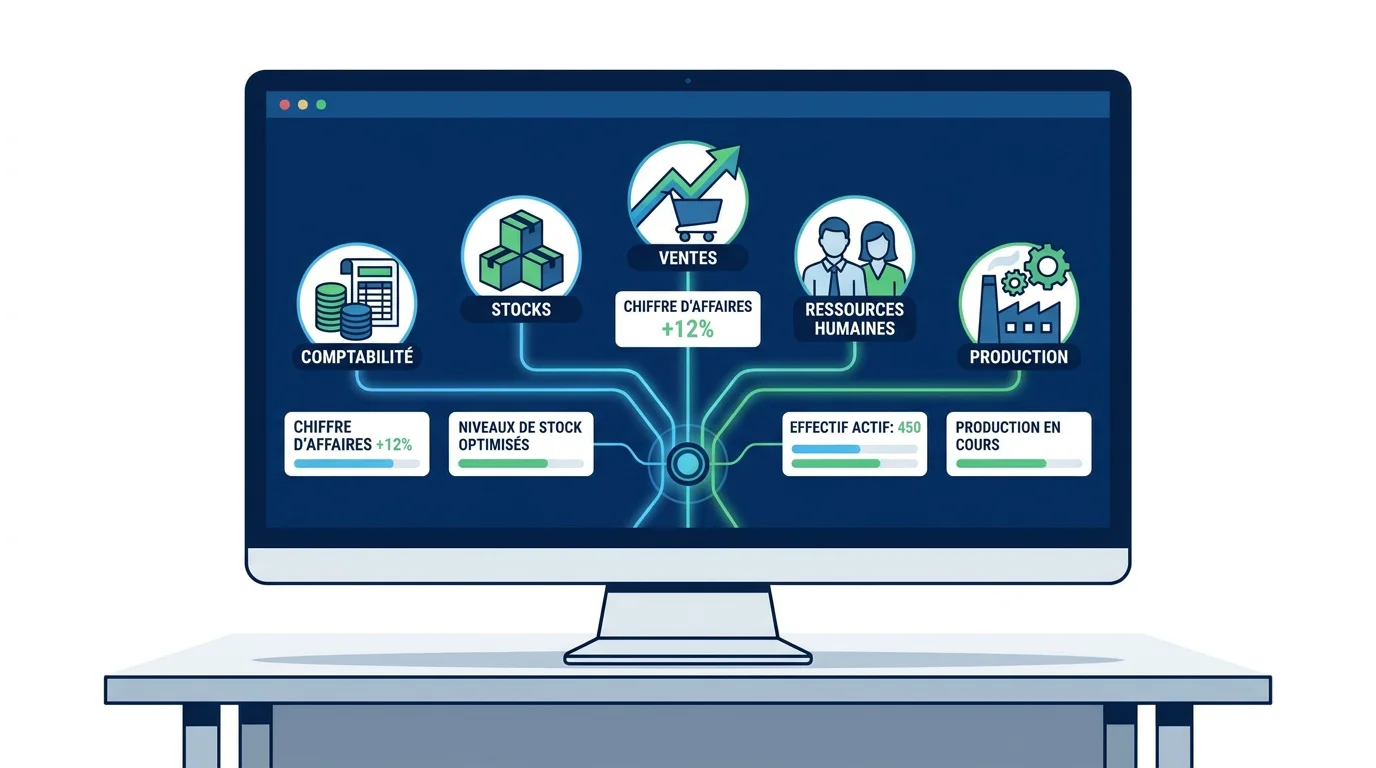
An ERP (Enterprise Resource Planning) is software that consolidates all of a company's data and processes within a single database. Accounting, sales, purchasing, inventory, production, human resources: every department accesses the exact same information, updated in real time.
In practice, when a sales representative creates a quote, the ERP can automatically generate the order, adjust stock levels, issue the invoice, and log the accounting entry. No more manual data reentry, fewer errors, and significant time savings on administrative tasks.
For an SME, the benefits are threefold. First, data centralization eliminates information silos between departments. Second, automating repetitive processes frees up time for high-value activities. Third, real-time dashboards provide a 360° view of operations, which is essential for making informed decisions.
According to the 2024 ERP Market Barometer, 70.2% of French SMEs consider business planning a critical challenge, and 69.5% are looking to improve mobile access to their system. These numbers confirm that expectations go far beyond basic accounting.
An Expanding Market: Key Figures to Know
The ERP sector is experiencing steady growth, driven by digital transformation and widespread cloud adoption. The global ERP market was valued at $71.62 billion in 2025 and is projected to reach $78.15 billion in 2026, and $120.96 billion by 2031, representing a compound annual growth rate (CAGR) of 9.12%.
The global ERP software market passed the $160 billion mark in 2024, showing annual growth of 4% to 5%, according to an analysis published by Apogea in March 2026. Differences in valuation across sources stem from varying measurement scopes (software-only vs. software and services), but the trend is undeniable: the market is accelerating.
In France, the momentum is just as strong. ERP software accounted for nearly €3 billion in software spending, and over 53% of ERP deployment projects are now carried out via cloud solutions. For SMEs, this migration to SaaS translates into more accessible entry-level budgets and automatic updates.
Cloud, On-Premise, or Hybrid: Which Model to Choose?
The choice of hosting model determines the budget, flexibility, and maintenance overhead of your project. Three options are available.
Cloud ERP (SaaS)
Hosted on the vendor's servers, a cloud ERP is accessible from any web browser. There is no infrastructure to buy and no updates to manage—the vendor takes care of it. The model relies on a predictable monthly or annual subscription, with no heavy initial investment. In France, 72% of new ERP projects launched in 2025 were cloud-based, according to data from Foxeet, citing IDC.
On-Premise ERP
Installed on your own local servers, this model offers total control over data and customization. It is suited for highly regulated environments (defense, nuclear) or companies with a strong internal IT team. On the downside, it requires a significant initial investment (licenses, hardware, maintenance) and manual updates.
Hybrid ERP
The hybrid approach combines the best of both worlds and allows for a gradual transition to the cloud. Certain sensitive data remains local, while collaborative modules are accessed online. This model appeals to SMEs looking to modernize their system without moving everything to the cloud on day one.
The Five Decisive Criteria for Choosing Your ERP
Before comparing vendors, clearly define your actual needs. Here are the five criteria that separate a successful implementation from a failed deployment.
1. Industry Fit
An oversized, generic ERP requires more customization, longer timelines, and higher costs. Conversely, an industry-specific ERP (manufacturing, construction, trade) offers out-of-the-box features and faster deployment. Always check the vendor's references in your specific field.
2. Functional Scope and Modularity
Your ERP should cover at least 80% of your immediate needs while offering modules that can be activated as you grow. Key features include financial management, purchasing, sales, inventory, production, and reporting. Choose a modular architecture so you only pay for what you actually use.
3. Total Cost of Ownership (TCO)
The sticker price of a license is only the tip of the iceberg. TCO includes integration, training, maintenance, custom developments, and future migrations. 67.2% of SMEs believe they have too many applications in their IT system, which inflates the overall bill. A properly sized ERP replaces multiple tools and reduces overall costs.
4. Quality of Support and Implementation
The integrator plays just as important a role as the software developer. Choose a partner with proven expertise in your industry, capable of understanding your processes and supporting you beyond go-live. A dedicated representative who understands your sector often makes the difference between a successful project and one that slips out of control.
5. Security and Compliance
Data hosting, encryption, audit logs, and GDPR compliance are non-negotiable, especially for SMEs operating in Europe. Ensure that the vendor or integrator guarantees hosting in Europe and protection mechanisms that meet regulatory requirements.
Comparison of the Main ERP Solutions for SMEs in 2026
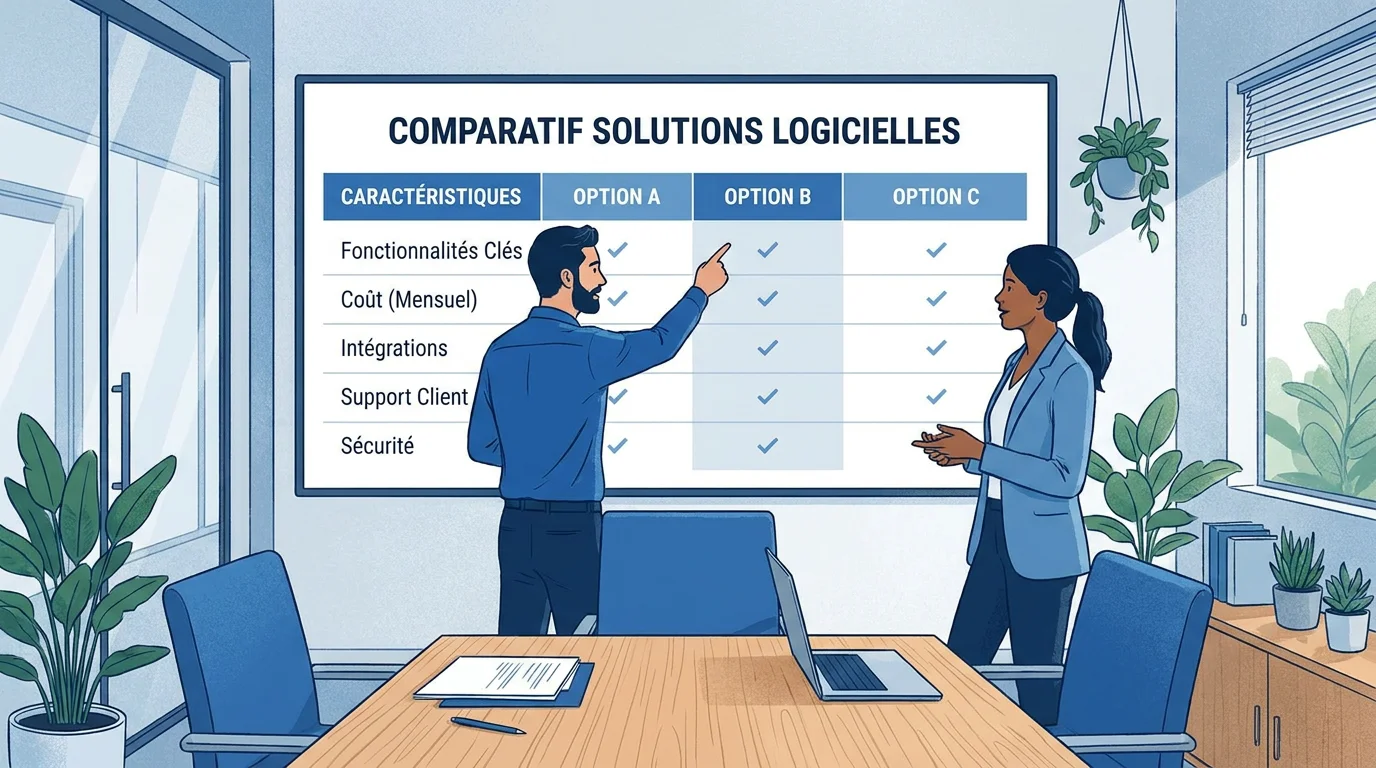
The table below summarizes the characteristics of the most common solutions in the French-speaking market, as well as the consulting and integration services we offer.
| Solution | Deployment | Target Profile | Estimated Price | Key Strength |
|---|---|---|---|---|
| SAP Business One | Cloud, on-premise | Structured SMEs | ≈ €90/user/month (cloud) | Functional depth and traceability |
| Microsoft Dynamics 365 Business Central | Cloud (SaaS) | SMEs, mid-market | €70 to €100/user/month | Native integration with the Microsoft ecosystem |
| Odoo | Cloud, on-premise | SMEs, startups | ≈ €25/user/month (cloud) | Modularity and affordable entry point |
| NetSuite (Oracle) | Cloud (SaaS) | Growing SMEs, multi-entity | Varies by module | Multi-country consolidation |
| Sage X3 | Cloud, on-premise | Structured manufacturing SMEs | Varies | Multi-site management and advanced analytics |
| SapAngel (SAP / Dynamics 365 consulting and integration) | Cloud, hybrid | SMEs, mid-market, enterprises | On quote, fixed price | Dedicated representative, dual functional and technical expertise, 3-month delivery |
SAP Business One covers the fundamentals (finance, purchasing, sales, inventory) with a robust core. Microsoft Dynamics 365 accounts for 12% of the French ERP market and integrates naturally with Excel, Teams, and Power BI. Odoo appeals with its open-source approach and entry-level pricing but requires strict technical governance to manage technical debt. NetSuite is ideal for multi-country structures, while Sage X3 targets manufacturing SMEs with complex workflows.
To get the most out of SAP or Dynamics 365, support from an experienced integrator is critical. If you are considering either of these platforms, discover our SAP ERP solution and our fixed-price deployment methodology.
Artificial Intelligence: The New Standard for Modern ERPs
Growing demand for integrated automation, cloud migration, and AI-powered analytics is fueling ERP market expansion across all sectors. In 2026, AI in ERP is no longer limited to predictive dashboards: it takes action.
We are now seeing agentic AI—software agents capable of executing tasks autonomously within rules defined by your teams. A supplier misses their delivery deadline? The agent triggers a follow-up, finds an alternative, and drafts a backup order. An unexpected spike in demand? The AI readjusts the production schedule and alerts the relevant manager.
Internal vendor benchmarks show that AI-assisted forecasting can reduce safety stocks by 30%, freeing up cash for investment. These tangible gains explain why every major software vendor (SAP with Joule, Microsoft with Copilot, Oracle with its AI modules) is accelerating the integration of AI into its suites. To explore more concrete applications, see our AI use cases for SMEs.
The Mistakes That Derail an ERP Project
42% of ERP projects exceed their timelines, and 23% to 45% run over budget. Behind these statistics, we often find the exact same pitfalls.
Underestimating the initial scoping. Launching a request for proposals without having clearly mapped out your business requirements leads to costly back-and-forth. Take the time to map your ten critical processes before contacting a vendor.
Choosing an oversized ERP. A software system built for large enterprises deployed in a 50-person SME creates unnecessary complexity, high integration costs, and poor adoption rates among teams.
Neglecting change management. Even the best tool will fail if users do not adopt it. Plan a training strategy, identify internal key users, and ensure post-deployment support. 66.7% of SMEs doubt the security and reliability of the data inside their IT systems; a well-implemented ERP dispels these fears by delivering traceability and reliability.
Ignoring scalability. Your immediate needs should not be your only guide. The chosen ERP must be able to support your mid-term growth without a complete overhaul. This is one of the main advantages of a modular architecture.
How to Successfully Deploy an ERP in an SME
A successful ERP project relies on a structured methodology. Here are the key steps to follow.
Step 1: Assessment. Identify your current processes, pain points, and priority objectives. Involve department heads from day one.
Step 2: Requirements Specification. Put your functional and technical requirements in writing. Distinguish must-have features from nice-to-haves. This document will serve as your benchmark throughout the project.
Step 3: Selection. Compare three to five solutions based on tailored demos, not generic marketing presentations. Review the vendor's track record in your industry.
Step 4: Integration. Opt for a phased rollout (priority modules first) rather than a "big bang" launch. This approach reduces risks and helps teams adapt gradually.
Step 5: Training and Support. Train key users, appoint internal system champions, and plan post-go-live support. A long-term partner with a dedicated contact secures your return on investment. To take your digital transformation further, discover how to digitize your SME in 2026.
In summary, choosing an ERP tailored to your SME is one of the most structural investments you can make. Today's market offers accessible, modular, and AI-enhanced solutions, but choosing the tool is only half the battle. It is the quality of support, deep understanding of your business, and rigorous deployment that turn software into a true performance driver. With a dedicated expert, a fixed-price methodology, and full ownership of your code and data, you stay in control from start to finish. Discover our ERP implementation services for manufacturing SMEs and make your transition with confidence.
Frequently Asked Questions
What budget should be allocated for an SME ERP?
Cloud solutions start around €25/user/month for basic offerings and can exceed €100/user/month for full suites. The overall budget depends on the number of users, chosen modules, and integration costs. Requesting a fixed-price quote helps secure your budget.
How long does it take to deploy an ERP in an SME?
A phased deployment typically takes three to six months for priority modules. More ambitious projects can span up to twelve months. At SapAngel, we deliver custom solutions in three months at a fixed price, minimizing the risk of project creep.
Is a cloud ERP secure enough for a European SME?
Modern cloud solutions often offer a higher level of security than local servers, provided you verify European hosting, data encryption, and GDPR compliance. These criteria should be included in your specifications from the very beginning.