
With a global market estimated at 78.15 billion dollars by 2026 according to Mordor Intelligence, enterprise resource planning software has never been so strategic for businesses. Yet, one question consistently comes up during project scoping: should you opt for a custom ERP or an off-the-shelf ERP? The answer involves far more than an IT budget; it shapes your organization for years to come. Our approach at SapAngel, through our ERP solution, is to start from your actual processes to build a tool perfectly aligned with your business.
This decision isn't just about technological preference. It impacts your company's ability to adapt, your independence from software vendors, and the day-to-day operational value you create. Regulatory challenges in 2026, such as mandatory electronic invoicing, add an extra layer of complexity. Here are the concrete criteria to help you make an informed decision.
Custom ERP vs. Off-the-Shelf ERP: What Exactly Are We Talking About?
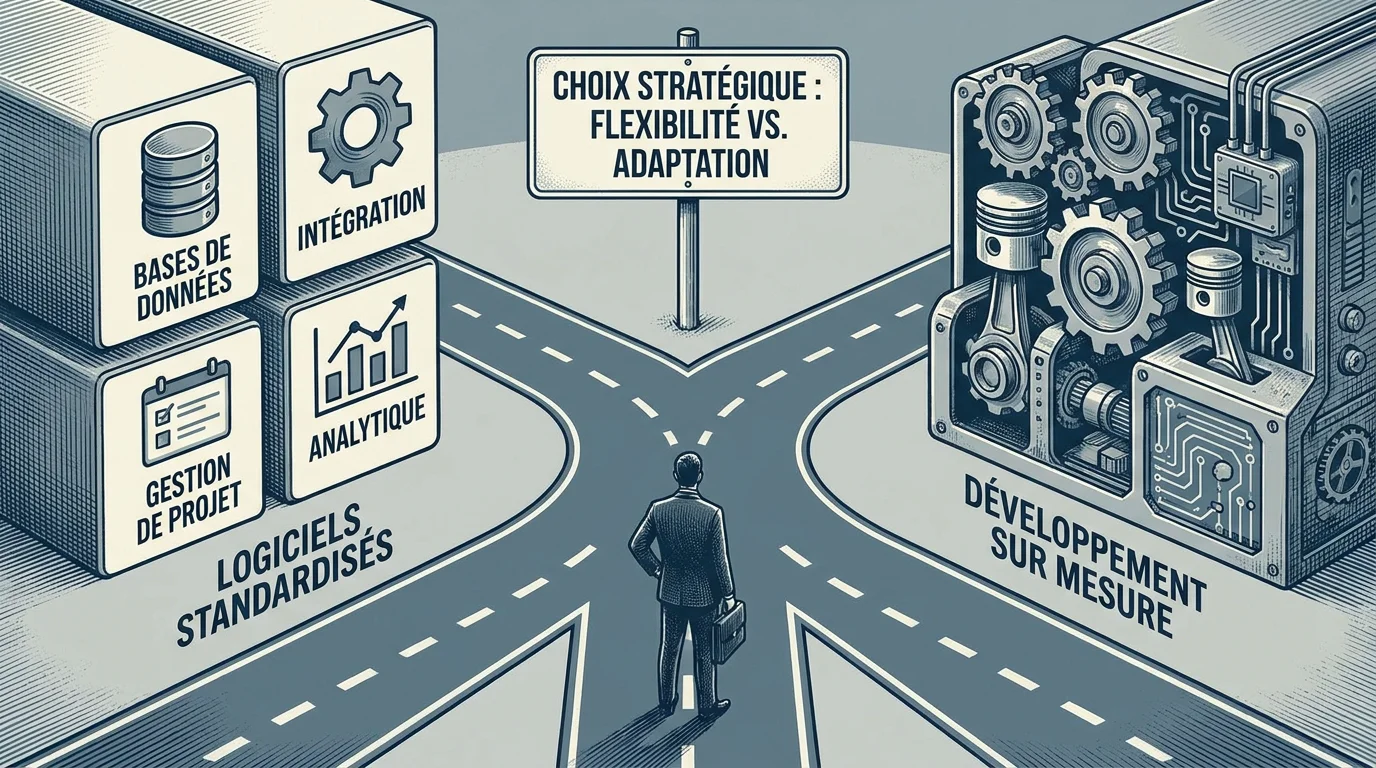
Before comparing, it is essential to clarify what these two approaches actually entail. An off-the-shelf ERP (or standard ERP) is a software package developed by a vendor to cover the common needs of a wide range of companies. SAP, Microsoft Dynamics 365, Sage, or Odoo fall into this category. The company adapts part of its operations to the tool provided.
A custom ERP, on the other hand, starts from the organization's operational reality. Processes are modeled exactly as they exist, without forcing the company into a predefined framework. The result is a proprietary system designed specifically for your teams and your industry.
The debate custom ERP vs off-the-shelf ERP is therefore not a simple binary choice. There is a whole spectrum of solutions, ranging from highly configurable generalist SaaS to fully bespoke development, as well as hybrid approaches that combine a standard core with dedicated business modules.
When an Off-the-Shelf ERP Perfectly Meets Your Needs
Not all businesses need custom development. For an SME whose sales management, invoicing, inventory tracking, and accounting processes follow traditional paths, a standard ERP is often the most rational choice.
The advantages are well-documented. Rapid deployment is the primary benefit: the infrastructure is already there, modules are ready to go, and teams can be trained on stable interfaces. The entry cost is also highly transparent, typically structured around a subscription model per user or per module.
Perceived longevity also plays a major role. Established software vendors have product roadmaps, active communities, and certified integrator networks. Regulatory updates, such as those related to electronic invoicing in 2026, are generally integrated automatically into the subscription.
However, this standardization comes with a trade-off. When a company deviates from the vendor's intended model, specific requests are handled through workarounds, add-on modules, or custom developments that are often expensive. This creates a risk of operational debt: the tool appears to be in place, but teams continue to work using parallel spreadsheets.
When Custom ERP Becomes a Competitive Advantage
Bespoke software is justified when your business processes are a true differentiator. Complex pricing engines, constraint-based planning, unique logistics, specific production cycles: these are all situations where forcing a standard software package to cover everything creates more friction than value.
The primary benefit is the alignment between the tool and the organization. When the system accurately reflects how your teams work, adoption is higher, workarounds disappear, and data becomes reliable. This is precisely the philosophy that guides our approach to ERP projects in the manufacturing sector: starting from the ground up, not from a catalog of features.
A custom ERP can also become a strategic asset. In some industries, the way a company operates is a major source of its value. Standardizing these processes in a generic tool sometimes amounts to erasing what makes you unique in the market.
However, this approach requires rigorous project management: tight scoping, feature prioritization, modular architecture, and planned maintenance. Without these safeguards, the risk of project drift is very real.
Total Cost of Ownership: The Real Decision Criterion
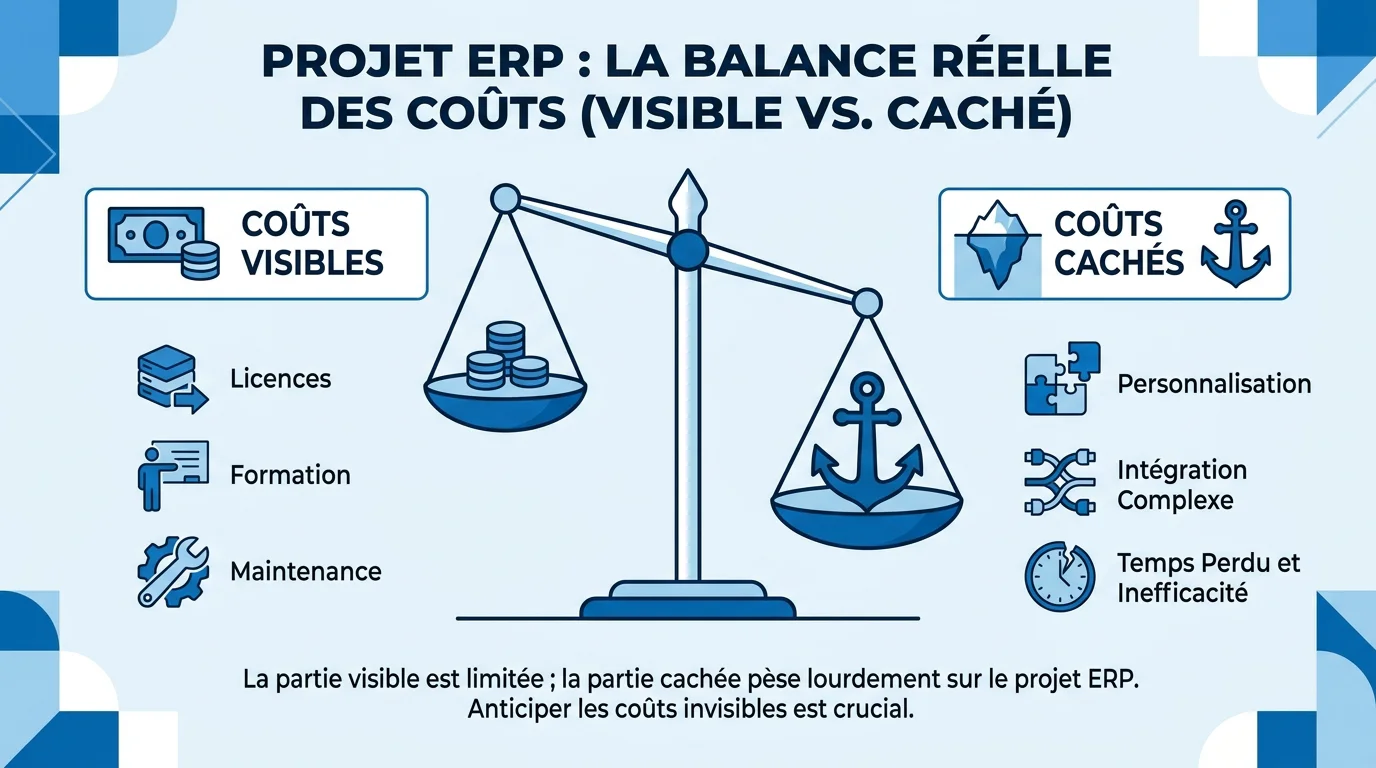
Comparing the price of a SaaS subscription to a quote for custom development is like comparing a monthly rent payment to a property purchase price. The only relevant analysis is the total cost of ownership (TCO) over five to ten years.
For a standard ERP, the TCO includes licensing (which often scales with user count), initial setup, data migration, training, change management, annual support, and any add-on modules. According to Panorama Consulting / Statista (2023 data), 47% of ERP projects exceeded their initial budget—a figure that highlights the importance of anticipating hidden costs.
For a custom ERP, TCO includes scoping, development, deployment, and then corrective and evolutionary maintenance, typically estimated at 15% to 25% of the build cost per year. Regulatory updates represent a specific expense area that should not be overlooked.
| Criterion | Off-the-Shelf ERP (SaaS) | Custom ERP | SapAngel Custom (Mind) |
|---|---|---|---|
| Entry Cost | Low to moderate (subscription) | High (development) | Fixed price, known from the start |
| Time to Go-Live | 3 to 12 months | 6 to 24 months | 3 months |
| Vendor Lock-In | High (roadmap, pricing) | Low to none | None (full ownership of code) |
| Business Fit | Medium (standard processes) | High | High, with a dedicated industry expert |
| Scalability | Depends on the vendor | Total, if well-architected | Continuous support with no overhead |
Risks to Assess in Each Scenario
Each approach carries its own risks. Identifying them beforehand allows you to make an informed decision rather than relying on gut feelings.
Risks of a standard ERP:
- Dependency on the vendor's roadmap and pricing decisions
- Functional rigidity as the business grows or diversifies
- Partial adoption by teams if the tool does not align with their practices
- Data lock-in making future migration complex
Risks of a custom ERP:
- Scope creep in the absence of strict project scoping
- Dependency on the technical service provider if documentation is poor
- Underestimated long-term maintenance costs
- Longer delivery timelines if project methodology is not rigorous
According to Panorama Consulting (2025), approximately 50% of organizations significantly underfund the migration phase during their ERP project planning. This holds true for both approaches and confirms the importance of an experienced partner capable of anticipating these pitfalls.
The Hybrid Approach: Often the Most Relevant Compromise
In practice, the best choice is rarely fully standard or fully custom. Many SMEs and mid-market companies find their balance in a hybrid architecture: a standard core for support functions (accounting, HR, CRM), supplemented by custom-developed business modules for unique, differentiating processes.
This modular logic is gaining traction. Gartner estimates that by 2028, around 80% of ERP systems will incorporate generative AI and predictive analytics as standard. This reinforces the case for keeping a vendor-supported core to benefit from these advancements, while maintaining control over high-value custom modules.
This approach avoids reinventing the wheel while protecting the processes that truly set you apart. However, it requires excellent integration capabilities: reliable APIs, data synchronization, and error handling.
Five Criteria to Guide Your Decision
Rather than making a decision based on a product demo or an attractive introductory price, here are five key areas to analyze methodically.
1. The degree of business specificity. Do your core processes resemble those of 80% of the companies in your industry? If so, a configured standard ERP will likely suffice. If your workflows, pricing models, or scheduling rules are truly unique, a custom option deserves serious consideration.
2. Quality of IT integration. An isolated ERP rarely creates long-term value. Check the available APIs, documentation, real-time sync capabilities, and compatibility with your existing systems.
3. Total cost over five years. Add up subscriptions, configuration, training, maintenance, integrations, internal staff time, and the cost of residual inefficiencies. A SaaS model might be cheaper to start with but can become more expensive if every adaptation requires paid add-on modules.
4. Scalability and adaptability. Your business will change. Your offerings, teams, and business rules will evolve. Choose a solution that can keep pace with this momentum without requiring you to start from scratch. Composable ERP, which relies on modules interconnected via APIs, is establishing itself as a key trend in 2026.
5. Project support. The biggest risk is not the technology, but the scoping phase. A partner with genuine industry expertise, capable of structuring priorities and delivering on time, often makes the difference between a successful project and an endless endeavor. Implementation roadmaps now prioritize business process redesign before feature parity.
Electronic Invoicing 2026: A Crucial Variable
Receiving electronic invoices becomes mandatory for all businesses starting September 1, 2026. This regulatory deadline adds a decisive criterion to your ERP choice.
With an off-the-shelf ERP, compliance is generally managed by the vendor through regular updates. With an internally developed ERP, each regulatory shift requires a dedicated development project to fund and schedule. This expense can range from €10,000 to €30,000 per major update.
The question to ask yourself is: does your organization have the internal resources to absorb these regular updates, or would you prefer to delegate this burden to a partner that builds compliance right into the design?
Making the Right Choice for Your Organization
The debate between custom and off-the-shelf ERPs has no single answer. The right decision depends on your unique context: how specific your processes are, your investment horizon, your scale potential, and your team's digital maturity. The ERP market, valued at $71.62 billion in 2025 and projected to reach $78.15 billion in 2026 according to Mordor Intelligence, offers a wide enough range of solutions for every business to find its path.
What truly makes a difference is the quality of the initial scoping and the expertise of your partner. A perfectly tailored tool, delivered on time and designed to scale with you, generates a measurable return on investment in productivity, reliability, and cost reduction. This is exactly the promise we deliver on with our software, completed in three months at a fixed price, with no licensing fees or vendor lock-in. To explore this approach, discover our Mind ERP solution and evaluate what it can bring to your business.
Frequently Asked Questions
Is a custom ERP always more expensive than a standard ERP?
Not necessarily. The initial cost of a custom ERP is generally higher, but the total cost of ownership over five to ten years can end up lower if the tool eliminates costly workarounds and reduces multiple subscription fees. The analysis should always focus on the overall TCO, not just the upfront purchase price.
Can you migrate from an off-the-shelf ERP to a custom ERP?
Yes, and this migration is common when the functional limitations of a standard ERP become an operational bottleneck. The key lies in data migration quality and change management. At SapAngel, our fixed-price, three-month delivery methodology secures this transition by mitigating the risk of project drift.
What types of businesses benefit most from a custom ERP?
SMEs and mid-sized businesses with more than 30% of non-standard operational processes benefit most from custom ERP systems. This is especially true in manufacturing, construction, specialized logistics, or highly specialized service industries, where management rules do not align with any preconfigured model.