
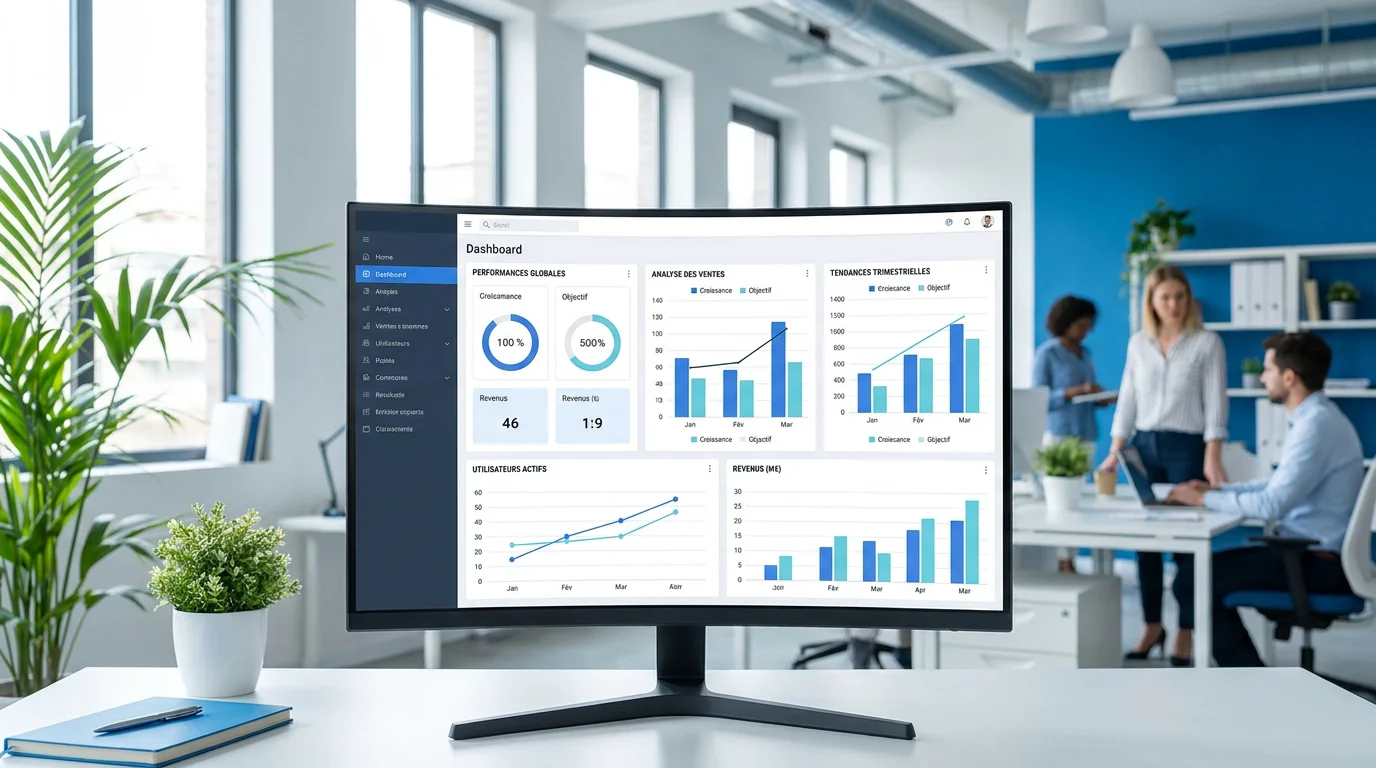
Did you know that over 61% of businesses worldwide had already adopted at least one custom software solution by 2024? This figure illustrates an unavoidable reality: off-the-shelf tools are no longer enough to meet the specific operational needs of every organization. Custom-built applications are becoming the preferred solution for companies looking to increase productivity, reliability, and agility. To better understand the differences between custom solutions and off-the-shelf software, we recommend reading our detailed analysis on Custom ERP vs. Off-the-Shelf ERP.
In a landscape where digital transformation is accelerating and artificial intelligence is redefining professional workflows, investing in software tailored to your business processes is no longer a luxury reserved for large enterprises. SMEs and mid-sized companies now have the technology and methodologies needed to design tools perfectly aligned with their goals. This article covers the fundamentals, concrete benefits, and key steps to ensure the success of your custom application project.
A Rapidly Growing Market: Key Figures
The global custom software development market is experiencing exceptional momentum. According to The Business Research Company, it is projected to grow from $53.95 billion in 2025 to $65.85 billion in 2026, with a compound annual growth rate of 22.1%. This growth far outpaces that of the overall software market, with the custom development segment showing a CAGR of 22.71%—nearly double the 11.8% rate observed for the software market as a whole.
Several factors explain this acceleration. The growing demand for personalized solutions, the limitations of standard applications, and the increasing complexity of business processes are driving organizations to invest in tools tailored to their needs. In Europe, the market is expanding at a CAGR of 26.2% between 2025 and 2030, according to Grand View Research, confirming that companies across the continent are accelerating adoption.
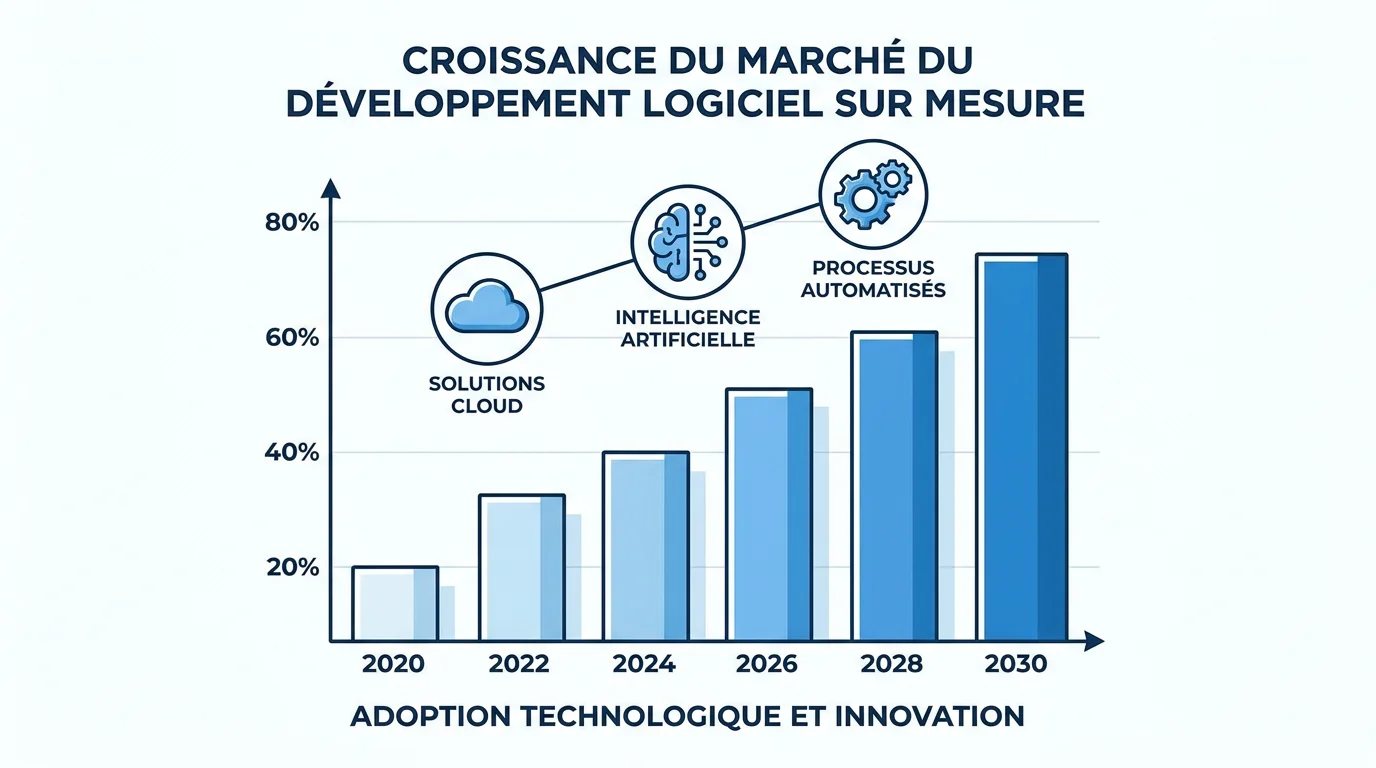
The Asia-Pacific region is the fastest-growing market, while North America dominated with a 34% share in 2025. In 2024, global spending on digital transformation technologies and services exceeded $2.3 trillion, with 35% to 40% dedicated to custom software development, according to Global Market Insights.
Why Choose a Custom Application Over Off-the-Shelf Software?
The choice between off-the-shelf software and a custom solution comes down to specific strategic goals. A standard tool imposes its own workflows, often forcing teams to change their habits to fit generic features. Conversely, a custom business application adapts to existing workflows, driving faster adoption and increased productivity.
Here are the key benefits of a solution developed specifically for your organization:
- Full functional coverage: 100% of your business needs are addressed, with no compromises or workarounds.
- Interoperability: the application integrates natively with your existing ecosystem (ERP, CRM, collaborative tools).
- Code ownership: no vendor lock-in, no recurring subscription fees. You retain full control of your tool and your data.
- Scalability: the software grows with your business and adapts to new processes without functional limitations.
- Security and compliance: the architecture is designed from day one to comply with GDPR and the regulatory requirements of your industry.
According to a study by 360 Research Reports, more than 49% of businesses worldwide report that their custom systems measurably improve operational efficiency, delivering double-digit gains. Reducing manual tasks, eliminating double-entry, and centralizing data in a single environment generate substantial savings within the first few months of use.
Artificial Intelligence: A Catalyst for Custom Solutions
Artificial intelligence is gaining more traction than any other technology in 2026. Integrating it into business software is transforming how teams work daily—enabling automated quote generation, predictive data analysis, lead qualification, or 24/7 customer support.
Around 48% of businesses are now deploying AI modules built directly into their custom solutions to automate processes, while AI integrations in custom systems jumped by 41% between 2023 and 2025. This trend reflects a practical need: companies no longer want generic AI, but rather intelligent assistants tailored to their specific data and workflows.
Combining custom applications with AI goes beyond typical efficiency gains, providing a genuine competitive advantage.
Key Steps to a Successful Development Project
The success of a custom software development project relies on a rigorous methodology. The most common issues (budget overruns, delays, poor functional fit) almost always stem from inadequate initial scoping. Here are the six key steps to follow:
- Define the main objective: articulate in a single sentence the core value the software must deliver. This clarification exercise guides all subsequent decisions.
- Map out the users: identify different profiles, their needs, and their level of influence. This helps prioritize which features to develop first.
- Write user stories: describe what each user does in non-technical terms. This step translates business needs into actionable functional specifications.
- Iterate and test: assess specifications against technical constraints, refining the product through successive sprints while involving future users.
- Estimate the workload: based on initial feedback, accurately determine the resources required to deliver the minimum viable product (MVP).
- Deploy and support: going live is just the beginning. Team training and change management are essential to ensure adoption.
This iterative approach, favored by the vast majority of organizations, allows for continuous product adjustment. According to Digital.ai's 17th State of Agile report, 74% of organizations now use hybrid or custom agile models rather than rigid frameworks.
How Much Does a Custom Application Cost?
Budget concerns are legitimate and deserve a nuanced answer. The price range for custom software development typically falls between €50,000 and €500,000, depending on the project's complexity. However, looking at it strictly through the lens of cost is shortsighted: a modest investment yields modest returns. The goal is to generate measurable value (productivity, reliability, data accessibility) that far outweighs the initial investment.
Several factors influence the overall budget:
- The complexity of the business processes being digitized.
- The number of features and integrations required.
- Interoperability with the existing IT ecosystem.
- Security and regulatory compliance requirements.
- Change management support and team training.
Our approach is built on transparency: a fixed price set upfront, delivery in three months, and full code ownership. This model eliminates the risk of budget overruns, a common issue affecting a significant portion of ERP and enterprise software projects.

Use Cases: From Commerce to Production
Custom applications fit any industry and business function. Here are the areas where they make the most significant impact:
| Department | Example Features | Typical Benefits |
|---|---|---|
| Sales & Marketing | Automated quote generation, lead management, integrated invoicing | Shorter processing times, higher conversion rates |
| Finance & Accounting | Automated reporting, real-time budget tracking, bank reconciliation | Increased data reliability, streamlined financial management |
| Human Resources | Automated onboarding, talent management, training tracking | Time saved on admin tasks, improved employee retention |
| Production & Quality | Real-time line tracking, end-to-end traceability, preventive maintenance | Fewer compliance issues, optimized resources |
| Customer Service | AI assistants, customized ticketing, knowledge base | 24/7 availability, improved customer satisfaction |
This versatility allows organizations to deploy a progressive digitization strategy, connecting business processes into a cohesive and scalable ecosystem.
Technologies Driving Custom Development
Low-code and hybrid development models are rapidly gaining popularity, reducing design timelines and making projects accessible to organizations with limited technical resources. Cloud computing, microservices architectures, and API connectors form the technological pillars of modern solutions.
Nearly 52% of companies prioritize API-driven custom software solutions, allowing them to unify siloed data from disparate systems. This technical approach guarantees optimal interoperability with tools already in place, whether they are SAP, Microsoft Dynamics 365, or other components of the IT system.
In 2026, security is recognized as the most pressing concern among technology decision-makers, according to a report by Itransition. Designing a custom application allows security and compliance requirements to be integrated directly into the initial architecture, featuring European hosting, data encryption, and native GDPR compliance.
Conclusion: Taking Action with a Proven Method
Developing custom-built applications is no longer reserved for organizations with unlimited IT budgets. With a market estimated at over $65 billion by 2026, this approach has become democratized thanks to technological advances (low-code, cloud, AI) and proven agile methodologies. The benefits are tangible: total functional coverage, code ownership, measurable productivity gains, and the ability to scale without vendor lock-in.
The key is choosing a partner capable of understanding your business challenges, delivering within controlled timelines, and supporting you over the long term. We design software delivered in three months at a fixed price, with no dependencies or subscriptions, and a dedicated contact who understands your day-to-day operations. To discover how you can transform your processes, explore our Mind solution and book a call with our team.
Frequently Asked Questions
What is the difference between a custom application and SaaS software?
SaaS software offers standardized features accessible via subscription, which are identical for all users. A custom application is designed specifically for your processes, data, and teams. It provides 100% functional coverage, without compromises, and you retain complete ownership.
How long does it take to develop a custom business application?
Timelines vary depending on complexity, but a structured project is typically completed in three to six months. With us, our Mind solution allows for the delivery of operational software in three months, thanks to an agile methodology and rigorous upfront scoping.
Can a custom application connect to an existing ERP?
Yes. Integrating with existing systems (SAP, Microsoft Dynamics 365, CRM, business tools) is a fundamental pillar of custom development. API connectors and modern architectures guarantee smooth data synchronization across all your tools.