

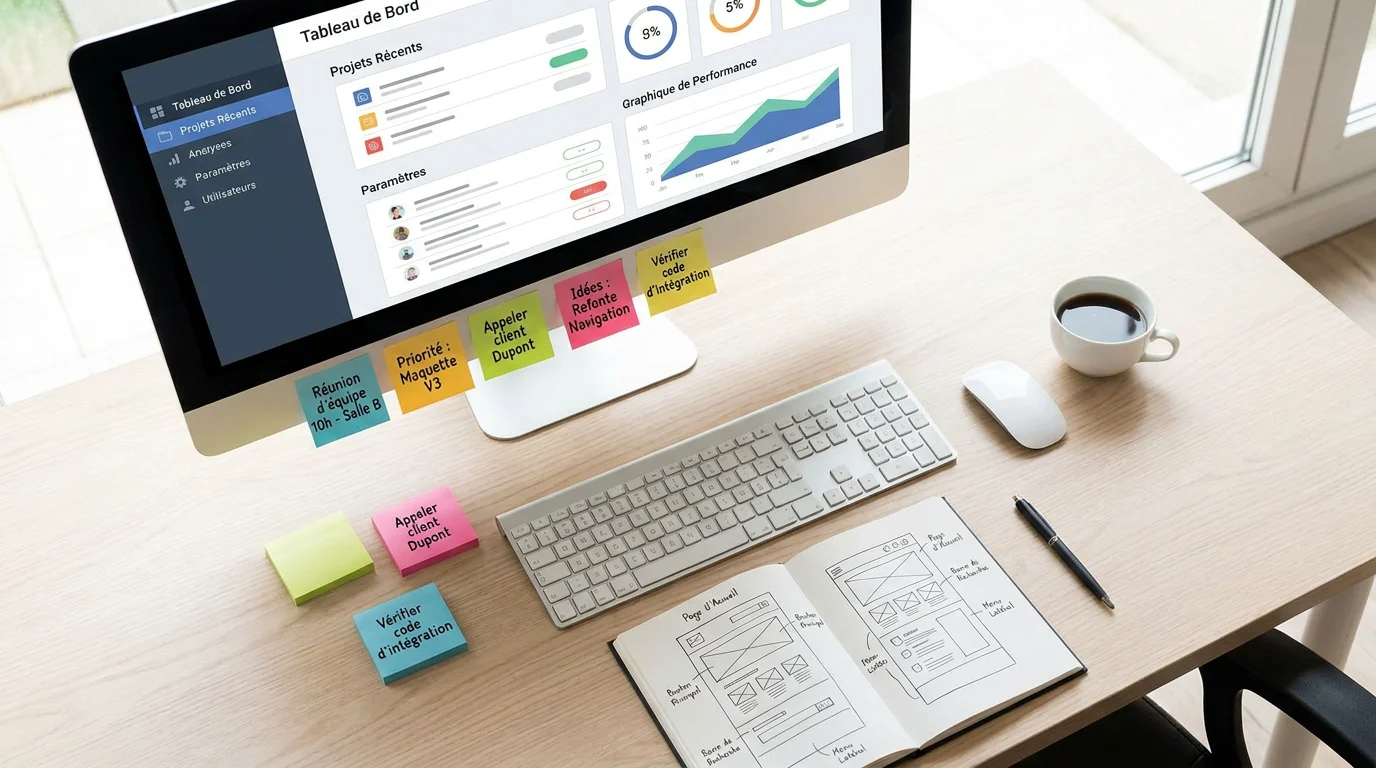
Your teams are juggling spreadsheets, disparate tools, and manual processes that hinder productivity. The global custom software development market was estimated at $44.2 billion in 2025 and is projected to reach $50.6 billion in 2026, according to Global Market Insights. This growth reflects a structural need: off-the-shelf solutions are no longer enough to cover the diverse needs of different business areas. For SMEs and mid-market companies looking to stand out, custom software development has become an essential strategic lever. This very belief drives our approach in our comparison of custom vs. off-the-shelf ERP systems.
However, succeeding with such a project requires methodology, clarity, and a trusted partnership. Between defining requirements, choosing technologies, managing budgets, and deployment, the pitfalls are many. This article gives you the keys to transform your vision into a powerful, sustainable tool that generates measurable value.
What is custom software and why build it?
A custom business software application is an IT solution designed from the ground up to meet the specific needs of a company. Unlike so-called "off-the-shelf" solutions, it does not force you to alter your processes to fit standardized features. It is the tool that adapts to your organization, not the other way around.
This approach applies to a wide range of areas: sales management, production tracking, customer portals, billing automation, scheduling interventions, or tracking business KPIs. Organizations are accelerating their digital transformation to modernize operations, improve customer engagement, and strengthen decision-making. Custom software enables tailored workflows, integration with existing systems, and domain-specific capabilities.
Opting for custom software development is particularly justified when off-the-shelf tools only cover a fraction of your needs, when your processes represent a competitive advantage, or when interoperability with your existing IT system is critical.

A rapidly growing market: key figures for 2026
Custom software development is no longer a niche market. According to a report by Global Market Insights, the market is expected to grow from $50.6 billion in 2026 to $213.4 billion by 2035, representing a compound annual growth rate (CAGR) of 17.3%. These figures illustrate a structural demand driven by the digital transformation across all industries.
The segment of intelligence and analytics technology accounted for 27% of the market share in 2025, with projected growth of 21.5% per year between 2026 and 2035. Integrating artificial intelligence into custom business applications is therefore a major driver of this evolution.
In France, the digital sector confirms its vitality. According to Polara Studio citing Numeum, the digital sector employs over 666,000 people and generates revenue exceeding €70 billion, up 4.3% after a difficult year in 2025. For managers of SMEs and mid-market companies, this dynamic represents a mature ecosystem capable of supporting ambitious projects.
Custom software vs. off-the-shelf solution: how to choose?
The choice between custom development and off-the-shelf software is a strategic trade-off, not just a technical one. Here are the decisive criteria to evaluate.
| Criterion | Custom software | Standard solution |
|---|---|---|
| Business adaptation | 100% customizable | Generic features |
| Scalability | Grows with the business | Limited to vendor updates |
| Long-term cost | Initial investment, sustainable ROI | Recurring subscription |
| Ownership | You own the code and data | Closed license |
| Delivery time | Varies by provider | Quick deployment but long adaptation phase |
| Security & compliance | Customizable | Depends on the vendor |
Standard solutions are suitable when needs are generic and processes are not highly differentiating. However, as soon as your business relies on specific business rules, complex validation workflows, or seamless integration with your existing IT systems, custom solutions offer a decisive advantage.
It is worth noting that low-code and hybrid development models are growing rapidly, accelerating delivery times and allowing projects to launch with limited technical resources. This does not challenge the relevance of custom software, but rather broadens the possible approaches to achieving it.
Key stages of custom software design
A successful custom software development project follows a rigorous methodology. Here are the six main phases to follow.
1. Goal definition and strategic scoping
It all starts with a clear formulation of the primary goal. What business problem are you trying to solve? What value will it create? This stage requires summarizing the vision in a single short sentence, like an elevator pitch. Scoping also includes identifying stakeholders, technical constraints, and functional scope.
2. Requirements analysis and user mapping
Collaborative workshops help map user profiles, their level of influence, and their expectations. Immersing oneself in the teams' daily routine (field observation, interviews) reveals actual usage, roadblocks, and adoption drivers. This forms the basis of a solid software specifications document.
3. Functional design and prototyping
The writing of user stories by a product owner translates business needs into understandable specifications. If necessary, a UX designer designs the interface wireframes. The goal is to validate user journeys before writing a single line of code.
4. Agile development through iterations
The agile method breaks the project down into short sprints, delivering testable features at each iteration. This approach ensures controlled progress, continuous adjustments, and regular involvement of business teams. Usage feedback fuels each improvement cycle.
5. Testing and acceptance
Every feature undergoes rigorous testing: unit tests, integration tests, and user acceptance testing (UAT). Real-world beta tests help detect anomalies and refine usability before final deployment.
6. Deployment and change management
Going live is done progressively to maximize adoption. User training, reactive technical support, and communication about the expected benefits are essential.
Evaluating the budget: an investment, not an expense
The price range for custom software varies significantly depending on the project's complexity, the number of features, required interoperability, and the resources mobilized. In France, projects typically range from €50,000 to €500,000, but focusing solely on cost is a mistake. The real question is: what measurable value will this software generate?
A return on investment (ROI) is measured in productivity gains, reduced errors, faster processes, and the elimination of recurring license fees. Companies adopting a data-driven approach achieve tangible results. According to a barometer compiled by Lysible, businesses that shifted to a data-driven approach increased their productivity by 63%.
The chosen business model also affects the total cost of ownership. SaaS solutions involve recurring subscriptions which, when accumulated over several years, often exceed the initial investment of custom software that you own.

Artificial intelligence: accelerating custom software design
While 2023 was the year of discovery and 2024 the year of experimentation, 2026 is definitively the year of industrializing AI in software development. This evolution is transforming how custom software is designed, developed, and enhanced.
According to the Stack Overflow Developer Survey 2025, 84% of developers use or plan to use AI tools in their development process, with 47% using them daily. For companies ordering custom software, this translates into shorter development times and richer features: integrated AI assistants, predictive analytics, and intelligent automation of repetitive tasks.
AI does not replace domain expertise, but it amplifies development teams' capacity to deliver higher-performing solutions, faster.
Criteria for choosing the right development partner
The success of a custom software project depends as much on the chosen partner as on the quality of the specifications. Here are the essential criteria to evaluate.
Domain expertise and listening skills. A good provider does not just write code. They understand your industry, your constraints, and your goals. Immersing themselves in your processes should be a non-negotiable step in their methodology.
Financial transparency. Budget overruns are a plague in IT projects. Opt for fixed-price models with clearly defined deliverables. For instance, we deliver our Mind software in 3 months at a fixed price, with no unpleasant surprises.
Technological independence. Beware of solutions that create dependency on a vendor or a proprietary platform. Total ownership of the code and data is a guarantee of sustainability and freedom.
Post-deployment support. Software lives and evolves. Ensure your partner offers long-term support: maintenance, functional updates, and training for new users. IDC estimates the economic impact of the IT skills shortage at $5.5 trillion in losses for organizations by 2026, and a large majority of companies report that the lack of developers directly slows down their productivity. A reliable partner offsets this shortage without increasing your headcount.
Security and compliance. Concerns over data security and privacy remain a major hurdle for organizations, especially with strict regulations like GDPR and increasingly frequent cyberattacks. Demand European hosting, data encryption, and GDPR compliance built in by design.
Future-proofing and evolving your software over time
Custom software is not a static deliverable. Its value lies in its ability to evolve with your business: new business rules, additional module integration, and adapting to new markets. A modular and documented architecture is the key to this sustainable scalability.
Updates should follow your pace, not that of an external vendor. This control protects you from forced upgrades, unscheduled service interruptions, and planned obsolescence. You decide what changes, when, and how.
Cloud adoption, digital transformation, and AI-driven automation continue to push organizations to modernize legacy systems and digitize processes across finance, HR, supply chain, and customer engagement. Your custom software must be able to fit into this dynamic and progressively integrate these innovations.
In summary, custom software design is a strategic investment that generates measurable gains in productivity, reliability, and competitiveness. The data confirms this: the market will reach over $213 billion by 2035, driven by AI and digital transformation. To succeed, choose a partner that combines domain expertise, financial transparency, and long-term support. With over 20 years of experience, a fixed-price model with no vendor lock-in, and a dedicated contact for each project, we help SMEs, mid-market companies, and large corporate groups transform their processes into sustainable competitive advantages. Take the time to explore our custom software solution to see how to bring your project to life.
Frequently Asked Questions
How long does it take to design custom software?
The timeline depends on the project's complexity. Generally, it takes between 2 and 6 months to get functional software. At SapAngel, we deliver our Mind solutions in 3 months at a fixed price, providing budget and timeline visibility right from the start.
Is custom software suitable for SMEs with a limited budget?
Yes, provided the scope is well-defined. An MVP (minimum viable product) allows you to launch with essential features, then enrich the tool gradually. The absence of recurring license fees reduces the total cost of ownership compared to SaaS solutions over the long run.
How do you ensure data security in custom software?
Security must be built in from the ground up: data encryption, granular access control, European hosting, and GDPR compliance. It is crucial to choose a provider who understands these requirements and documents them contractually.