


One quote at €15,000. Another at €120,000. A third at €300,000. For what appears to be an identical scope, the differences in custom software development costs often leave decision-makers bewildered. Yet, these variations are not arbitrary. They reflect structural choices: the level of expertise mobilized, functional complexity, technology strategy, and the scope of maintenance. To help you make sense of it all, we have designed a detailed comparison between Custom ERP vs. Off-the-Shelf ERP: Which Solution to Choose?
Whether you are an SME business owner, a project manager, or a department head, this guide provides concrete benchmarks to build a realistic forecast budget. You will find ranges observed in French and international markets, a line-by-line breakdown of actual costs, and key levers to control your investment without sacrificing quality.
Price Ranges Observed in 2026
There is no single answer to the question of custom software development costs. Every project is unique. However, the market has structured itself enough to provide reliable orders of magnitude.
According to a survey published in 2026 by GoodFirms, custom development costs range from $30,000 to $200,000, with the $30,000 to $100,000 bracket being dominant for nearly 66% of businesses. This data, expressed in dollars, translates consistently to the European market described in the 2026 GoodFirms survey.
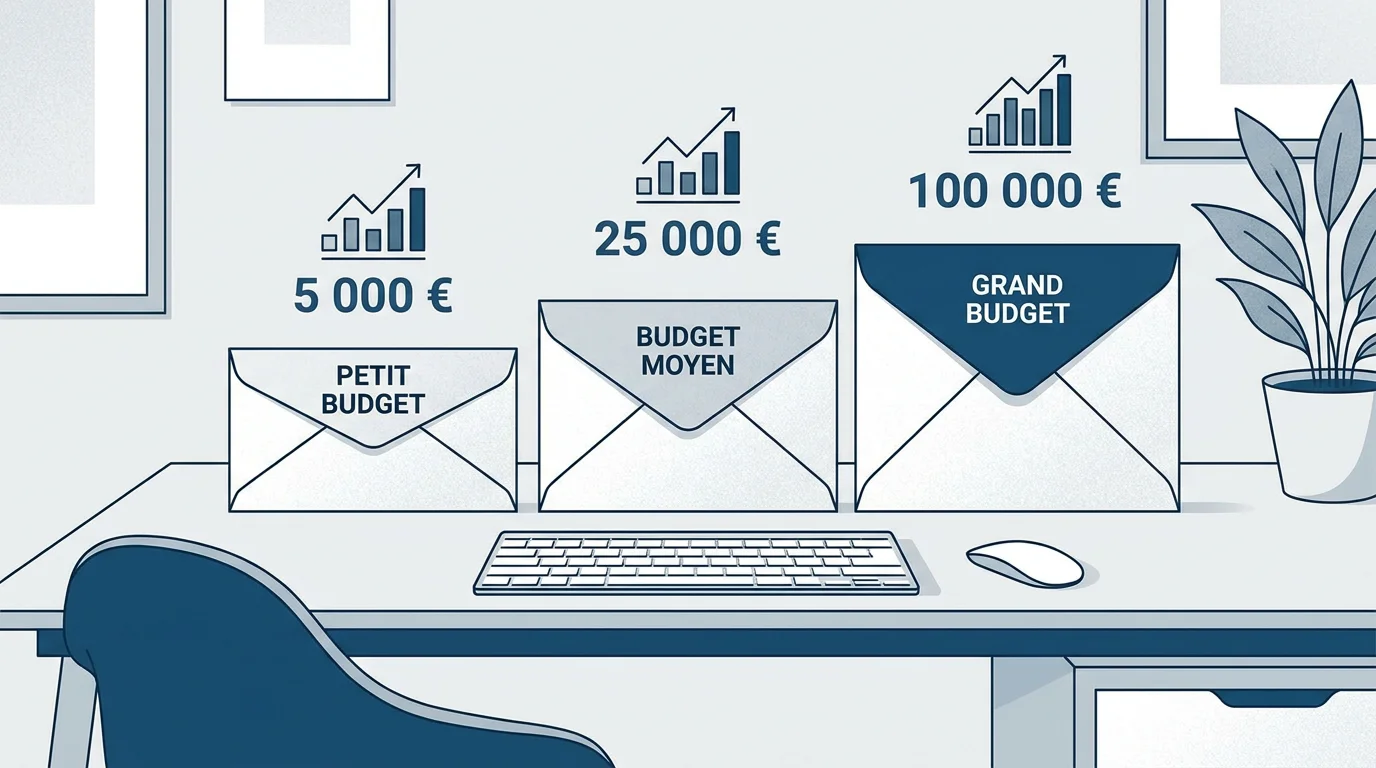
In the French market, the price ranges observed for professional services (excluding solo freelancers) generally fall into three tiers:
| Project Type | Estimated Budget (2026) | Examples | Average Timeline |
|---|---|---|---|
| Tactical tool (targeted automation) | €5,000 to €15,000 | API connector, processing script, data entry interface | 2 to 6 weeks |
| Business application (SME) | €20,000 to €60,000 | Custom CRM, extranet portal, dashboard/management tool | 2 to 5 months |
| Enterprise system / ERP | €80,000 and up | Full ERP, B2B SaaS platform, IT system overhaul | 6 to 18 months |
These amounts cover design, development, testing, and deployment. They generally do not include ongoing hosting, evolutionary maintenance, or subsequent compliance audits.
The Real Breakdown of Software Costs
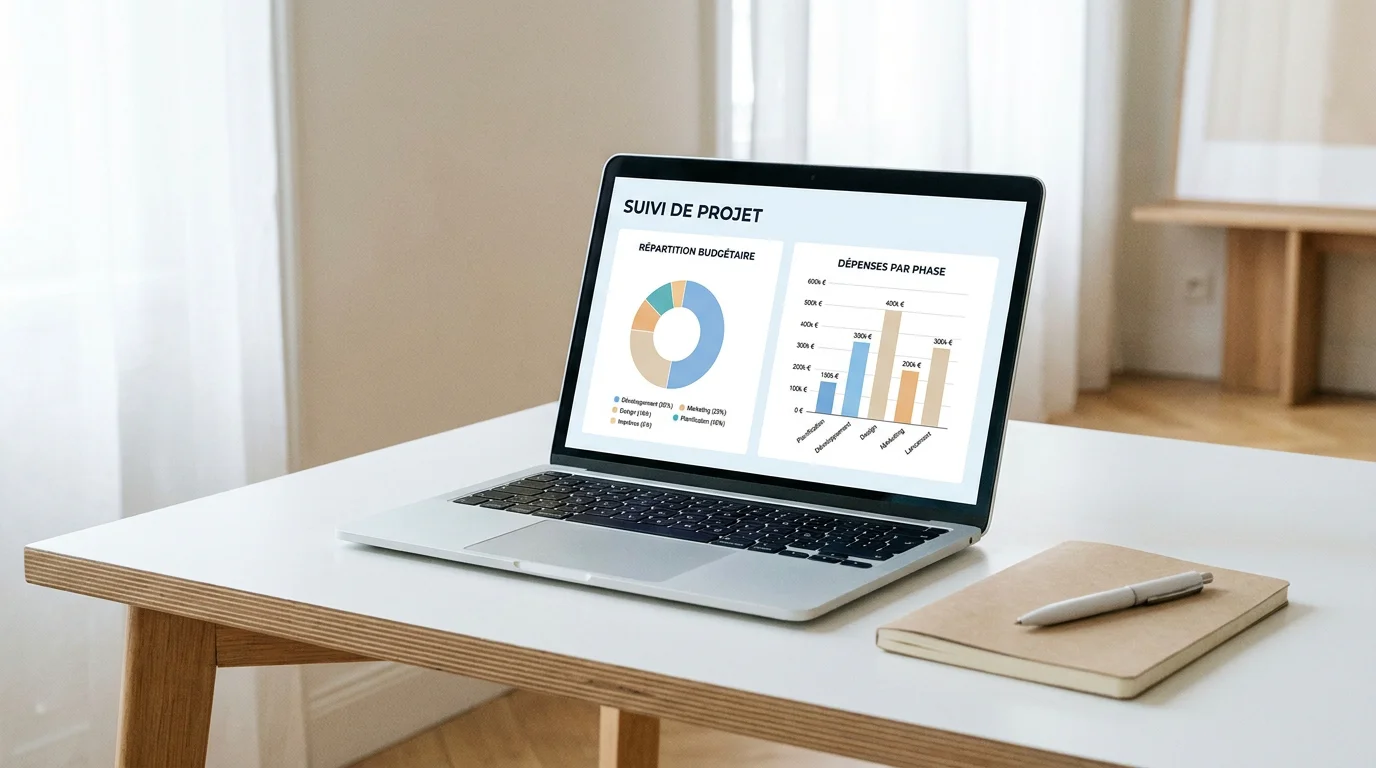
Contrary to popular belief, pure development (writing code) only accounts for 50% to 60% of the total budget. The rest is split among phases that are just as critical to the project's success.
Scoping and specifications (15% to 20% of the budget): This phase involves parsing your needs, defining the functional scope, and validating technical feasibility. A design error caught at this stage costs a fraction of what it would after the code is written. It is the investment that protects all the others.
UI/UX Design (10% to 15%): In 2026, users expect immediate fluidity. A well-designed component system (design system) subsequently speeds up front-end development by 20% to 30%, while ensuring visual consistency.
Technical production (50% to 60%): The largest cost item. It encompasses back-end development (business logic, database, APIs) and front-end development (user interface, interactions). The choice of technology stack directly impacts this area.
Quality assurance, deployment, and warranty (10% to 20%): Automated testing, User Acceptance Testing (UAT), user training, and post-launch bug fixing. Neglecting this phase compromises the entire upstream investment.
Factors Influencing the Budget
Why can two seemingly identical projects show such different quotes? Seven main factors explain these discrepancies.
Functional Complexity
It is not the number of features that determines the cost, but the business logic embedded within them. A simple dashboard with filters can be developed in a few days. The same screen with five user profiles, three validation levels, a custom export, and SSO authentication can require four weeks of work.
Integrations and Interconnections
Every connection with a third-party system (existing ERP, CRM, accounting tools, partner APIs) adds complexity. Complex integrations can represent 30% to 40% of the total development time on major enterprise projects.
Team Expertise Level
In 2025–2026, development rates range from roughly $25 to $60 USD/hour for offshore regions, up to $100 to $300+ USD/hour for leading onshore firms, depending on specialization and seniority. In France, average daily rates (TJM) hover between €400 for an experienced developer to over €900 for a cloud architect or cybersecurity expert.
A senior profile costs more per day, but they write cleaner, more scalable code and generate fewer reworks. The total cost of ownership is often lower than that of an poorly supervised junior team.
Impact of Artificial Intelligence
The 2025 Stack Overflow Developer Survey found that 84% of respondents use or plan to use AI tools in their development process, while 51% of professional developers use them daily. However, as highlighted in this analysis published by Dreambit in 2026, the 2025 DORA research showed that while AI can speed up code generation, the time saved is often reallocated to auditing and verification.
Integrating AI capabilities (recommendations, predictive analytics, conversational assistants) into your software can increase the development budget by 10% to 20% for medium-to-large projects. This is an investment that makes sense when the business value is clearly identified.
SaaS vs. Custom: Which Model Is More Cost-Effective?
Off-the-shelf SaaS software is appealing due to its low entry cost. But a five-year financial analysis often tells a different story.
SaaS represents a recurring operating expense (OPEX). At €50/month per user for 30 employees, the bill reaches €18,000 per year, or €90,000 over five years. And at the end of this period, you own nothing. If your headcount grows from 30 to 50 people, the cost increases proportionally.
Custom software is a capital expenditure (CAPEX) that can be capitalized. A €45,000 development project incurs no per-user licensing fees. If your team grows, the cost remains exactly the same. Over five years, custom software is often twice as cheap as a comparable SaaS subscription.
This logic is particularly true for growing SMEs, where user headcounts are bound to change. Custom software then becomes a strategic asset on the balance sheet, rather than an expense that inflates with your business success.
The Hidden Cost: Maintenance and Lifecycle
The initial launch budget is only part of the equation. According to projections cited by several analysts, global software spending is expected to reach $1.44 trillion in 2026, growing by 15.1% year-on-year, confirming that businesses are investing heavily in the long run, not just at launch. This data is reported in the cost guide published by Liqteq in 2026.
The total cost of ownership (TCO) over three years can represent two to three times the initial budget. It includes:
- Corrective maintenance (bug fixes, security patches)
- Adaptive/evolutionary maintenance (new features, adaptation to business changes)
- Hosting and cloud infrastructure
- Continuous user training
- Compliance audits (GDPR, industry-specific standards)
Planning a post-launch budget from the start is essential. For many products, this means setting aside a budget for at least three to six months of optimization after deployment, integrated into the financial model from day one.
The MVP Method: Controlling Budget Without Sacrificing Value
The main driver of budget overruns isn't the provider's daily rate; it is feature inflation, commonly known as scope creep. According to data compiled by Keyhole Software from over 200 verified projects, more than 52.7% of software projects exceed their initial budget by at least 89%. These figures, documented in the 2026 Keyhole Software report, highlight the critical importance of a structured approach.
The MVP (Minimum Viable Product) approach involves:
- List all desired features
- Separate the essential (the 20% of features that generate 80% of the value) from the "nice-to-have"
- Develop the core functional scope first
- Keep the remaining budget for upgrades driven by actual usage
This method reduces risk, accelerates deployment, and ensures that every euro invested meets a real-world, validated need.
Freelancer, Agency, or Consultant: Which Provider to Choose?
The choice of provider directly influences the cost, quality, and longevity of your software. Three main options are available.
Freelancers offer flexibility and responsiveness. They are ideal for one-off projects or tightly-scoped MVPs. However, continuity can be an issue: if they become unavailable, the project stops. Project management remains entirely your responsibility.
Development agencies bring a structured team, a proven methodology, and the capacity to scale up. While costs are higher, risk is much better managed. Service continuity is guaranteed even if team members change.
Specialized consulting firms go further by integrating business expertise into the technical process. They don't just write code; they challenge your requirements, optimize your processes, and measure return on investment. This is the model we apply with our custom development solution: software delivered in three months at a fixed price, with no licenses or vendor lock-in, and a dedicated contact who understands your industry.
| Criteria | Freelancer | Agency | SapAngel (consulting + development) |
|---|---|---|---|
| Average Timeline | Variable | 3 to 9 months | 3 months (fixed price) |
| Code Ownership | To be negotiated | Subject to contract | 100% Client |
| Recurring License | No | Sometimes | None |
| Integrated Business Expertise | Limited | Variable | Dedicated contact, 20+ years of experience |
| ROI Tracking | No | Rare | Reporting & measurable tracking |
Calculating Your Software's Return on Investment
Custom software is not an expense. It is a productivity lever with a very concrete ROI.
Let’s take a simple example. If a €40,000 application allows ten employees to save twenty minutes a day, the annual savings amount to approximately €15,000 (calculating the value of employee time). The break-even point is reached in two and a half years. Beyond that, every year generates net profit.
The benefits go far beyond saved time:
- Fewer errors: Automation eliminates duplicate data entry and file discrepancies
- Organizational agility: The tool adapts to your business changes, whereas off-the-shelf software forces its constraints on you
- Competitive advantage: An automated process that your competitors still handle manually acts as a sustainable differentiator
- Enhanced compliance: Hosting in Europe, data encryption, native GDPR compliance
The most economically successful companies are those that invest in proprietary software assets rather than generic solutions, as highlighted by several reference studies, notably McKinsey research cited by industry analysts.
In summary, the cost of custom software development is rarely justified by its face value alone. It is measured by productivity gains, reduced operational costs, and the strategic value it creates for your organization. With rigorous scoping, an MVP approach, and a partner committed to results, the investment becomes predictable and profitable. We have been supporting SMEs, mid-caps, and large corporations in this journey for over twenty years, committing to a three-month delivery at a fixed price, with no licenses or vendor lock-in.
To evaluate the appropriate budget for your project, discover our custom development solution and schedule a meeting with our experts.
Frequently Asked Questions
What is the minimum budget for custom software in 2026?
For a tactical tool meeting a specific need (API connector, task automation), expect between €5,000 and €15,000. A complete business application for an SME typically ranges from €20,000 to €60,000. These amounts vary based on functional complexity, required integrations, and the level of expertise involved.
How long does it take to develop custom software?
A simple tool can be developed in a few weeks. A standard business application requires three to six months. At SapAngel, we commit to a three-month delivery at a fixed price for our Mind projects, securing both the timeline and the budget.
Is custom software always more expensive than off-the-shelf software?
At initial purchase, yes. But over five years, custom software is often cheaper than a SaaS subscription, especially if your number of users increases. You eliminate recurring licensing fees and own an asset that depreciates. Calculating the Total Cost of Ownership (TCO) is essential to objectively compare the two options.