

Are you looking to automate a business process, replace aging spreadsheets, or connect disparate tools? The question of custom software costs immediately arises. And the usual answer, "it depends," isn't enough when you need to build a budget forecast. To help you get a clear picture, we have gathered in this article the actual price ranges observed on the French market, the factors that influence the bill, and the leverage you have to control your investment. If you are hesitant between a standard solution and custom development, our comparison Custom ERP vs. Market ERP: Which Solution to Choose? is a useful addition to this read.
In 2026, the software development market is evolving rapidly. While 2023 was the year of discovery and 2024 that of experimentation, 2026 is definitely the year of AI industrialization in software development. Productivity gains, estimated at 17% in 2026 for IT service companies, are pushing clients to demand lower daily rates or fixed-price billing indexed on delivered value. Understanding how much custom software costs therefore requires taking this new technological and economic context into account.
Three Budget Ranges to Situate Your Project
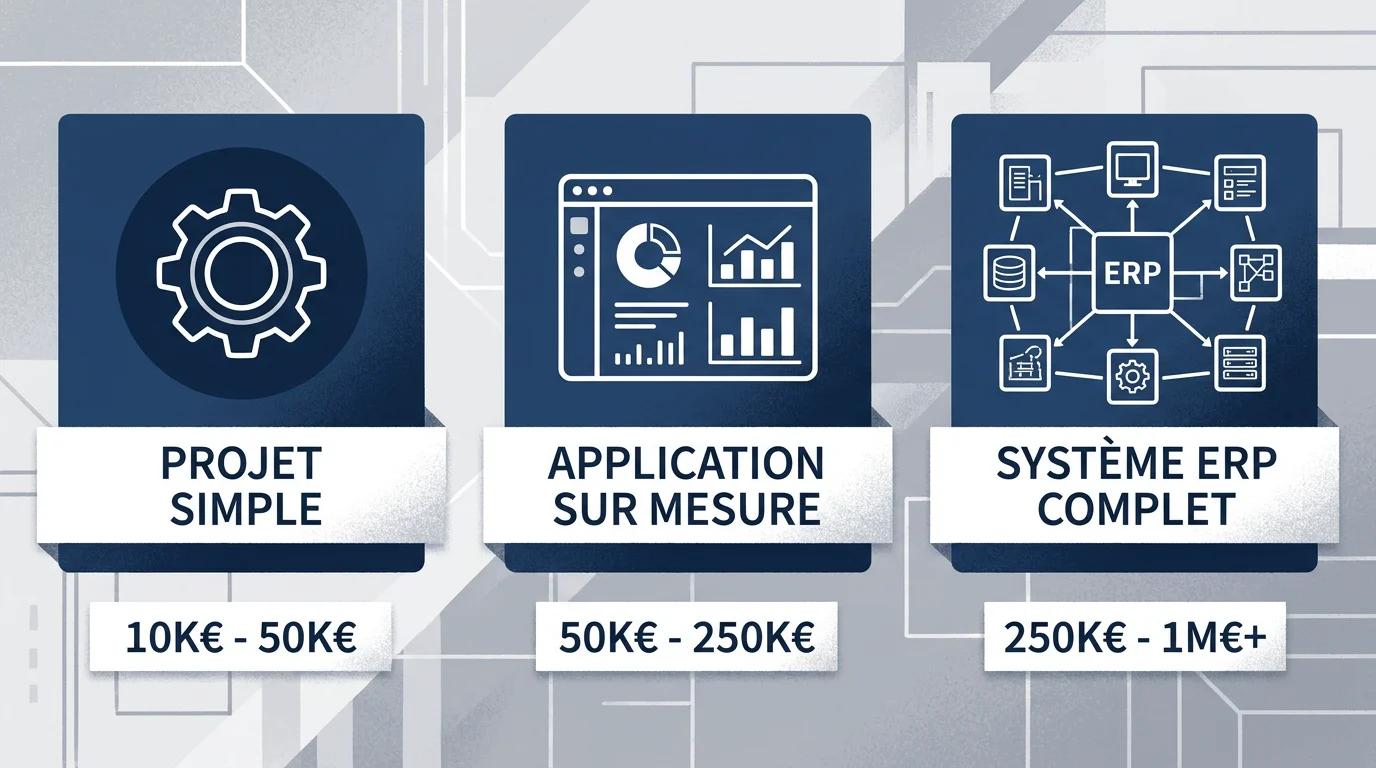
Every software development project is unique, but it is possible to identify realistic ranges. In 2026, although each project is unique, the market has structured itself sufficiently to establish precise pricing rules. Here are the three main categories observed on the French market, according to data published by Diagram.fr.
| Project Type | Price Range | Examples |
|---|---|---|
| Tactical tool (targeted automation) | €5,000 to €15,000 | API connector, processing script, mobile data entry interface |
| Business application (SME) | €20,000 to €60,000 | Custom CRM, extranet portal, production management tool |
| Core system / ERP | €80,000 and up | ERP overhaul, B2B platform, multi-service system |
| SapAngel (our Mind offer) | Fixed price, delivered in 3 months | Complete business software, no license or subscription, full ownership of the code |
These ranges cover design, development, and deployment. Annual maintenance, estimated at around 7% to 9% of the initial budget, is essential to ensure the software's security, performance, and updates. This item must be included in your budget forecast from the very start.
Factors That Truly Influence the Price
Why can a software project cost €10,000 or €100,000? Several variables come into play, and ignoring them is like comparing incomparable quotes.
Functional Complexity
The number of features is not the only criterion. The embedded business rules, access rights levels, interconnections with other systems (APIs, SSO, existing ERP), and unanticipated edge cases are what truly drive up the bill. A seemingly simple screen can hide weeks of development if the business logic is complex.
The Level of Expertise of the Team
By late 2025, average daily rates (ADR) for expert profiles (cloud architects, senior React/Node developers, security experts) remained high, often between €500 and €900 per day. A junior developer costs less per day, but saving on senior expertise in favor of junior profiles assisted by AI is a risky gamble that often results in a complete rewrite within 12 months.
Technological Choices
The chosen tech stack directly impacts the development budget. Mature and widely adopted technologies (Laravel, Vue.js) reduce costs thanks to a larger talent pool. Conversely, niche technologies (Rust, Elixir) offer high performance but require rarer and more expensive profiles. The chosen cloud ecosystem (Azure, AWS, Google Cloud) also generates licensing and infrastructure costs that must be anticipated.
The Hidden Structure of a Development Quote
A software quote is not just about "coding time." A development quote does not pay for code alone. The budget is typically distributed as follows: 20% for scoping and specifications, 60% for production (development and testing), and 20% for deployment and warranty.
The scoping phase is often underestimated, yet it is your best project insurance. Investing in detailed specifications upfront significantly reduces the risk of budget overrun along the way. Regulatory changes are another area to plan for: for example, mandatory e-invoicing in France starting in 2026 or the strengthening of GDPR may require 3 to 15 days of development, costing between €2,000 and €8,000 every 2 to 3 years.
SaaS vs. Custom: The Real 5-Year Financial Calculation
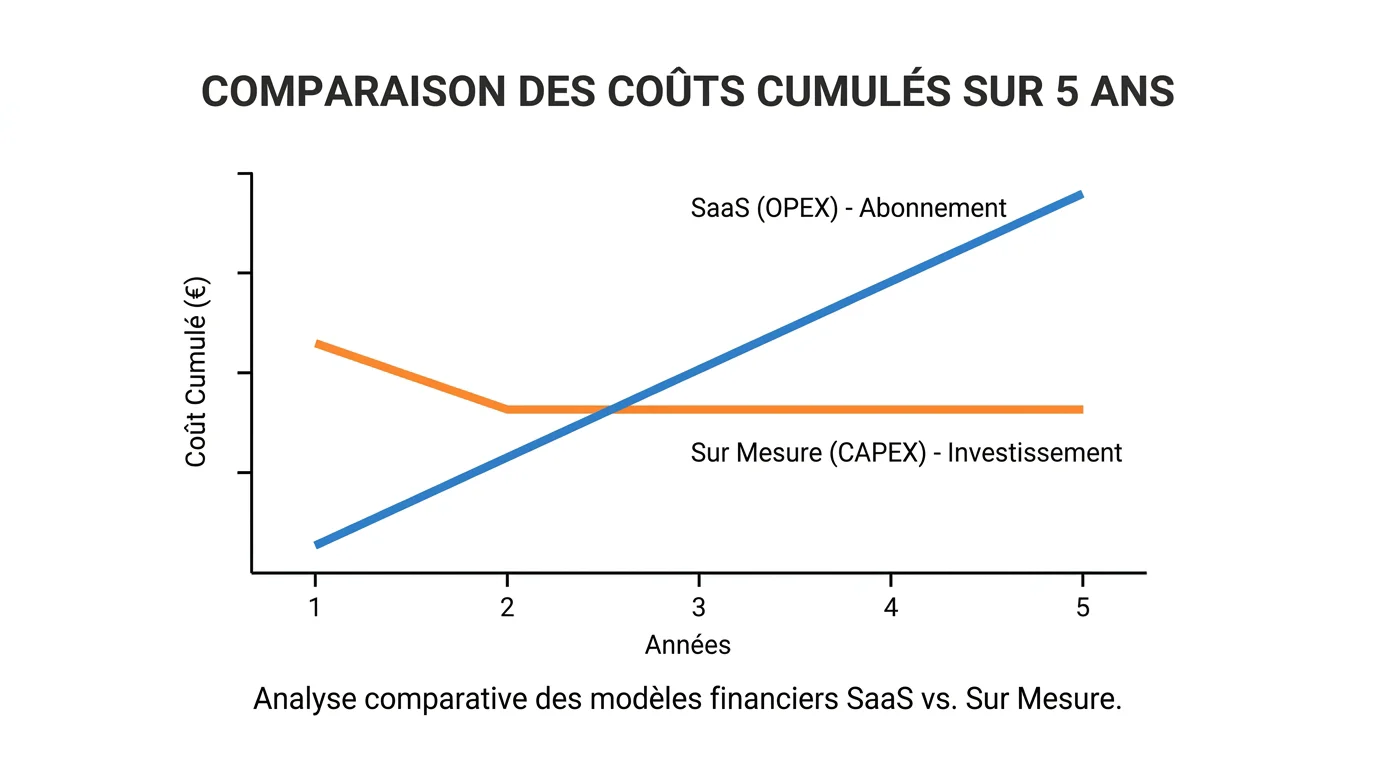
Standard software in SaaS mode is attractive due to its low entry cost. But over time, the calculation often reverses. Let's take a concrete example: a SaaS subscription at €50 per month per user for 30 employees represents €18,000 per year, which is €90,000 over 5 years. And at the end of this period, you own nothing.
A custom development at €45,000, on the other hand, represents a capitalizable asset on the balance sheet. No licensing cost per user. If your team grows from 30 to 50 people, the cost remains the same. Over 5 years, custom software can potentially cost half as much as a SaaS solution, while giving you full ownership of the code and data.
This is precisely the logic we apply: our custom software is delivered without licensing fees or subscriptions, so that your investment becomes a long-term asset rather than a recurring expense.
The Impact of AI on Development Costs in 2026
The technological landscape of 2026 is redefining the rules of the game. According to the Stack Overflow Developer Survey 2025, 84% of developers use or plan to use AI tools in their development process. This massive adoption translates into measurable productivity gains: a GitHub study of 4,800 developers shows that tasks are completed 55% faster with Copilot.
In practice, these gains are reflected in delivery times and, in some cases, prices. According to Polara Studio, productivity gains estimated at 17% in 2026 for IT service companies are driving clients to demand lower daily rates or fixed-price billing indexed to the value delivered. However, this drop in unit costs does not necessarily mean a reduced overall budget: requirements for security, GDPR compliance, and integration remain high and require solid human expertise.
The MVP Method to Control Your Budget
The main cause of budget overruns is not the provider's daily rate. It is feature inflation, often called "scope creep." The MVP (Minimum Viable Product) method is the best defense against this risk.
The principle is simple: identify the 20% of features that generate 80% of the value, develop this critical core first, and then iterate based on real user feedback. In a case documented by Magram, an agency offered an MVP for €28,000 with four essential features. After 4 months of use, the company found that 80% of the value came from these features and only added a single add-on module for €8,000, saving €29,000, or 45% of the initially planned budget. This type of result illustrates the power of a well-executed MVP scoping.
To go further in digitalizing your processes with a gradual approach, check out our guide on how to digitalize your SME in 2026.
Freelance, Agency, or Consulting Firm: Which Partner to Choose?
The choice of provider impacts the budget as much as the quality of the final result. Here are the three main options and their implications.
A freelance developer offers flexibility and contained costs for targeted projects (a single module, a highly scoped MVP). Limitations appear on cross-functional projects: lack of backup in case of unavailability, no built-in QA, and project management tasks falling back on your teams.
A development agency brings a structured team (developers, designers, project managers). Continuity is guaranteed, and processes are well-established. The daily rate is higher, but project risk is significantly reduced.
A specialized consulting firm adds a layer of business expertise and strategic support. This is the most relevant choice when the software impacts core business processes (ERP, production management, complex CRM), as understanding operational challenges is just as important as technical mastery. We offer this approach with a dedicated contact who combines business expertise and project management, so that your tool truly meets your field constraints.
The Concrete ROI of Custom Software
Custom software is not an expense: it is a measurable productivity driver. Let's look at a simple calculation. If a €40,000 application saves 10 employees 20 minutes per day, the annual savings are close to €15,000. The break-even point is reached in less than 3 years. Beyond that, every year of operation generates a net gain for the business.
IBM's 2025 report puts the average cost of a data breach at $4.44 million. Investing in secure, GDPR-compliant software hosted in Europe therefore also provides substantial financial protection. This is actually a pillar of our approach, as detailed in this analysis of SaaS costs in 2026 by Polara Studio.
Beyond time savings, custom development eliminates the hidden costs of standard solutions: user licenses that skyrocket with growth, unused features you pay for anyway, dependence on a third-party vendor's roadmap, and the inability to adapt the tool to your specific processes.
Frequently Asked Questions
What is the minimum budget to develop custom software?
In 2026, a simple tactical tool (API connector, targeted automation) can start from €5,000. For a complete business application tailored to an SME, plan for a budget starting at €20,000. With our offer, we deliver complete business software in 3 months at a fixed price, which eliminates the risk of budget overruns.
How can I avoid budget overruns on a software project?
The MVP method is the most effective: prioritize essential features, develop an initial functional batch, and then iterate based on usage feedback. Rigorous upfront scoping, with detailed specifications, significantly reduces the risk of "scope creep."
Is custom software really more cost-effective than a SaaS subscription?
Over a 3 to 5-year horizon, custom software often proves to be more economical. You don't pay user licenses, you own the code and data, and you avoid vendor lock-in. The total cost of ownership decreases as your business grows.
Ultimately, the price of custom software depends on the complexity of your needs, the level of expertise involved, and the technological choices made. The ranges observed in 2026 go from €5,000 for a simple tool to over €80,000 for a core system. Whatever your budget, the key lies in precise scoping, an MVP approach, and choosing a partner capable of combining business expertise and technical excellence. This is exactly what we offer: business software delivered in 3 months, at a fixed price, with no licensing fees or vendor dependency, and a target ROI measurable from the very first project. To evaluate your project, discover our Mind solution and schedule a meeting with our teams.