

How much does custom software actually cost? This question comes up in every board meeting, and the classic response ("it depends") satisfies no one. Yet, in 2026, the market has structured itself enough to provide reliable benchmarks. Whether you run an SME or a mid-cap, you can compare options with the same rigor as any other strategic investment, as long as you understand what lies behind a quote. If you are hesitating between a packaged solution and custom development, our comparison of custom ERP vs off-the-shelf ERP can guide your thinking.
This guide breaks down the price ranges for custom software, the factors that influence the final cost, a financial comparison with the SaaS model, and practical levers to keep your budget under control. The goal: to provide you with a decision-making tool, not a generic quote. Let's look at custom software pricing with verified figures and a proven methodology.
The Three Main Budget Tiers in 2026
Every development project is unique, but budgets can be classified by complexity level. In 2026, even though each project is distinct, the market has matured enough to establish precise pricing rules.
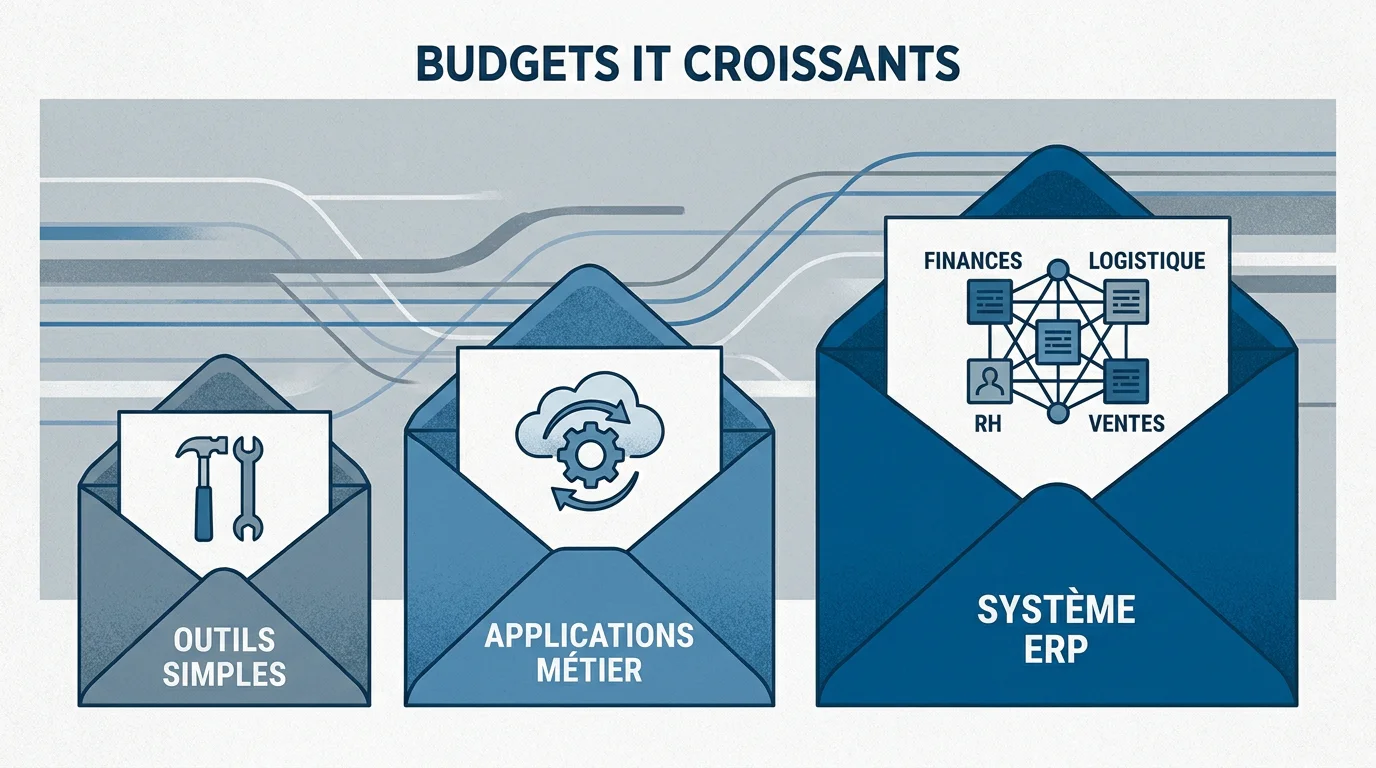
The Tactical Tool (€5,000 to €15,000). It addresses a specific pain point: the scope is fixed, the risk is low, and the goal is to automate a time-consuming task or connect two silos. Examples include an API connector between your website and your accounting software, or a simple mobile interface for your field technicians.
The Core Business Application (€20,000 to €60,000). This is the standard for custom development for SMEs and mid-caps. The software integrates proprietary business rules, a structured database, access rights, and integrations with other systems (CRM, ERP, accounting). According to a reference guide published by Diagram, the rates observed in the French market apply to professional services (excluding solo freelancers or offshore outsourcing).
The Enterprise System / ERP (€80,000 and up). This is a different scale: the software manages interactions across multiple departments (procurement, inventory, sales, finance, HR). Rebuilding a full ERP or creating a critical B2B platform falls into this category.
What Actually Makes Up the Price
A development quote does not just pay for code. For a project to succeed, the budget is roughly broken down as follows: 20% for scoping and specifications (ensuring you don't build the wrong solution), 60% for production (development and testing), and 20% for deployment, training, and post-launch support/warranty.
In addition to these three phases, there are often underestimated costs:
- Ongoing Maintenance: updates, bug fixes, and regulatory adjustments. Regulatory changes (such as mandatory electronic invoicing in France starting in 2026, or GDPR tightening) can require 3 to 15 days of development depending on the impact, translating to €2,000 to €8,000 every two to three years.
- User Training: crucial for adoption, it often represents 5% to 10% of the initial budget.
- Hosting and Security: servers, certificates, backups, and GDPR compliance.
With us, these items are included in a fixed price announced from the start, with no surprises or budget overruns. Our approach guarantees complete ownership of the code and data, without licenses or recurring subscriptions.
Factors That Impact the Cost
Why can a similar piece of software cost €15,000 with one provider and €60,000 with another? Several variables explain these differences.
Functional Complexity
It is not the number of features that determines the price, but the business logic they contain. A simple data-entry interface can be developed in a few days. However, a rules engine with five user profiles, three levels of approval, and custom exports can require several additional weeks of work.
Technical Integrations
Connecting your software to an existing ERP (SAP, Microsoft Dynamics 365), a banking API, or an electronic signature system adds complexity. Each API integration requires dedicated scoping, development, and testing.
The Team's Level of Expertise
By late 2025, the average daily rates (ADR) for expert profiles (cloud architects, senior developers, security experts) hovered between €500 and €900 per day, according to data from platforms like Malt. A junior developer costs less per day, but an experienced senior aligned with your goals delivers faster and produces cleaner, more maintainable code, which often reduces the total cost.
The Impact of AI on Development Costs
Artificial intelligence is deeply transforming the economics of software development. According to the Stack Overflow Developer Survey 2025, 84% of developers use or plan to use AI tools in their development process. Google and Microsoft report that over 30% of their new code is now generated by AI, and Gartner predicts that 60% of code will be generated by AI by the end of 2026. This trend translates to measurable productivity gains, as explained in a detailed analysis by Polara Studio. For businesses leveraging these advances, development can be significantly accelerated.
We integrate these advancements directly into our build process.
SaaS vs. Custom: The 5-Year Financial Comparison
Off-the-shelf software in SaaS mode is appealing because of its low initial cost. But comparing them over time tells a different story.
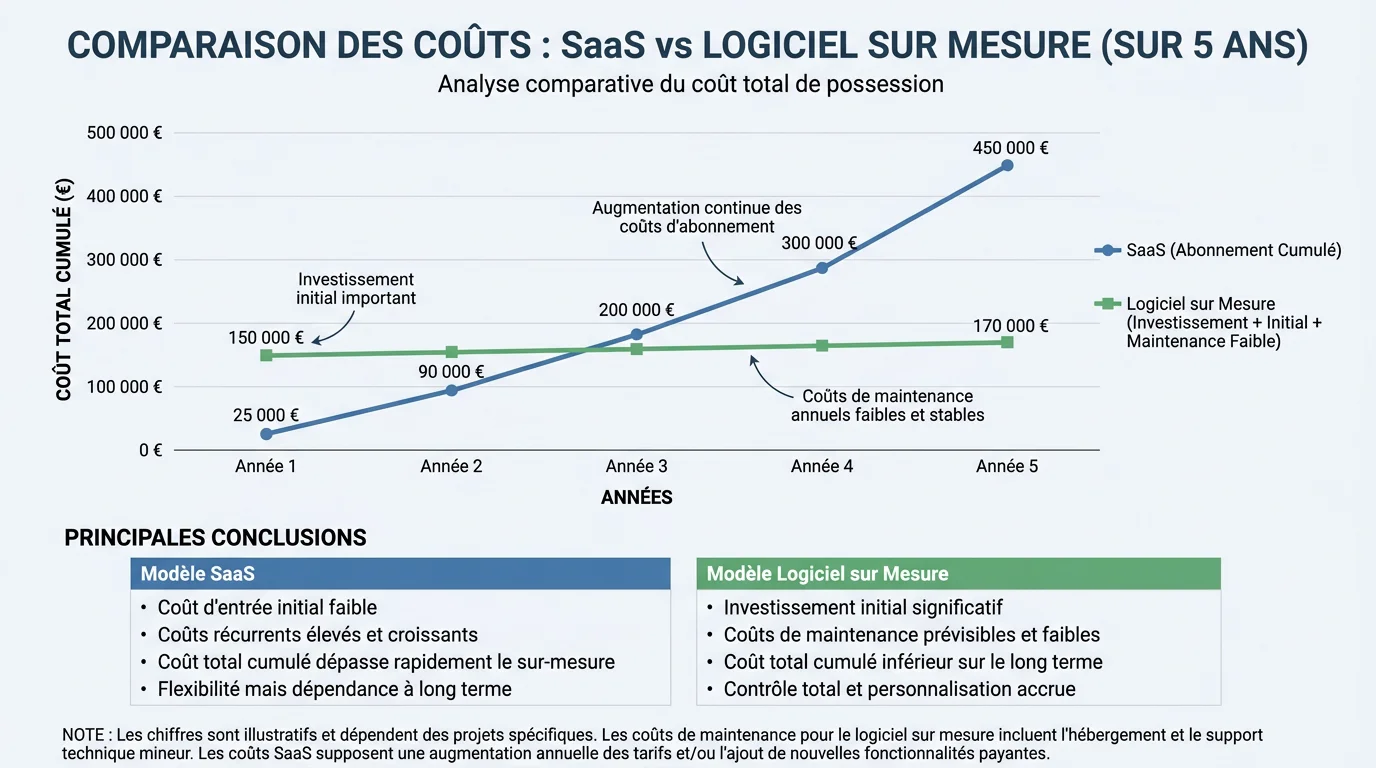
| Criterion | SaaS (Off-the-shelf software) | Custom (SapAngel Mind) |
|---|---|---|
| Year 1 Cost (30 users) | €18,000 (€50/month/user) | €45,000 (development) |
| Cost over 5 years | €90,000 | €45,000 + maintenance |
| Cost if scaled to 50 users | €150,000 over 5 years | Unchanged (€0 per license) |
| Code ownership | No | Yes, complete |
| Vendor lock-in | High (subject to roadmap) | None |
| Alignment with business processes | Limited | Complete |
A €45,000 custom development requires zero user licensing fees. If your team grows from 30 to 50 people, the cost remains the same. Over five years, custom software is often half as expensive. SaaS is an operating expense (OPEX); custom software is a capital expenditure (CAPEX) recognized on your company's balance sheet.
How to Control Your Budget: The MVP Method
The main driver of budget overruns isn't the provider's daily rate, but scope creep. The most effective way to secure your investment is the MVP (Minimum Viable Product) approach.
The principle is straightforward:
- List all desired features.
- Isolate the critical core: the 20% of features that generate 80% of the value.
- Develop this first version, launch it, and monitor actual usage.
- Invest the remaining budget into iterations guided by real-world feedback.
A real-world example: an agency offers a custom CRM in an MVP format for €28,000 instead of €65,000 for the full version. After four months of use, the company realizes that 80% of the value comes from just four features, and adds only one complementary module for €8,000. Result: a total investment of €36,000 instead of €65,000, without sacrificing the essentials. This type of approach is documented in Magram's budget guide.
This is precisely the logic we apply: software delivered in three months, at a fixed price, with a dedicated point of contact to guide your prioritization. You can explore this approach through our custom software.
Calculating the Return on Investment
Custom software is not an expense; it is a productivity lever. To convince your financial department, a simple calculation is often all it takes.
If a €40,000 application saves ten employees 20 minutes per day, the annual savings amount to approximately €15,000. The break-even point is reached in less than three years. Beyond that, every Euro saved in time and avoided errors turns straight into net margin.
The most common gains focus on:
- Automation of repetitive tasks (quotes, invoices, reminders, approvals).
- Breaking down silos: a single database replaces scattered Excel spreadsheets.
- Reliability: fewer manual entries, fewer errors, and fewer disputes.
- Steering: real-time dashboards for faster decision-making.
Every project we deliver comes with integrated ROI tracking, using measurable indicators defined during scoping. The objective is simple: prove the value generated, quarter after quarter.
Available Funding and Subsidies
Custom software development can benefit from public support programs that significantly offset the initial investment.
BPI France offers several forms of support covering a portion of development costs: the French Tech Grant to fund a prototype, innovation aid via grants or repayable advances, and the innovation loan to deploy and scale the solution.
Regional authorities also regularly finance digital projects through innovation vouchers, digital transformation grants, or subsidies for intangible investments; each region operates its own programs.
Choosing the Right Development Partner
Your choice of provider influences the outcome just as much as the budget. Three main options are available to you.
Freelancers are best suited for one-off, well-defined projects. They offer flexibility and competitive rates, but business continuity can be a risk in case of unavailability.
Development agencies provide a structured team (project managers, developers, designers). They are suited for mid-sized to complex projects, offering a rigorous methodological framework.
Specialized consulting firms combine business expertise with technical capability. This is the most relevant choice when the software needs to integrate into a global transformation strategy, including systems like SAP or Microsoft Dynamics 365.
What sets a great partner apart: cost transparency, a commitment to deadlines, full ownership of the code handed over to the client, and support that doesn't end at delivery. With over twenty years of field experience and clients like LVMH, Richemont, or E.Leclerc, we offer a fixed-price, license-free model delivered in three months, built to generate measurable returns from day one.
Conclusion: Invest, Don't Spend
The price of custom software is not a cost to be minimized, but an investment to be optimized. From €5,000 for a tactical tool to over €80,000 for an enterprise system, the price ranges are clear. The MVP approach can reduce the initial budget by 40% to 60% without sacrificing value. Over five years, custom software is often twice as cost-effective as SaaS, while giving you complete code ownership and total independence from any software publisher. The key is to choose a partner committed to measurable results, not just a set number of billable days.
With delivery in three months at a fixed price, zero subscription or vendor lock-in, and built-in ROI tracking, our approach turns your project into a strategic asset. Book a consultation to discover our custom software and together we will evaluate the right budget for your needs.
Frequently Asked Questions
What is the minimum budget for custom software in 2026?
For a simple tool automating a single process (API connector, smart form, dashboard), expect between €5,000 and €15,000. This budget covers scoping, development, testing, and deployment. For a complete business application, budgets start around €20,000.
Is custom software more cost-effective than SaaS?
Over a three- to five-year period, custom software is generally more profitable, especially if your user base grows. A SaaS at €50/month/user for 30 users represents €90,000 over five years, without code ownership. At SapAngel, our software is delivered at a fixed price, license-free, with complete ownership of code and data.
How can I prevent budget overruns?
The most reliable method is the MVP approach: first develop the 20% of features that yield 80% of the value, then iterate. A detailed scope of work, a provider committed to a fixed price, and a dedicated point of contact drastically reduce the risk of scope creep.