


Nearly 80% of organizations now prioritize a cloud ERP to run their operations. Yet, connecting this central system to the company's other software components remains a major challenge. A disconnected CRM, an isolated project management tool, manually updated inventory data: all of these generate silos, errors, and wasted time. ERP integration aims precisely to eliminate these points of friction by creating a continuous flow of data across all your applications.
Whether you run a growing SME or a mid-market company undergoing a digital transformation, understanding the methods, benefits, and pitfalls of this integration is essential. The choice between a custom ERP or an off-the-shelf ERP heavily influences the integration strategy to adopt. This article provides you with the keys to approach this project methodically and with peace of mind.
What is ERP Integration and Why is it Essential?
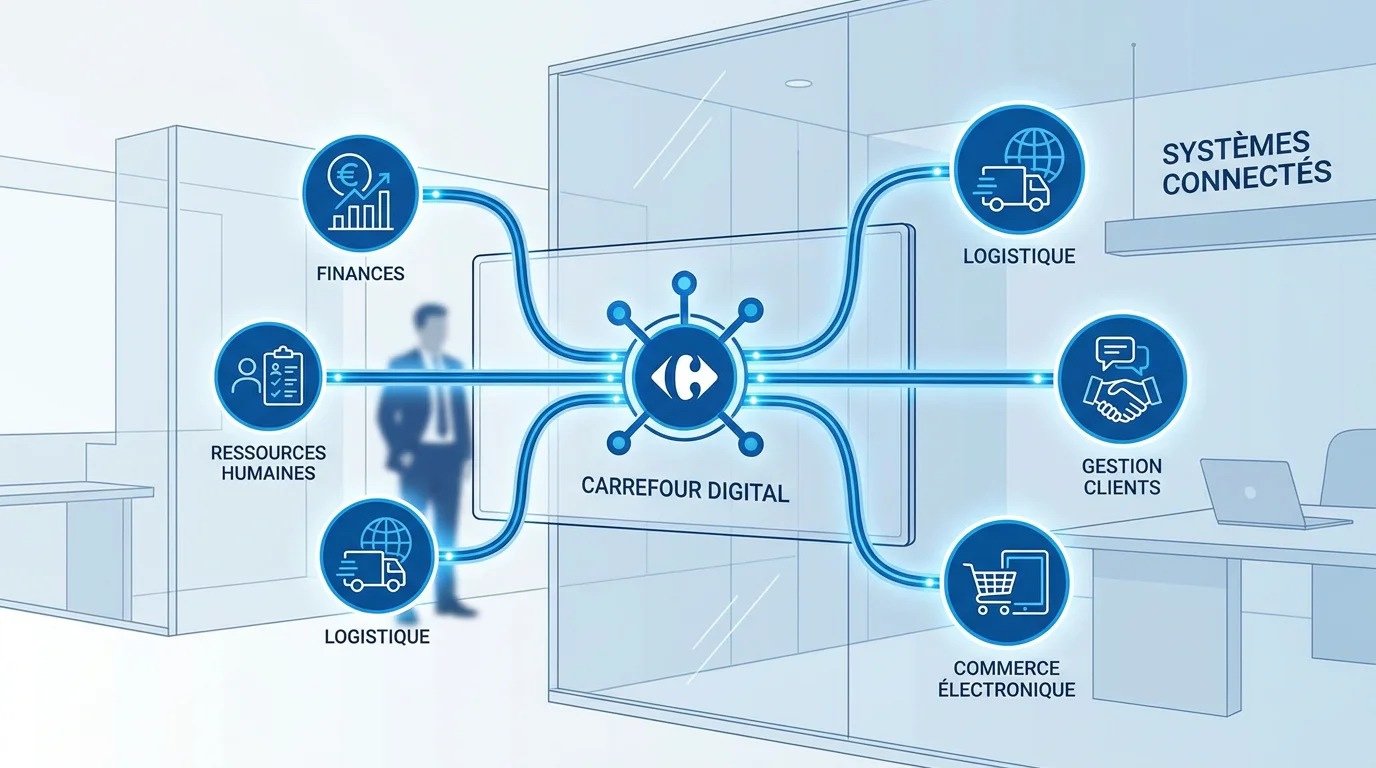
ERP integration refers to the process of connecting your enterprise resource planning system with all of your other business applications: CRM, accounting tools, e-commerce platforms, project management software, or warehouse management systems. The objective is simple: to make data flow automatically and in real time between these different tools, without manual data entry.
Without this integration, each software operates in isolation. Sales teams cannot see inventory levels. The accounting department receives sales information with a delay. Production managers plan without updated order data. These data silos slow down decision-making and increase the risk of errors.
The stakes are even higher as companies use an increasing number of specialized applications. The global ERP market is estimated to reach $78.15 billion in 2026, up from $71.62 billion in 2025, according to a report by Mordor Intelligence. The growing demand for process automation, cloud migration, and AI-powered analytics is driving this expansion. In this context, a successful integration becomes a decisive competitive advantage.
The Concrete Benefits of a Successful Integration
Why do so many companies invest in this project? Because the benefits affect every department, from the finance team to the warehouse.
Data Centralization and a Single Source of Truth
When your ERP is connected to all your applications, all teams access the same up-to-date information. No more back-and-forth between departments to get a sales figure or check inventory levels. This data centralization significantly reduces the time spent looking for information and allows everyone to focus on higher-value tasks.
Process Automation and Error Reduction
Manual data entry is tedious and prone to human error. Integration automates data synchronization between systems: automatic invoice creation from purchase orders, real-time inventory updates on the e-commerce site, and payroll data transfers to accounting. Every workflow automation frees up time and makes operations more reliable.
Faster Decision-Making
With consolidated and updated data, leaders have reliable dashboards to guide the business. Real-time visibility across all processes allows them to quickly spot inefficiencies, anticipate stockouts, or adjust marketing campaigns based on sales trends.
Reducing Operational Costs
Less manual re-entry, fewer duplicates, less wasted time: integration mechanically reduces costs. According to a report citing Eurostat data, 45% of small businesses identify implementation cost as a barrier to ERP integration, which is confirmed by Business Research Insights. Yet, the savings achieved after deployment quickly offset the initial investment, particularly by eliminating redundant manual tasks.
The Main ERP Integration Methods
Not all integrations are the same. The choice of method depends on your existing architecture, your budget, and your growth ambitions.
Point-to-Point Integration
This approach connects two systems directly via APIs or webhooks. It is quick to implement and cost-effective for a limited number of connections. However, complexity increases exponentially as you add applications. Every new connection requires specific code, and maintenance becomes time-consuming.
Enterprise Service Bus (ESB)
An ESB is a centralized software layer that acts as a "communication bus" between your various systems. It translates and standardizes data to ensure compatibility. ESB is particularly suited for complex on-premise architectures. However, it requires internal technical expertise and is less adaptable to modern cloud environments.
iPaaS (Integration Platform as a Service)
This is the fastest-growing method. iPaaS is a cloud platform that offers pre-built connectors, data mapping tools, and configurable integration workflows. Cloud ERPs are now prioritized by nearly 80% of organizations, as highlighted in an article by Sylob on 2026 ERP trends. This massive adoption of the cloud makes iPaaS particularly relevant for companies using multiple SaaS applications.
Which Systems Should You Connect to Your ERP?

The integration scope varies depending on your sector and priorities. Here are the most common and highest-value connections.
CRM (Customer Relationship Management)
Connecting your CRM to the ERP allows sales teams to access order history, payment terms, and inventory levels directly from their sales tool. The customer journey is unified, from prospecting to invoicing.
E-commerce Platforms
Synchronization between your online store and the ERP ensures that displayed products match actual stock. Orders are automatically sent to logistics teams, and shipping information is sent back to the customer without manual intervention.
Supply Chain Management
Integrating manufacturing, procurement, and shipping data with the ERP provides end-to-end visibility across the supply chain. In case of a supplier delay, an automatic alert informs the relevant teams, who can adjust the delivery times promised to customers.
Business Intelligence (BI) and Analytics
Connecting a BI tool to your ERP transforms your operational data into visual dashboards and predictive analytics. Gartner predicts that by 2028, approximately 80% of ERP systems will include generative AI and predictive analytics as standard. BI integration prepares your organization to leverage these advancements.
Human Resources and Payroll
HR integration centralizes employee profiles, automates onboarding, and simplifies payroll management. HR teams save valuable time on administrative tasks and have reliable data to manage their workforce.
Common Challenges and How to Overcome Them
An ill-prepared integration project is a project destined to slip. Industry data speaks for itself: the global ERP market, estimated at around $70 billion in 2025, is expected to exceed $120 billion by 2030 according to an analysis by Axys Consultants. Growth is strong, but pitfalls remain numerous.
Data Migration and Quality
Legacy systems often store data in incompatible formats. Before any integration, data cleaning is essential: deduplication, error correction, and format standardization. Without this preliminary step, you risk spreading erroneous data across your entire ecosystem.
Security and Compliance
Every connection between systems expands the attack surface. Encryption of exchanges, multi-factor authentication, and rigorous access rights management are essential. For companies operating in Europe, GDPR compliance also imposes strict requirements on the hosting and processing of personal data. We offer hosting in Europe with encryption and auditable logs, integrated into our Microsoft Dynamics 365 support.
Resistance to Change
ERP integration transforms working habits. Employees may perceive the new system as a constraint. Key user training, communication on concrete benefits, and continuous support significantly reduce this resistance. A dedicated champion, capable of translating technical issues into business language, facilitates adoption.
Budget and Schedule Overruns
Industry statistics confirm a very real risk. According to feedback compiled by consulting firms, 42% of ERP projects miss their deadlines and 23% to 45% exceed their budget. Rigorous planning, a detailed specifications document, and choosing an experienced integrator are the best defenses against these overruns.
Best Practices for a Successful Integration Project
An integration project is won long before the first line of code is written. Here are the practices that make the difference between a controlled deployment and an endless project.
- Define clear business goals: align every integration effort with a measurable result (reducing order processing times, improving inventory accuracy, accelerating the billing cycle).
- Audit the existing ecosystem: map out all the applications in use, their data flows, and their friction points before choosing an integration method.
- Clean data beforehand: deduplicate, correct, and format your data to ensure consistency in the new system.
- Build a cross-functional project team: involve representatives from each department right from the scoping phase to gather actual needs and encourage adoption.
- Proceed in phases: deploy high-priority integrations first (typically CRM and accounting), then gradually expand the scope.
- Test and monitor continuously: validate every integration flow before going live and set up error monitoring.
If your organization lacks internal IT resources to manage this project, external support from a part-time CIO or a specialized consultant can secure each stage. This is precisely the approach we offer to digitize your SME without requiring a permanent in-house IT team.
Cloud, AI, and Modular ERPs: Trends Shaping Integration in 2026
The global cloud ERP market was valued at $65.89 billion in 2025 and is expected to reach $76.17 billion in 2026, and $207.59 billion by 2034, with an annual growth rate of 13.40%, according to Fortune Business Insights. This dynamic is profoundly transforming integration strategies.
Cloud ERP simplifies integration through standardized APIs and pre-built connectors. Updates are automatic, reducing the risk of broken compatibility between systems. For SMEs and mid-market companies, the SaaS model eliminates infrastructure investments and allows for a quick start.
Artificial intelligence enriches ERPs with a powerful analytical layer. Vendor-internal benchmarks show that AI-assisted forecasting can reduce safety stock by up to 30%, freeing up cash flow. Integrated AI assistants generate reports, detect anomalies, and formulate optimization recommendations.
Finally, the composable ERP approach is gaining ground. Instead of a monolithic system, companies assemble modules connected by APIs. This architecture offers maximum flexibility to integrate new software blocks without disrupting the entire system. For organizations hesitating between SAP and Microsoft, our SAP solution guides you in choosing and integrating the platform best suited to your processes.
How to Choose the Right Integration Partner
The choice of integrator heavily influences the success of the project. Here are the criteria to evaluate carefully.
| Criterion | Questions to Ask | SapAngel |
|---|---|---|
| Technical expertise | What certifications? Which platforms are mastered? | Dual SAP and Microsoft Dynamics 365 expertise |
| Industry knowledge | Does the partner understand your industry-specific processes? | 20+ years of experience, 40+ clients (LVMH, Richemont, Givaudan, TPG) |
| Methodology | Is the project structured in phases with clear deliverables? | Fixed-price delivery in 3 months, dedicated coordinator |
| Ownership & security | Who owns the code and data after the project? | 100% ownership of code and data, European hosting, GDPR compliance |
| Post-deployment support | What support is provided after go-live? | Part-time CIO, ongoing support, and long-term partnership |
A good partner does not just connect systems together. They understand your business challenges, anticipate friction points, and help you get the most value out of your unified data. Geographic proximity, support responsiveness, and cost transparency are also key factors, particularly for businesses in Switzerland and France.
ERP integration is not just a technical operation: it is a lever of transformation that affects every process, every team, and every decision in your organization. Companies that approach this project with a clear strategy, clean data, and a competent partner reap the benefits for years to come. With a market exceeding $78 billion in 2026, the movement is irreversible. The essential thing is to surround yourself with support that combines functional and technical expertise, with a concrete commitment to deadlines and results. To evaluate the best approach for your organization, book a scoping call with our advisory team and lay the foundations for a controlled project.
Frequently Asked Questions
How long does an ERP integration project take?
The duration depends on the scope and complexity of your application ecosystem. A targeted integration (for example, ERP and CRM) can be achieved in a few weeks. A comprehensive project, covering all business processes, usually takes 3 to 12 months. A phased approach allows you to deliver value quickly while managing risks.
Should you choose a cloud or on-premise ERP to facilitate integration?
The cloud significantly simplifies integration through standardized APIs and pre-built connectors. On-premise remains relevant for certain sectors subject to strict regulatory constraints. In either case, a partner like SapAngel helps you determine the most suitable architecture and secure the deployment.
What budget should be allocated for ERP integration?
Costs vary significantly depending on the chosen method (point-to-point, ESB, iPaaS), the number of systems to connect, and the level of customization required. It is important to think in terms of total cost of ownership, integrating maintenance, updates, and support. Precise specifications and a fixed-price commitment reduce the risk of budget overruns.