
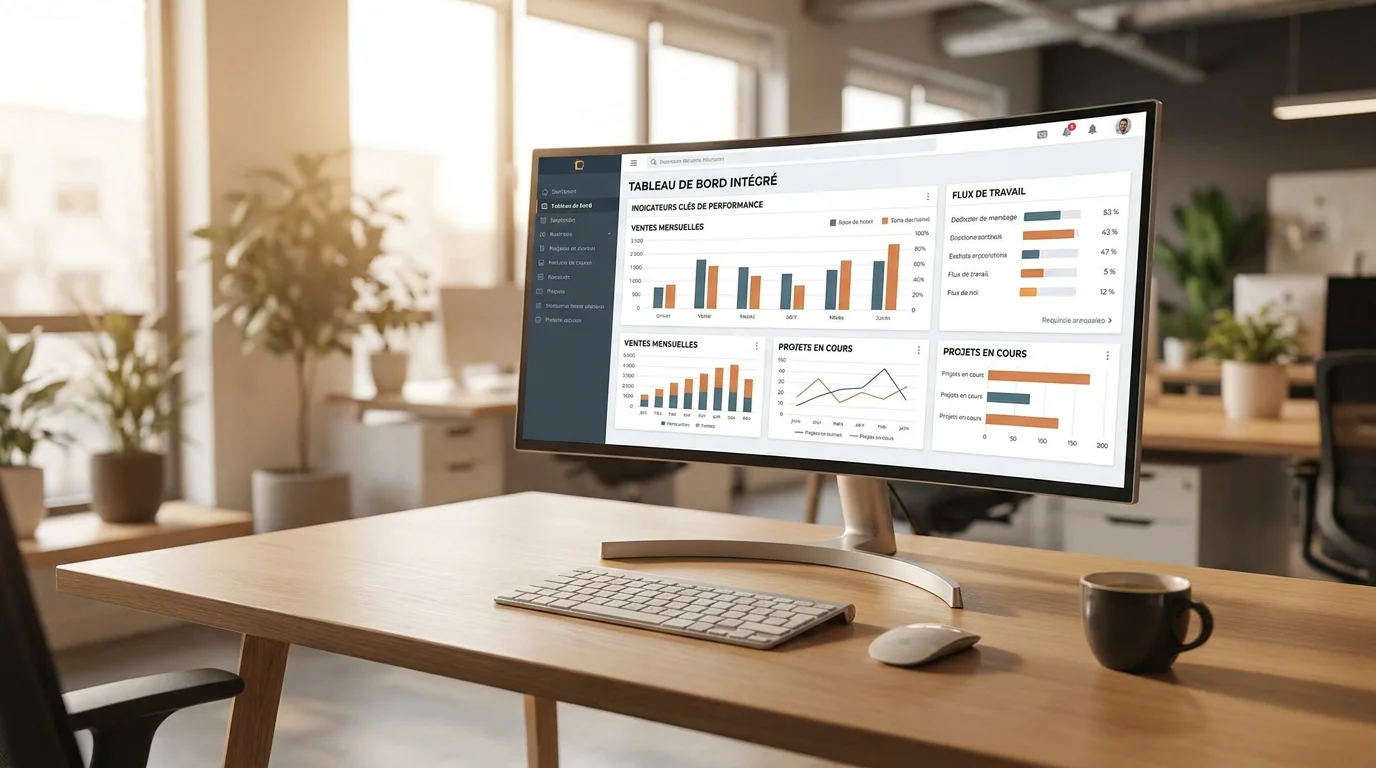
The global ERP market is estimated to reach $78.15 billion in 2026, growing at an annual rate of over 9%. This dynamic reflects a massive need: businesses are looking to centralize their processes, automate repetitive tasks, and gain visibility into their operations. Yet, with so many solutions available, identifying the best ERP for your organization remains a real puzzle. Whether you are a growing SME, an industrial mid-cap, or a large multinational, the right choice depends on highly practical criteria. Before diving in, the fundamental question is whether you need a custom ERP or an off-the-shelf ERP.
This guide provides an in-depth analysis of the leading solutions on the market, the essential selection criteria to master, and the trends redefining the ERP landscape. The goal: to give you the insights needed to make an informed decision aligned with your business challenges and growth trajectory.
Why Choosing an ERP Has Become Strategic in 2026
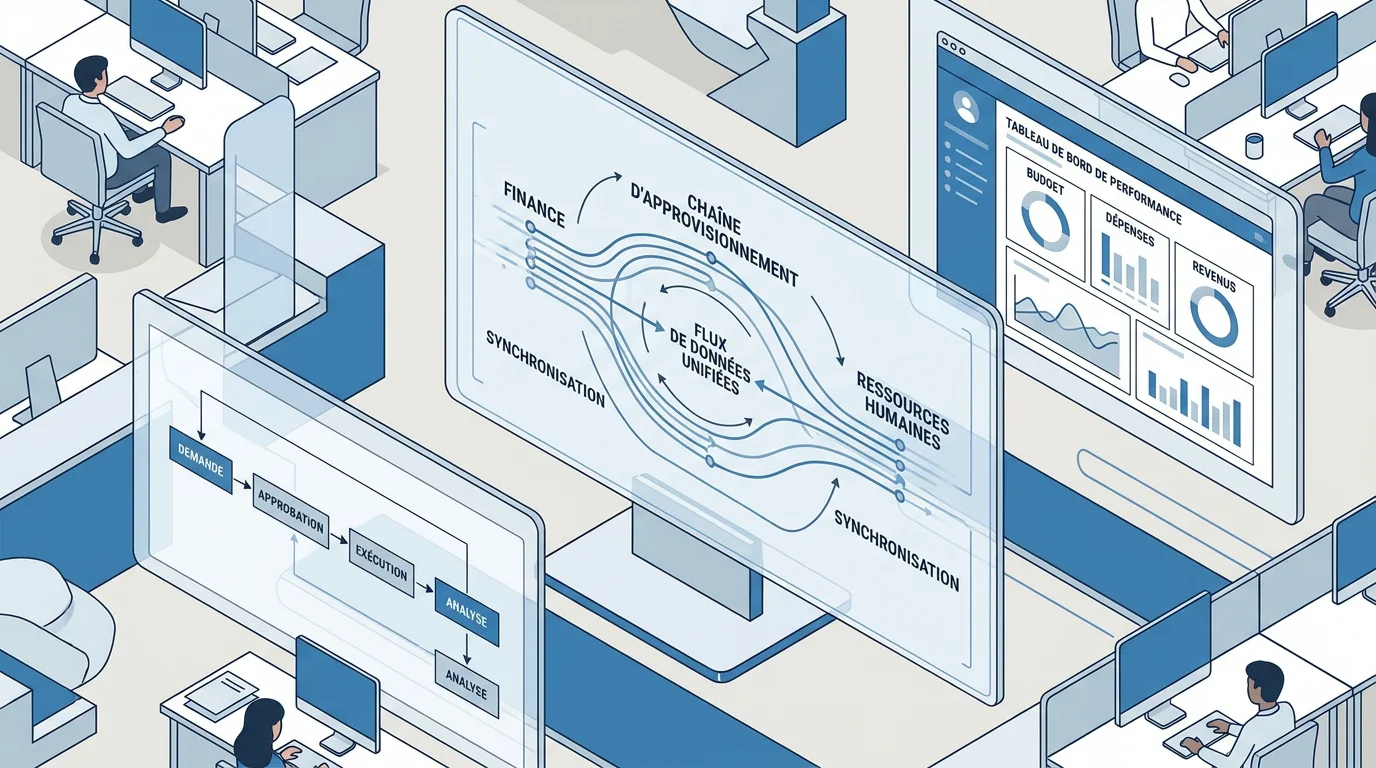
An ERP is no longer just a simple accounting tool. The ERP market in 2026 is marked by three major shifts: the widespread adoption of the cloud, the integration of artificial intelligence, and the rise of modular ERPs. These transformations make Enterprise Resource Planning (ERP) software a strategic pillar that directly impacts business agility, competitiveness, and regulatory compliance.
The numbers speak for themselves. According to Mordor Intelligence, the global ERP market was valued at $71.62 billion in 2025 and is projected to reach $120.96 billion by 2031, growing at a compound annual growth rate (CAGR) of 9.12%. This acceleration is driven by digital transformation, process automation, and increasing compliance requirements (e-invoicing, GDPR, ESG reporting).
The demand for integrated automation, cloud migration, and AI-driven analytics is fueling expansion across the manufacturing, services, and public sectors. For companies still hesitating, delaying this choice means accumulating technical and operational debt.
Overview of the Leading ERP Solutions on the Market
Each ERP solution addresses specific business needs. Here is an overview of the major players, segmented by company profile, to help you navigate your options.
SAP S/4HANA and SAP Business One
SAP offers two distinct products. SAP S/4HANA is designed for enterprise corporations with complex, multi-site processes. It covers finance, production, and supply chain, and integrates real-time analytical capabilities. Its high cost and deployment complexity limit its use to organizations with substantial IT resources. SAP Business One, which is more accessible, targets SMEs and mid-market companies with solid functional coverage (manufacturing, retail). If you are considering this solution, we offer dedicated support through our SAP expertise.
Microsoft Dynamics 365 Business Central
Business Central is positioned as the go-to cloud solution for growing SMEs, natively integrated into the Microsoft ecosystem (Teams, Excel, Power BI). Its subscription model (around €65 to €110 per user per month, depending on market sources) makes it a cost-effective option. The strength of this solution lies in its ease of deployment and automation capabilities. For organizations seeking structured guidance, we act as a consulting partner for Microsoft Dynamics 365.
Oracle NetSuite
Oracle NetSuite stands out as a native cloud ERP designed for fast-growing companies and international organizations. It offers extensive functional scope (finance, CRM, e-commerce, multi-entity management). Oracle NetSuite is well-positioned to support rapidly growing businesses, particularly scale-ups, by allowing them to progressively unlock new modules as operational complexity increases, without requiring a complete overhaul of their IT systems.
Sage 100 and Sage X3
Sage 100 remains a common choice for standard French SMEs looking for simplicity and local tax compliance. Sage X3, on the other hand, targets industrial mid-market companies with complex production needs (bills of materials, routing, traceability). The entry cost for Sage X3 is higher (custom quotes, often exceeding €100,000), but its functional depth makes it a foundational tool for multi-site operations.
Odoo
Odoo appeals to small businesses and SMEs with its modularity and aggressive pricing model (starting at €19.90 per user per month). Its open-source version allows for deep flexibility. However, heavy customization can complicate upgrades and generate significant technical debt in the long run.
Summary Comparison of ERPs by Business Profile
| ERP Solution | Ideal Target | Deployment | Key Strength | Points to Watch |
|---|---|---|---|---|
| SAP S/4HANA | Large Enterprises | Cloud / Hybrid | Analytical power and functional depth | High cost and complexity |
| SAP Business One | SMEs / Mid-caps | Cloud / On-premise | Manufacturing and retail coverage | IT resources required |
| Microsoft Dynamics 365 BC | Growing SMEs | Cloud | Microsoft ecosystem, rapid deployment | Extensions needed for heavy industry |
| Oracle NetSuite | Scale-ups / International | Cloud-native | Global scalability | Complex pricing structure |
| Sage 100 | Standard SMEs | On-premise / Cloud | Simplicity, French compliance | Limited for multi-site growth |
| Sage X3 | Industrial Mid-caps | Hybrid | Deep industrial functional scope | Steep learning curve |
| Odoo | VSEs / SMEs | Cloud / On-premise | Modularity, low entry cost | Risk of technical debt |
| Custom ERP (SapAngel) | SMEs / Mid-caps / Large Enterprises | Cloud (hosted in Europe) | Tailored to actual workflows, delivered in 3 months at a fixed price | Requires precise scoping of requirements |
Key Criteria for Choosing the Right ERP
Beyond the features advertised by vendors, several criteria determine the success or failure of an ERP project. Ignoring them exposes you to the timeline and budget overruns that affect a significant portion of implementation projects.
Business Alignment and Functional Scope
A general-purpose ERP might work for a service-based SME but will fall short for an industrial business with production planning, traceability, or quality management needs. The first question to ask is: does the solution cover your critical processes natively, or does it require expensive custom development?
Total Cost of Ownership (TCO)
The advertised price of an ERP is only a fraction of the actual budget. License fees, process re-engineering workshops, and staff training can push the cost of an ERP project for a mid-sized organization well over one million dollars. Surveys by Panorama Consulting reveal that total expenses often double once data migration and change management services are factored in. Be sure to evaluate the TCO over three to five years: licenses, integration, migration, training, maintenance, and future upgrades.
Deployment Model: Cloud, On-Premise, or Hybrid
The cloud and hybrid segment is expected to represent 83.07% of the ERP market in 2026, according to Fortune Business Insights. The cloud offers clear advantages (accessibility, automatic updates, reduced infrastructure costs). On-premise remains relevant for highly regulated sectors requiring complete data sovereignty. The rapidly growing hybrid model combines both approaches.
Scalability and Longevity
Your ERP must support your growth for the next five to ten years. Ask yourself: does it support multi-site operations, multi-currency transactions, and the progressive addition of new modules? Today's businesses look for flexible, modular ERPs capable of adapting quickly to their needs through on-demand modules and native integration with third-party applications.
AI and the Cloud: The Two Forces Transforming ERP in 2026
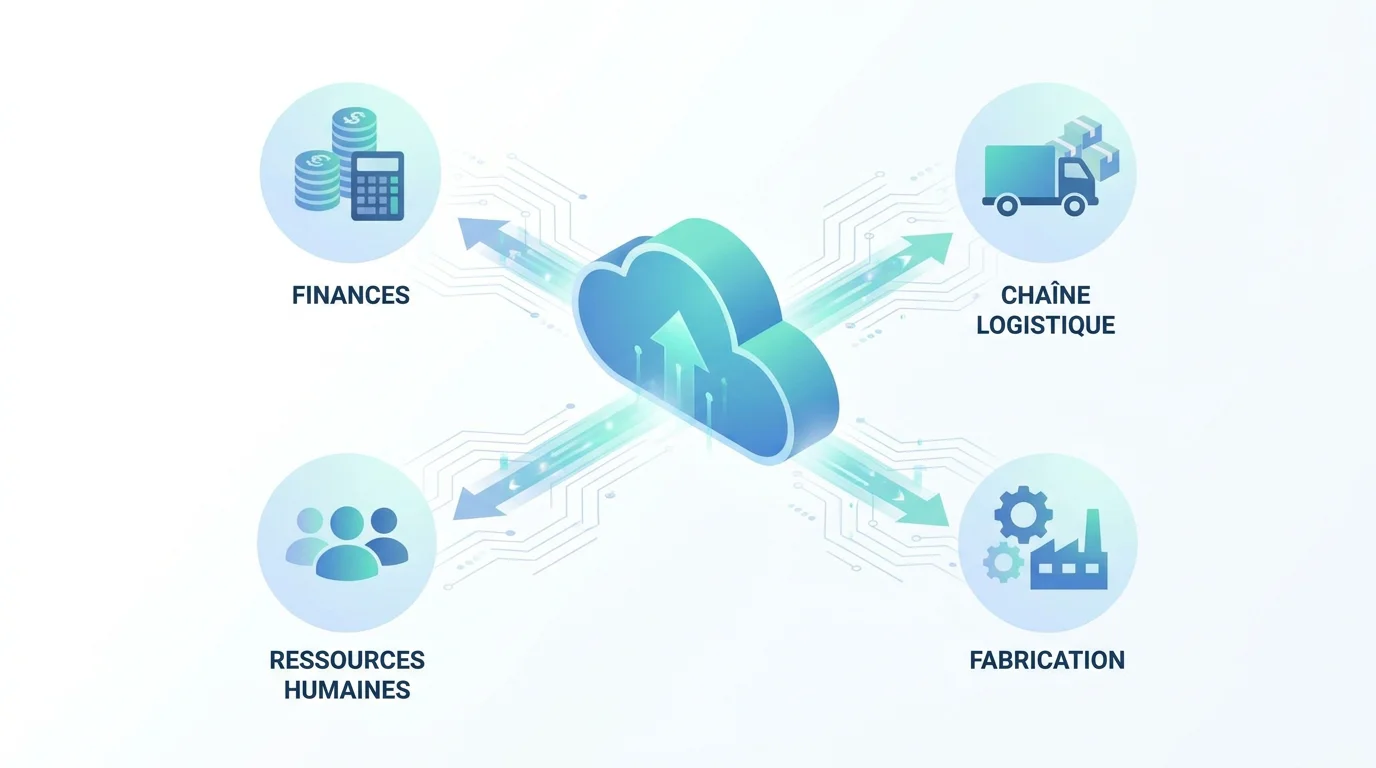
Artificial intelligence is becoming a standard component of modern ERPs, enabling the automation of financial tasks and real-time anomaly detection. In practice, this translates to more reliable sales forecasts, automated inventory optimization, and built-in assistants capable of analyzing massive volumes of data.
On the cloud side, the shift is now complete. Cloud models held a 55.11% share of the ERP market in 2025 according to Mordor Intelligence, while hybrid models are expected to grow at a CAGR of 15.48% through 2031. Major software vendors (SAP, Microsoft, Oracle) have all adopted a cloud-first approach.
For SMEs and mid-caps, this convergence of AI and cloud represents an opportunity to close the technology gap with large enterprises—provided they choose a partner capable of integrating these components pragmatically.
Composable ERP: The Trend to Watch
Composable ERP is one of the standout trends in 2026: instead of a monolithic system, businesses construct their environment from modules connected via APIs, allowing each component to be added, replaced, or updated without breaking the rest. This modular approach appeals to organizations that want to keep a stable core (accounting, inventory, payroll) while connecting specialized tools for specific needs (e-commerce, supplier portals, marketplaces).
Composable architecture reduces dependency on a single software vendor and offers superior agility in response to market changes. However, it requires rigorous IT governance and strong integration skills. This is precisely the kind of support we provide to our clients, using our ERP solution designed to adapt to the actual workflows of each organization.
Pitfalls to Avoid in an ERP Project
42% of ERP projects overrun their timelines, and 23% to 45% exceed their budget. These figures, drawn from our hands-on experience with over 40 clients, reveal recurring causes that can easily be anticipated.
Underestimating Change Management
The most powerful tool will fail if your teams do not adopt it. Training, internal communication, and involving key users from the initial scoping phase are essential. An ERP imposed without change management only breeds frustration and workarounds.
Neglecting Data Quality
Data migration is often the most underestimated aspect of the project. Poorly structured, obsolete, or inconsistent data in the legacy system will only be amplified in the new one. Plan a thorough data audit before any migration.
Choosing an Over-Engineered (or Under-Engineered) ERP
An ERP designed for a large corporate group will be too heavy and costly for an SME. Conversely, a solution that is too limited will stifle growth. The key is to find the right balance between current functional requirements and future scalability. The SME segment is expected to represent 50.57% of the global ERP market in 2026 according to Fortune Business Insights—a clear sign that vendors are tailoring their offerings to this profile.
The Role of the Integrator: An Underestimated Success Factor
Choosing the software is only half the battle. The integrator supporting you through deployment, configuration, and training directly determines the success of the project. An experienced integrator spots risks early on, adapts the solution to your actual workflows, and ensures a sustainable transfer of skills.
With over 20 years of experience and a client portfolio including LVMH, Richemont, Shiseido, and Aéroport de Paris, we have guided organizations of all sizes through securing their ERP projects. Whether you need consulting for SAP, Microsoft Dynamics 365, or custom software, our approach is built on a dedicated contact person, a fixed price, and delivery in three months. If you want to structure your digital transformation more broadly, discover how to digitize your SME in 2026.
Choosing the right ERP in 2026 is, above all, about aligning technology with your business strategy. The market offers solutions for every profile, from open-source software to global cloud suites and custom-built developments. What makes the difference is not just the software: it is the quality of support, the rigor of the scoping phase, and the ability to deliver a system that your teams actually adopt. With a dedicated contact person, dual technical and functional expertise, and European hosting compliant with GDPR, we secure every step of your project. To evaluate your needs and explore the best-suited solution, contact us to discover our ERP solution.
Frequently Asked Questions
What budget should be planned for an ERP project in 2026?
The budget depends heavily on company size and the chosen solution. For an SME with 50 users, expect an initial cost between €30,000 and €150,000 (covering licenses, integration, and migration). The three-year TCO can easily double this amount. Cloud ERPs under a SaaS model offer more predictable subscription pricing (ranging from €30 to over €200 per user per month depending on the solution).
Cloud vs. On-Premise ERP: Which should you choose?
In 2026, the cloud is the standard for most SMEs and mid-caps due to its flexibility, automatic updates, and the elimination of server maintenance. On-premise remains relevant for sensitive industries requiring complete data sovereignty. We support our clients across both models depending on their specific constraints.
How long does it take to deploy an ERP?
Expect six to twelve months for an SME and up to eighteen months for a mid-cap when implementing off-the-shelf ERP systems. With a custom approach, timelines can be significantly reduced; for instance, we deliver our personalized software within three months at a fixed price, focusing on critical processes first.