
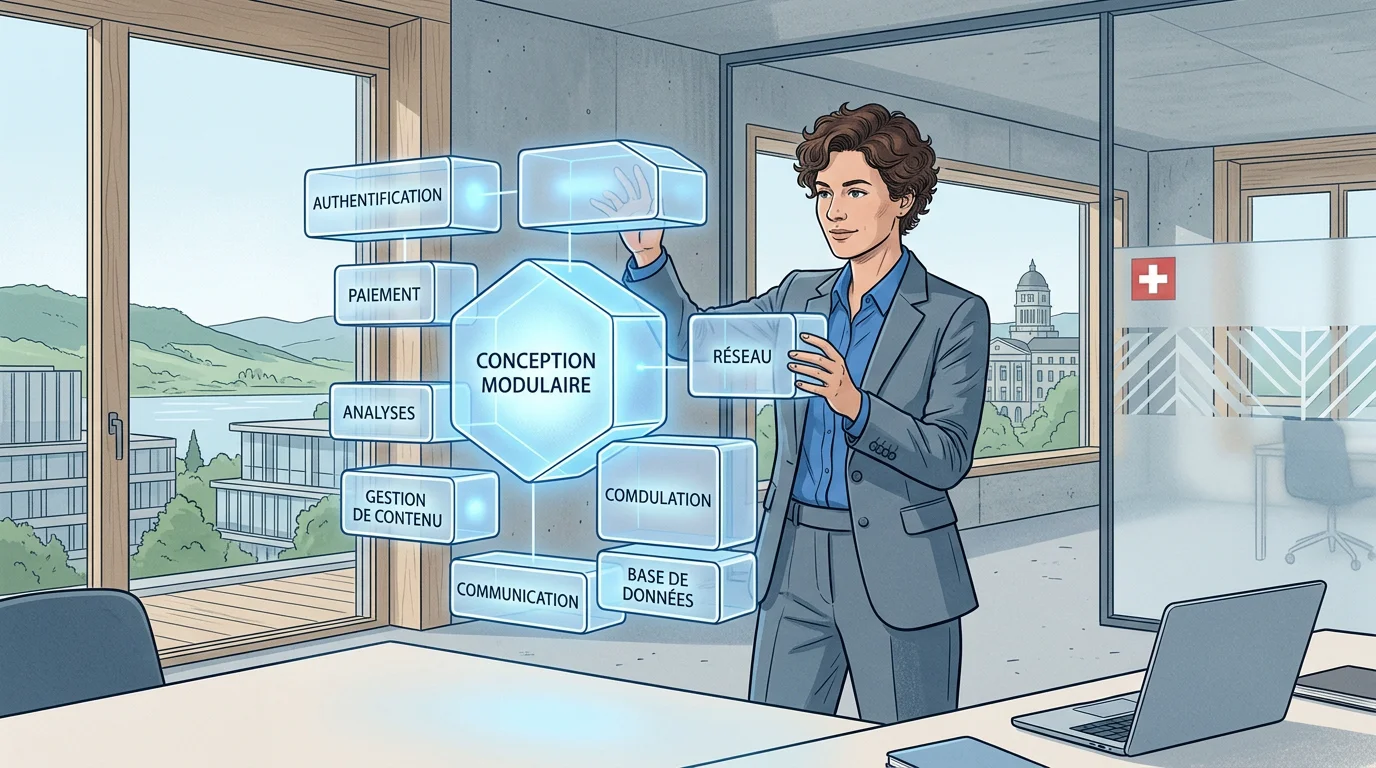
One in two IT projects runs over schedule or budget, often because the company buys an overly complex, bloated system instead of assembling the functions it actually needs. The modular approach flips this logic: you start with a few useful blocks, then add more as you grow. To structure this architecture without a full-time CIO, our modules and integrations around SAP help lay the right foundations from the very start.
This is far from trivial. According to an analysis by Apogea using data from HG Insights, the global market for ERP solutions reached approximately $147.7 billion in 2025. Behind this figure lies a major shift: companies are abandoning scattered spreadsheets for systems where every module communicates with the others.
Why Software Modules Appeal to Swiss SMEs
Switzerland has a unique profile. According to ProConcept, 99% of the economic fabric is made up of SMEs and mid-market companies (ETIs), often family-owned, looking for flexibility and quick ROI. These organizations have neither the time nor the budget for a massive deployment.
This is precisely where Swiss software modules come in: instead of a monolithic software suite, you only activate the functions useful to your business. A construction company manages its sites and measurements, an agency manages its mandates and billing, an association tracks its members and dues.
The benefits of a modular architecture come down to three concrete points:
- Immediate adoption: fewer unnecessary features means faster onboarding for your teams.
- Controlled costs: you pay only for the activated blocks, not an entire catalog.
- Scalability: you add a module when the need arises, without a global overhaul.
How a Modular Software Architecture Works
A modular system relies on a common database. Each block feeds into the others, eliminating double entry and making information more reliable. An order entered in the sales module is automatically reflected in inventory and accounting.
In practice, data flows between modules to connect quotes, hours, documents, inventory, and financial flows. This consistency is the real benefit: a single source of truth, updated in real time, rather than five conflicting tools.
To orchestrate this data flow without dedicated internal expertise, our CIO and software services for modular and IT architectures help determine which blocks to prioritize and how to make them communicate with your existing systems.
Essential Modules for an SME in Switzerland
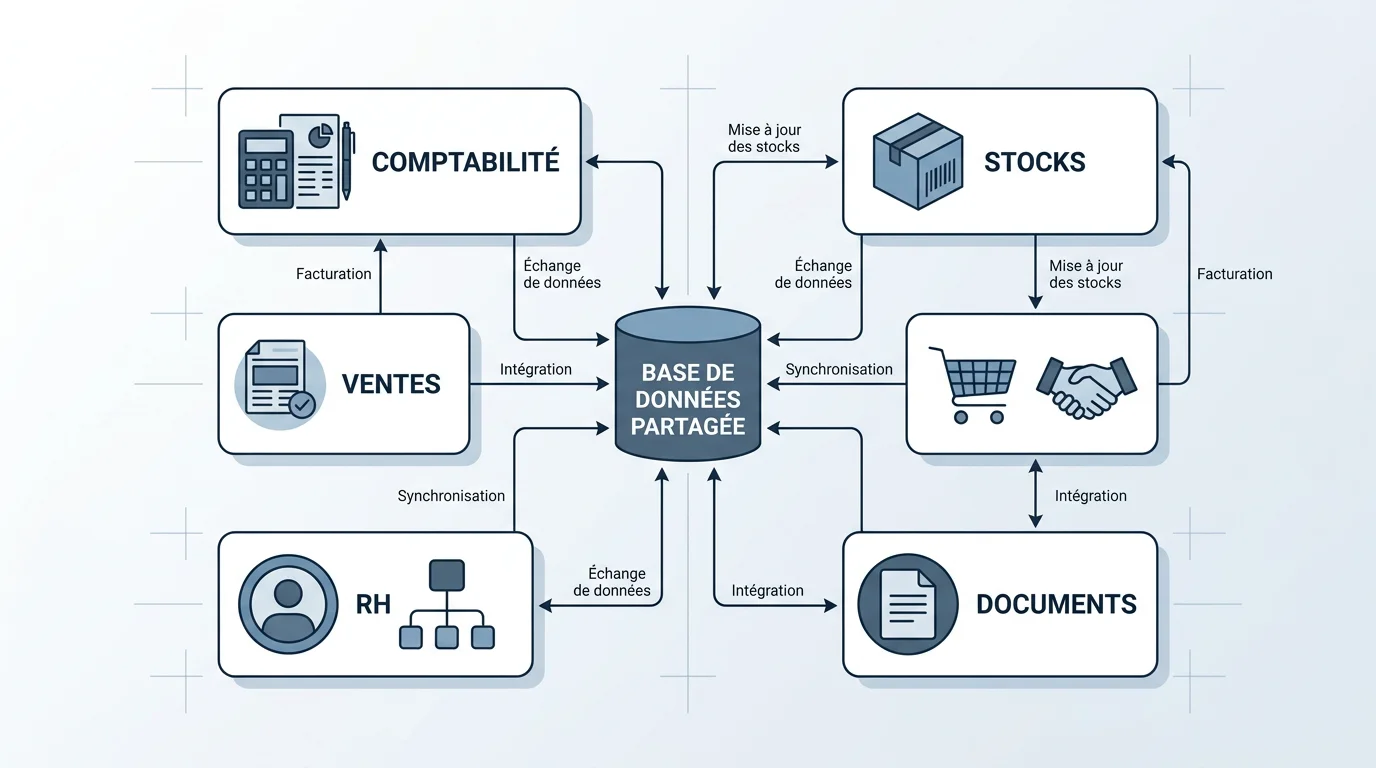
Which blocks should you activate first? It depends on your sector, but certain modules are almost always needed in a Swiss SME.
- Financial and accounting management: tracking invoices, VAT, accounts receivable, and accounts payable, with export options for your fiduciary.
- Inventory management: real-time stock levels, replenishment alerts, barcode tracking.
- Sales and Customer Relationship Management (CRM): consolidated history, quotes, interaction tracking.
- Human Resources and payroll: contracts, absences, Swiss-compliant payroll.
- Time and project management: time tracking, breakdown by mandate, legal tracking requirements.
- Document management: classification, version control, auditable archiving.
Each module can run on its own and then be connected as your needs evolve. This gradual approach is what distinguishes a modular software solution from a rigid ERP bought as a single block.
Custom Modules vs. Off-the-Shelf Blocks: Which to Choose?
Here is the big question. An off-the-shelf module is quick to install and cheaper upfront, but it forces its logic on you. A custom module fits your processes perfectly, at the cost of initial development.
The key detail: custom development is only worthwhile if it remains manageable. Too many specific projects end in vendor lock-in, with code that no one controls. According to industry research shared by Panorama Consulting, a significant portion of ERP projects exceed their deadlines (around 42%) and budget (by 23% to 45%), often due to a lack of clear scoping.
Our answer relies on custom software designed block-by-block, delivered in three months at a fixed price, with no licensing fees and 100% ownership of the code and data. You approve, we deploy, and you remain autonomous. To decide between standard blocks and dedicated development, our tool to simulate and scope your software module needs prices each scenario before you commit.
| Criterion | Off-the-shelf module | Standard custom module | Our approach (SapAngel) |
|---|---|---|---|
| Implementation time | Fast | Variable, often long | 3-month delivery at a fixed price |
| Cost model | Recurring license | Flat-rate development | Fixed price, no licenses |
| Code ownership | Vendor | Variable | 100% yours |
| Process alignment | Limited | High | Only useful functions |
| Vendor lock-in | High | Medium | Zero lock-in |
How to Properly Choose and Size Your Modules
Before activating anything, map out your processes. Identify repetitive tasks, tool silos, and friction points. This analysis determines the essential building blocks and filters out gimmick features.
The underlying trend is clear: according to ERP-PGI, about half of SMEs have already adopted an ERP to modernize their management, with a strong trend toward modular systems that allow for gradual growth. Starting small and then expanding is becoming the norm rather than the exception.
A few guidelines to size your project correctly:
- List the truly critical functions in a brief specification document.
- Verify integration with your existing systems (e-banking, e-invoicing, payroll).
- Evaluate the total cost of ownership over several years, not just the entry price.
- Plan for training: this is what ensures user adoption and return on investment.
Security, Compliance, and Hosting in Switzerland

In Switzerland, data is not a secondary issue. Regulatory and security requirements are high, especially with the revised FADP (LPD) and GDPR for international exchanges. Your modules must therefore integrate compliance by design, not as an afterthought.
Three safeguards deserve your attention: data encryption, auditable access and activity logs, and hosting in Europe or Switzerland. These elements are not options: they determine your clients' trust and your legal coverage.
We integrate security directly into the scoping of every project, with European hosting, encryption, and auditable logs. This way, compliance becomes a structural asset of your modular information system, rather than a late-stage patch.
Key Takeaways for Swiss SMEs
Adopting software modules in Switzerland is not about technology; it's about methodology. Start with your actual processes, activate the useful building blocks, connect them around a common database, and maintain control of your code and data. This gradual approach protects your budget, speeds up adoption, and allows your system to grow with you. Rigorous scoping, including security and compliance from day one, transforms a simple software purchase into a real engine for sustainable performance.
Take Action with SapAngel
Are you unsure about which blocks to activate, how to integrate them with your existing systems, or the right level of customization? These decisions impact your budget and autonomy for years to come. An expert, business-oriented technical perspective prevents the schedule delays and costly vendor lock-ins that so many Swiss SMEs and mid-market companies face.
We support SMEs, mid-market companies, and large enterprises with fractional CIO services and custom software delivered in three months at a fixed price, with no licensing fees and complete code and data ownership. Book a 30-minute consultation to scope your project via our IT consulting and CIO services for SME software in Geneva, with a dedicated representative at every stage.
Frequently Asked Questions
What exactly is a software module?
A module is an independent functional block, such as accounting, inventory, or time tracking. It can be used standalone or connected to other modules around a shared database. This logic eliminates double data entry and maintains consistent information.
How many modules do I need to get started?
It is best to start with two or three truly critical blocks, often invoicing, inventory, or time tracking. You then add other modules as your needs evolve, without rebuilding the system. This gradual approach minimizes risks and initial costs.
Are software modules suitable for small organizations?
Yes, modularity is perfectly suited for SMEs that want to manage their budgets. You only pay for the features you activate and scale the entire system as you grow. It is a much more flexible model than buying a monolithic software suite.
Do I need an internal CIO to manage these modules?
No, it is not necessary. A fractional CIO can set the direction, prioritize needs, and scope the architecture without adding fixed overhead to your business. This is exactly the kind of support we provide, with a dedicated expert and business advisor at every step.
How can we guarantee data compliance and security?
Security must be built in from the scoping phase, not after deployment. This involves encryption, auditable access and activity logs, and hosting that complies with the revised FADP and GDPR. These safeguards protect your data and maintain customer trust.