


Nearly seven out of ten enterprise projects run off course before they even reach production, and the reason is rarely technical. It almost always stems from vague scoping and poorly defined expectations. A well-structured reference document remains your best protection, whether it frames internal development or our approach to custom software design.
Searching for a software specifications template for Switzerland often comes from a desire to secure a significant budget and tight timeline. According to several industry analyses, around 75% of ERP projects fail according to Gartner, and 70% according to McKinsey. Precise scoping makes all the difference between a controlled project and a runaway budget.
Why Software Specifications Determine Project Success
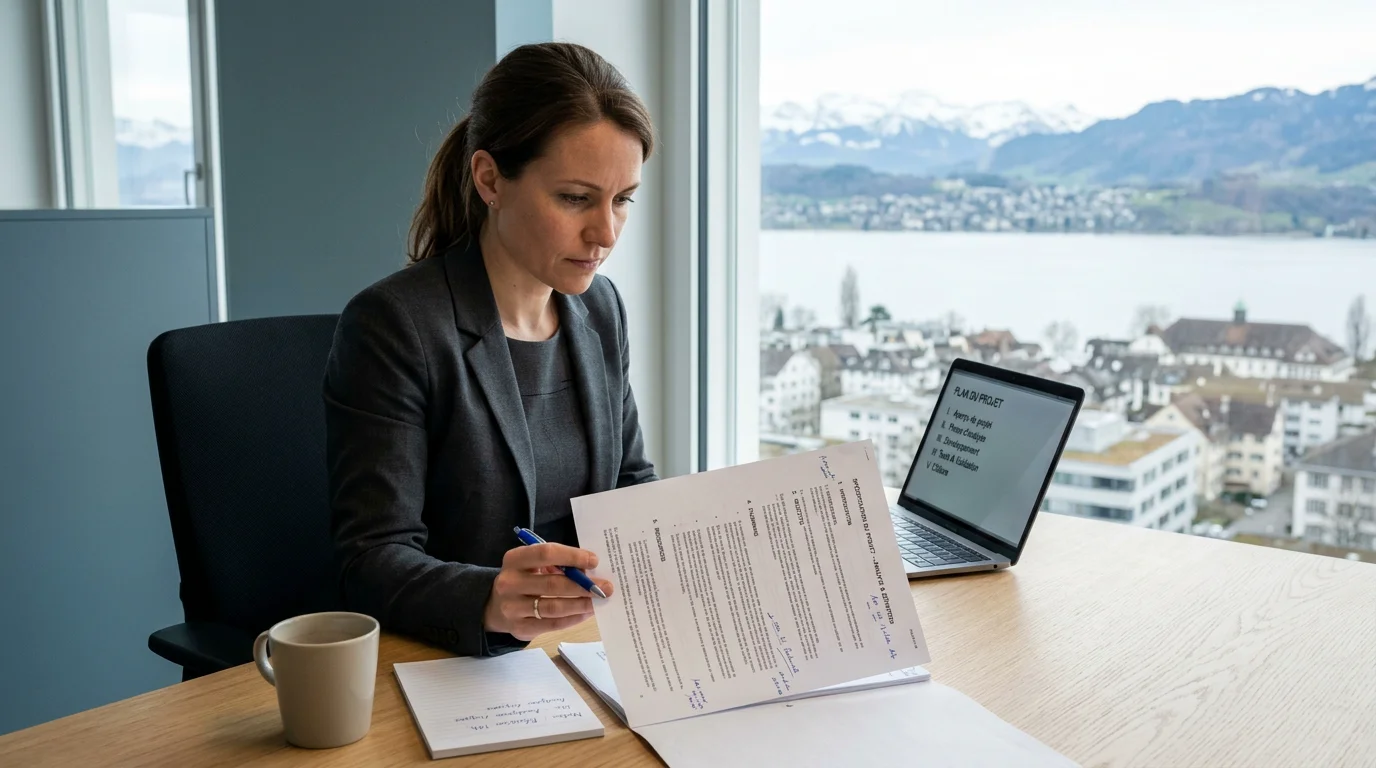
The software requirements specification, often abbreviated as SRS, is the written document that serves as the foundation for any digital project. It centralizes the scope, objectives, constraints, resources, deadlines, and budget. Internally, it guides your development teams. Externally, it serves as a contractual basis when working with service providers.
Without this framework, each stakeholder moves forward with their own interpretation of the requirements. This is exactly where budget overruns begin. Since 1994, the Standish Group has analyzed tens of thousands of software projects and continues to find a structural failure rate that remains high year after year, despite the progress of agile methodologies.
A good document doesn't lock in your project; it guides it. It translates a business vision into concrete, measurable, and prioritized requirements. It aligns business units, IT departments, and project management on the same trajectory, while serving as a steering reference right up to final acceptance testing.
The Structure of an Effective Software Requirements Specification
There is no single template, but there is a proven methodology. A readable document first explains why you are acting, then what you expect, and finally how and with whom. Here are the essential sections of a robust IT specifications document.
- Context and company: presentation of the organization, existing environment, business applications in place, and current pain points.
- Project objectives: business ambitions expressed in a clear, measurable, and dated manner.
- Scope: what the project includes, and more importantly, what it excludes, to prevent scope creep.
- Functional specifications: user journeys, screens, and business rules, prioritized using the MoSCoW method.
- Non-functional specifications: performance, security, compatibility, and compliance.
- Budget, timeline, and governance: overall budget, milestones, roles, and responsibilities.
A vague objective leaves room for all kinds of interpretations. Opt for a precise phrase like "reduce quote processing time by 30% by Q4" rather than a vague "modernize our tools." This level of rigor becomes your compass when the budget gets tight. To scope major trade-offs without a full-time CIO, our IT consulting and CIO services for software in Switzerland can step in from the preparatory phase.
Example of a Template Tailored to the Swiss Market
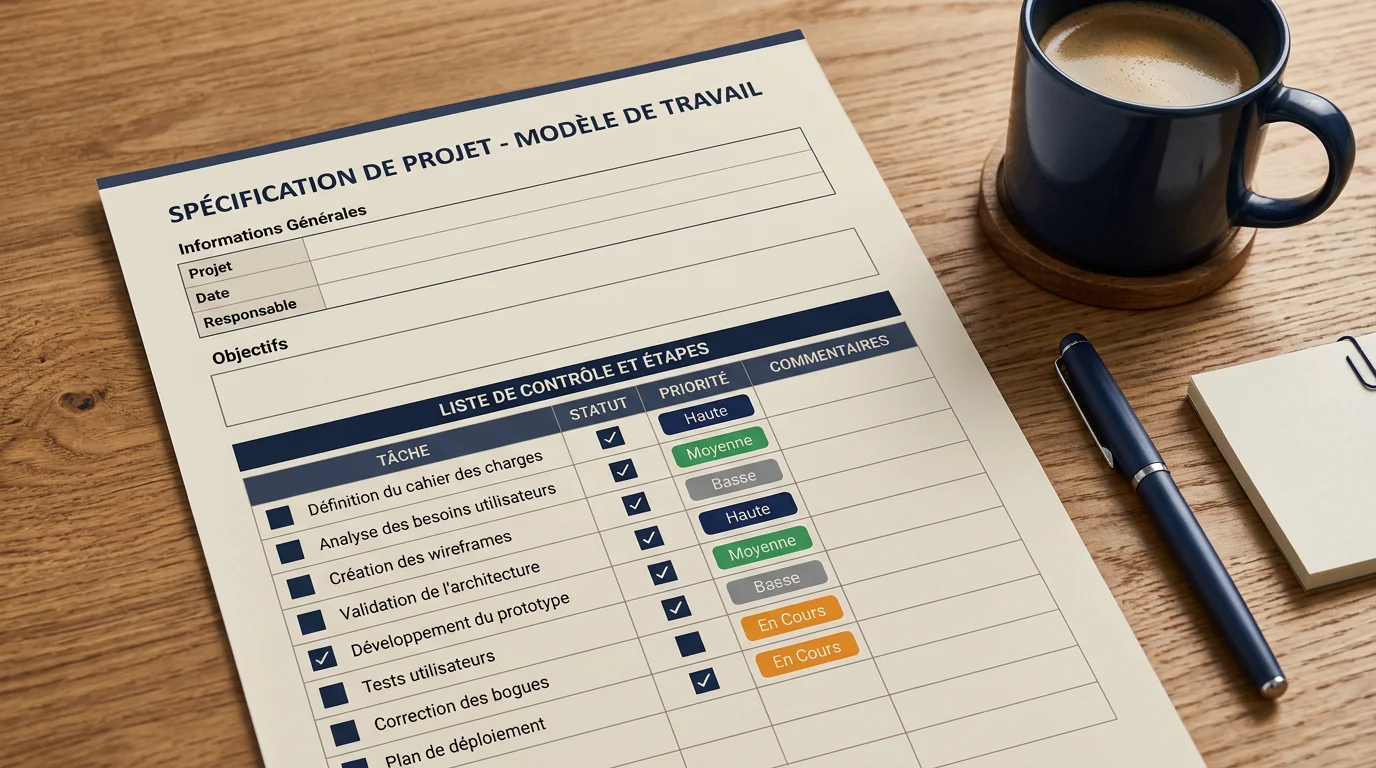
A concrete outline helps you get started quickly. Here is a structure you can use and adapt to your context, whether it is for business software, a web application, or an ERP project in Switzerland.
- Presentation of the company and its digital ecosystem.
- Problem statement and strategic challenges.
- Quantifiable objectives and key performance indicators (KPIs).
- Included scope and explicit exclusions.
- Description of end-users and their needs.
- Expected features, formatted as prioritized user stories.
- Non-functional requirements (security, performance, compliance).
- Integration constraints with your existing IT system.
- Estimated budget and billing terms.
- Project schedule, milestones, and governance.
The Swiss context adds its own set of requirements. Development quality and data location matter just as much as price. An unusually low quote often hides distant outsourcing and quality that falls short of expected standards. Specify your requirements for European hosting and GDPR compliance right from the drafting stage. To discover reusable building blocks, check out our modular software solutions in Switzerland.
Functional, Non-Functional, and Security Specifications
Functional specifications describe what the solution must do. Always distinguish between the front-end (the user-visible interface), and the back-end (the invisible logic that processes and stores data). The back-office, meanwhile, is the admin interface that coordinates both.
To organize these requirements, the MoSCoW method remains essential. It categorizes each requirement into four groups.
- Must have: essential features directly linked to the project's objectives.
- Should have: important but not critical in the short term.
- Could have: optional features, to be added if resources allow.
- Won't have: ruled out for the current scope, but noted for future phases.
The non-functional specifications are too often overlooked. They cover usability, browser compatibility, response times, scalability, and maintainability. Cybersecurity plays a central role here: data encryption, access control, strong authentication, and compliance with standards like GDPR or ISO 27001. A poorly scoped security requirement weakens the entire project.
Budget, Timeline, and Governance: Avoiding Overruns
Budget and timeline are the trickiest parts. Some hesitate to share their budget, but withholding your financial envelope is counterproductive. A provider will always look for the best solution within a realistic range. You can indicate a global amount, a target range, or a breakdown by item.
Overruns are frequent and well-documented. Back in a Panorama Consulting study reported by the trade press in 2014, 72% of surveyed ERP projects experienced delays, and more than half went over budget. More recently, a compilation of industry statistics puts the global failure rate of ERP projects at 68% according to Panorama's 2025 research, often due to poor change management and rushed data migration.
Governance mitigates these risks. Appoint a sponsor, a project management team, and a development team, and clarify who makes which decisions. The table below compares three approaches based on key criteria for a Swiss SME or mid-market company.
| Criterion | Off-the-shelf software | Unstructured internal development | Our custom software offering |
|---|---|---|---|
| Delivery timeline | Long, depends on the integrator | Variable, often slipping | 3 months at a fixed price |
| Code and data ownership | Vendor license | Internal, but poorly documented | 100% proprietary ownership |
| Dependency | High (recurring licenses) | Depends on internal resources | No licenses, no lock-in |
| ROI-driven management | Rarely contractualized | Often absent | Measurable target ROI |
To anticipate true costs, a budget must integrate development, training, and future maintenance. You will find concrete benchmarks in our analysis of the price and budget of custom software development.
Key Takeaways for Scoping Your Project in Switzerland
A well-written software specifications document turns a vague idea into a structured, measurable, and manageable project. Remain precise about objectives, explicit about the scope, and realistic about the budget. Involve your stakeholders from the preparatory phase, prioritize your requirements, and never overlook security or maintainability. In Switzerland, demand a level of execution quality and data localization that matches your investment. This document remains your best tool for avoiding budget overruns and comparing offers on an objective basis.
Take Action with SapAngel
Drafting robust software specifications takes time and a clear understanding of the challenges, especially without a full-time CIO. We support SMEs and mid-market companies in Switzerland to scope their projects, secure their processes, and transform business requirements into concrete solutions, with a dedicated specialist at every stage.
We deliver our custom software in 3 months at a fixed price, with no licenses and no vendor lock-in, full ownership of code and data, European hosting compliant with GDPR, and measurable ROI management. Take 30 minutes to discuss and scope the best approach for your project.
Frequently Asked Questions
Is a software requirements document mandatory for a project?
It is not mandatory, especially in agile approaches with short cycles. However, it remains highly recommended to outline the scope and obtain comparable bids. Even a short document secures your project and facilitates relationship management with service providers.
What is the difference between functional and technical specifications?
Functional specifications describe what needs to be built: use cases, user journeys, and business goals. Technical specifications detail how to implement it: architecture, integrations, and security constraints. The two are complementary and target different readers.
How many service providers should I send the specifications to?
Contacting two to four providers is common and healthy. Specify the terms of your request for proposal: deadlines, point of contact, and decision criteria. This allows you to compare proposals on an objective basis.
How do I adapt my specifications to the Swiss context?
Emphasize development quality, data localization, and GDPR compliance, which are strong requirements in the Swiss market. Beware of unusually low bids, which are often linked to distant outsourcing. We design custom software with European hosting and complete ownership of the code.
How long does it take to write a software specification document?
It can take anywhere from a few days to several weeks, depending on the complexity of the project and the number of stakeholders involved. This is a collaborative process: business units, IT, and project managers should all contribute. External assistance often speeds up scoping and prevents costly omissions.