

Even today, half of all businesses print a contract solely to sign it, then scan and send it back. This detour wastes time, paper, and compromises reliability. Adopting electronic signature software in Switzerland removes this friction while guaranteeing the legal validity of your documents. To structure this type of digitization project, our Swiss software modules and solutions help design a clear roadmap, free from vendor lock-in.
Going digital is no longer a gamble; it is an operational standard. According to a 2026 report, electronic signatures have become a cornerstone of digital transactions, with growing adoption among businesses and administrations. It remains to be understood which rules apply in Switzerland and how to select a tool truly tailored to your processes.
Why Adopt a Digital Signature Solution

Choosing Swiss e-signature software meets a simple need: speed up agreement completion while securing exchanges. The benefits are tangible in terms of turnaround times, printing costs, and document traceability.
The market confirms this momentum. According to Deloitte Switzerland, Europe is one of the fastest-growing regions over the 2023–2026 period, with the financial services sector being one of the most dynamic. This adoption is driven by organizations' deep need to fully digitize their document workflows.
An online signature tool also provides evidentiary value. A digitally signed document contains timestamps that trace its creation, and its content cannot be altered after the fact. Where paper leaves room for doubt, the electronic version offers a robust chain of custody.
SES, AES, QES: Understanding the Three Types of Signatures
Not all electronic signatures carry the same legal weight. Swiss law distinguishes three levels, to be selected based on the risk of litigation and the document's formal requirements.
- Simple Electronic Signature (SES): suitable for very low-risk transactions with no specific formal requirements, such as a minor purchase agreement or internal document approval.
- Advanced Electronic Signature (AES): for agreements with a risk of litigation but no statutory written form requirement, such as a service contract, quote, or non-disclosure agreement (NDA).
- Qualified Electronic Signature (QES): the only one legally equivalent to a handwritten signature since January 1, 2017. It is required whenever the law prescribes the written form (employment contracts, lease terminations, debt assignments, among others).
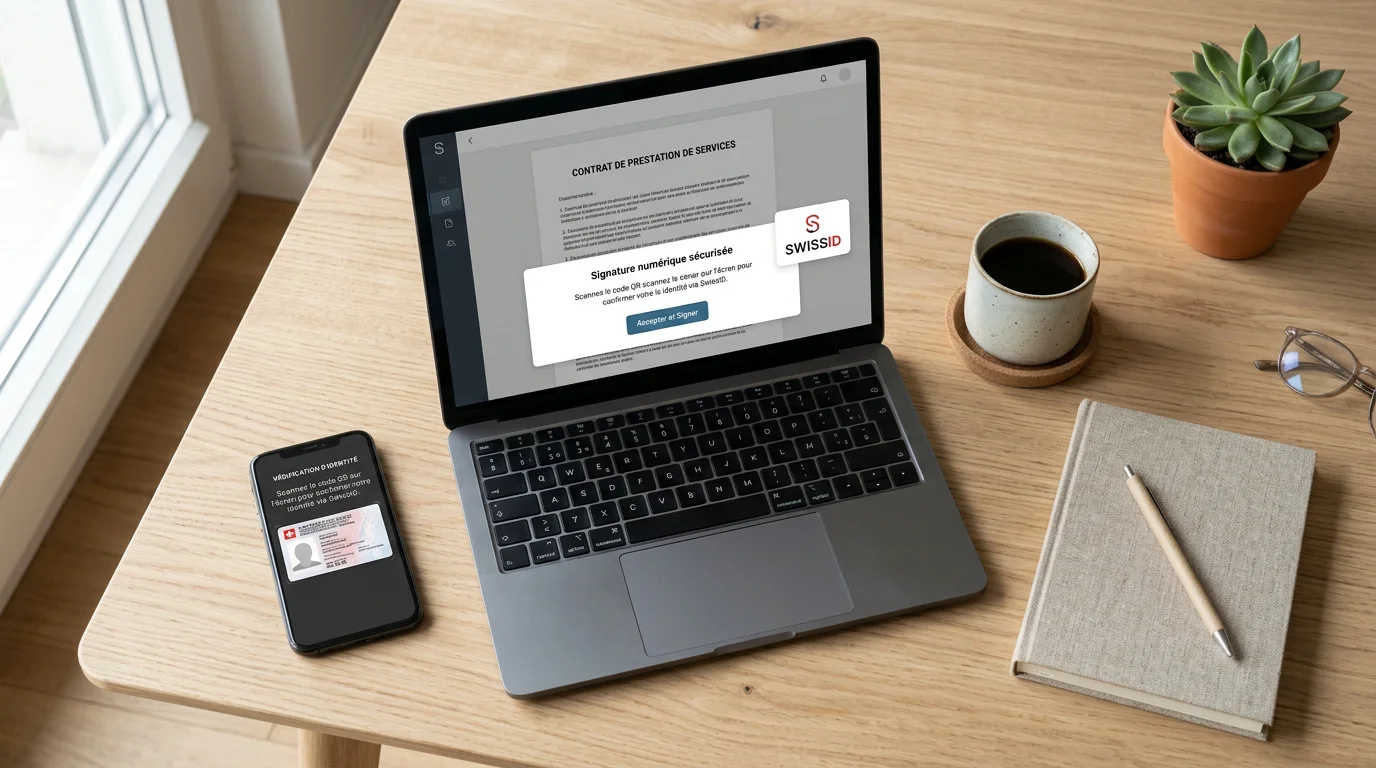
The choice of level is not cosmetic. A QES requires each signatory to verify their identity the first time, usually via video identification with an ID document. For your daily workflows, a digitization tool to manage and sign your documents integrates these different levels into a single journey, without multiplying applications.
Legal Framework: SCSE and eIDAS
Two legislative frameworks structure the legal validity of electronic signatures on both sides of the border. In Switzerland, the Federal Act on Electronic Signatures (SCSE) sets out the requirements for digital certificates and trust service providers. In the European Union, the eIDAS regulation establishes the common framework for electronic identification and trust services.
In practice, only a QES issued by an accredited provider can replace a handwritten signature. The principle of freedom of form, enshrined in Article 11 of the Swiss Code of Obligations, dictates that most Swiss contracts can be concluded without any specific formalities. The written form is only required for certain sensitive transactions, where warning functions and legal certainty take precedence.
An often overlooked point: when a contract stipulates that any amendment must be in writing, a QES becomes necessary to countersign it, unless explicitly stated otherwise. Properly framing these use cases prevents costly formal invalidations.
How to Choose Your Solution in Switzerland
Beyond compliance, several criteria differentiate market solutions: the level of signature covered, the hosting model, ease of integration with existing tools, and the pricing model. The table below summarizes typical approaches.
| Criterion | Standard Cloud Solution | On-Premise Solution | Our SapAngel Approach |
|---|---|---|---|
| Signature types | SES, AES, QES | SES, AES, QES | Integrated into custom software |
| Hosting | Third-party cloud | On your servers | Europe, encryption, GDPR compliance |
| Data ownership | Vendor | You | 100% of code and data |
| Business integration | Limited connectors | Variable | Custom-built, 3-month delivery at a fixed price |
| Vendor lock-in | High | Low | No licenses, no dependency |
The central question is not just "which provider," but "how to integrate the signature into your processes." A signature isolated from a quote, invoice, or contract creates a new silo. Conversely, embedding it into an automated workflow establishes a single source of truth and reduces team workload.
This integration logic is part of a broader trend. According to a 2026 UBS study, six out of ten Swiss companies already use artificial intelligence, often to pragmatically extend their digitization. Electronic signatures fit into this same movement of automating repetitive tasks.
Security, Hosting, and Data Sovereignty
For regulated sectors—law, healthcare, finance—confidentiality is just as important as legal validity. Two models coexist. The cloud facilitates deployment and mobility. On-premise installation ensures that sensitive documents never leave your infrastructure, a decisive argument for certain organizations.
Data localization is equally important. European hosting, complete with encryption and GDPR compliance, provides a clear framework for your clients and auditors. Switzerland is also moving towards a more digital administration: a 2026 overview notes that electronic invoicing is already mandatory in certain relations with the Confederation, pushing businesses to make their entire document chain more reliable.
These issues are particularly sensitive in the accounting and fiduciary sectors. Our resources dedicated to electronic signatures for fiduciaries detail how to reconcile client confidentiality, high volumes, and probative value within a single tool.
Key Takeaways for Signing in Switzerland
Adopting electronic signature software in Switzerland comes down to three decisions: choosing the right signature level (SES, AES, or QES), verifying SCSE and eIDAS compliance, and deciding on the hosting model based on your confidentiality requirements. The real leverage lies in integration: a signature linked to your quotes, contracts, and approvals transforms a simple formality into a lasting productivity gain. Start by mapping out your documents with high legal value, then align the required signature level for each.
Take Action with SapAngel
Integrating electronic signatures into your processes only makes sense if it is part of a coherent digitization roadmap, without vendor lock-in. That is precisely our job: helping you define, build, and run solutions that belong to you.
With our fractional CIO services to steer your digitization, you benefit from a dedicated expert, European hosting compliant with GDPR, and custom software delivered in 3 months at a fixed price, where you remain 100% owner of the code and data. Take 30 minutes to discuss and scope out the best approach for your project.
Frequently Asked Questions
Does an electronic signature have the same value as a handwritten signature in Switzerland?
Only the Qualified Electronic Signature (QES) is legally equivalent to a handwritten signature since January 1, 2017. Simple and advanced signatures remain valid for documents with no statutory written form requirement. The choice therefore depends on the document type.
What is the difference between SCSE and eIDAS?
The SCSE (ZertES) is the Swiss federal law regulating electronic signatures and certification providers. eIDAS is the equivalent European regulation. A solution compliant with both allows you to legally sign documents in Switzerland as well as in the European Union.
Do you need to verify your identity to sign electronically?
For a qualified signature, yes: each signatory must verify their identity the first time, typically via video identification using a passport or ID card. Simple and advanced signatures do not systematically require this step.
Is it better to choose a cloud or an on-premise solution?
The cloud facilitates mobility and rapid deployment, while an on-premise installation keeps your confidential documents within your own infrastructure. The right choice depends on your industry and confidentiality requirements. Our solutions prioritize European hosting in compliance with GDPR.
Can electronic signatures be integrated into existing tools?
Yes, and this is often the primary driver of value. Linking signatures to your quotes, contracts, and approvals avoids creating another silo. We design custom software that integrates signatures directly into your business processes.