


In 2025, employee access to artificial intelligence jumped by 50% according to Deloitte. The shift is massive. However, the majority of organizations limit themselves to efficiency gains without deeply rethinking their processes. This gap between experimentation and real transformation represents the central challenge for leaders. If you are looking for concrete AI use cases for SMEs, the question is no longer "should we do it?" but "how do we structure the process?"
This gap between ambition and execution affects businesses of all sizes, from SMEs to mid-market and large enterprises. AI adoption in business requires much more than just a tool: it demands a clear strategy, solid governance, and the right skills. Here are the essential reference points to get there.
Current Landscape: Where Do Businesses Stand with AI?

In 2025, global surveys from McKinsey, IDC, PwC, Deloitte, and IBM revealed a strong trend: nearly three-quarters of businesses now integrate AI into their processes. Adoption is accelerating with proven gains in productivity and efficiency, but actual business transformation remains limited.
The contrast between individual usage and structural integration is striking. According to Microsoft's "Work Trend Index," 75% of knowledge workers already use AI at work, but 78% of them bring their own tools, creating a major security and governance challenge. This phenomenon, dubbed "Shadow AI," reveals a mismatch between employee willingness and the framework provided by employers.
KPMG's AI Pulse study, published in spring 2026 and conducted among 2,210 executives across 20 countries, paints a clear picture: in France, companies are moving forward with solid governance and gradual adoption, but AI remains primarily leveraged for execution rather than strategic decision-making.
Key Figures for Adoption in France and Worldwide
Recent data allows us to measure the speed of the phenomenon. The global AI market was valued at $244 billion in 2025, up 32% from the previous year. In France, the picture is more nuanced.
According to data compiled in 2025 and 2026, 44% of French companies use at least one AI tool and 31% integrate it into their marketing strategy. On the SME side, the momentum is encouraging. According to Bpifrance's annual report published in March 2026, 47% of small and medium-sized French enterprises—nearly 300,000 organizations—have launched at least one AI project. Among companies with over 200 employees, this figure reaches 95%.
Despite this acceleration, disparities persist. 17% of French companies fail to see the value of AI (compared to 9% globally), but 67% of them will continue to invest in AI regardless of their ability to measure a tangible ROI.
| Indicator | France | Global | Source / Year |
|---|---|---|---|
| Companies using AI | 44% | 72% | HubSpot / McKinsey, 2024-2025 |
| SMEs that have launched an AI project | 47% | — | Bpifrance, March 2026 |
| Companies not perceiving the value of AI | 17% | 9% | KPMG AI Pulse, 2026 |
| Employees using AI at work (weekly) | 35% | 75% (knowledge workers) | Ipsos / Microsoft, 2025 |
Productivity and ROI: Measurable but Uneven Gains
A McKinsey study reveals that 90% of AI users say it saves them time, 85% say it helps them focus on high-value tasks, and 84% say it boosts their creativity. Operational benefits are real and well-documented.
Twice as many business leaders as last year report seeing a transformational impact of AI on their business. Yet, only 34% are actually reinventing their business model. The rest of the organizations focus on optimizing the existing state without deeply rethinking processes.
Hundreds of SMEs have publicly shared their results: 15% to 30% reduction in administrative time, 15% increase in sales conversion rates. These tangible case studies fuel the confidence of companies that are still hesitant. To turn these gains into a sustainable advantage, the challenge lies in scaling use cases rather than simply multiplying isolated experiments.
The Four Major Barriers to AI Integration
Enthusiasm must not obscure the hurdles. Four main challenges slow down scaling in most organizations.
The Skills Gap
The AI skills gap is perceived as the main barrier to integration. Education, rather than redesigning roles or workflows, remains the primary lever used by companies to adapt their talent management strategies. However, training alone is not enough without a reconfiguration of job roles.
The Lack of Governance
The "Shadow AI" phenomenon illustrates this gap. 78% of AI users at work bring their own tools, often without a formal framework. While 42% of companies believe their strategy is well-prepared for AI, they feel less ready when it comes to infrastructure, data, risk management, and talent.
Insufficient Data Infrastructure
Deploying AI at scale requires a unified data strategy. Cloud-native data platforms have become essential for scaling AI projects. Without solid foundations (data quality, system interoperability, real-time data), models remain confined to one-off use cases.
The Difficulty of Measuring ROI
67% of French companies will continue to invest in AI regardless of their ability to measure a tangible ROI. This stance is risky. Without precise indicators, it becomes impossible to prioritize high-impact use cases and justify the investment to financial departments.
Agentic AI and Physical AI: New Horizons
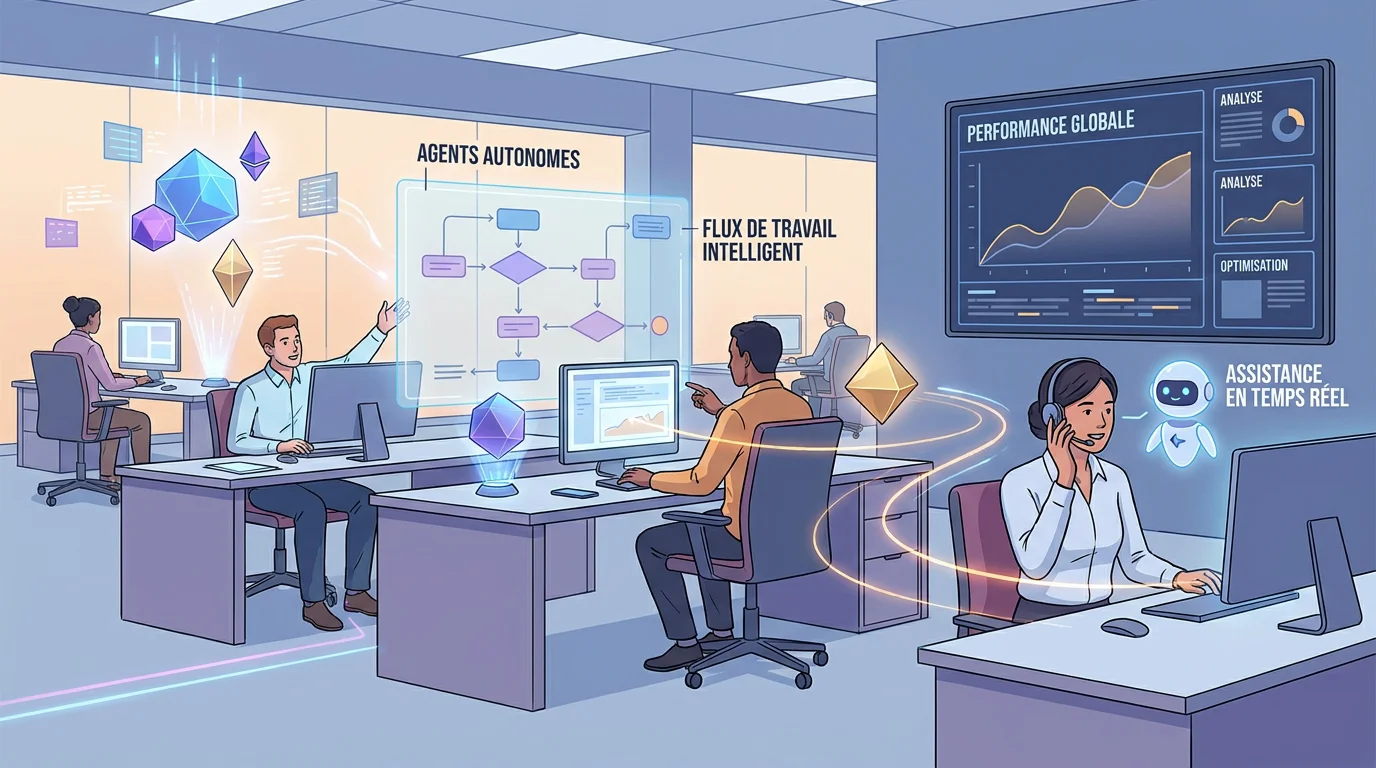
In 2026, business AI is no longer limited to automation or advanced analytics: it includes generative AI, agentic AI, and physical AI, integrated at the heart of business processes and business models.
Physical AI has progressed by 22 points in two years. More than half of companies (58%) say they use it at least to a limited extent, and this figure is expected to reach 80% within two years. Agentic AI, capable of driving end-to-end workflows autonomously, represents a paradigm shift.
According to Adobe's "2026 Digital Trends" report, more than four out of ten consumers say they are ready to interact with a brand's AI agent, provided that transparency and the ability to transition to a human contact are guaranteed. In France, the approach is more cautious: only 30% of French respondents say they would interact with an AI agent, compared to 40% in Europe.
For SMEs and mid-market companies, these advancements open up concrete possibilities: integrated AI assistants for quote generation, data analysis, or 24/7 customer support. The key lies in an informed ERP choice to support your transformation and host these new technological building blocks.
Governance and Compliance: The Pillars of a Sustainable Deployment
As AI transitions from experimentation to deployment, governance becomes the deciding factor between success and getting bogged down. Deloitte's "State of AI in the Enterprise" study identifies the main levers for scaling: aligning strategy, data, technology, talent, and governance to turn trials into sustainable impact.
The European regulatory framework, with the AI Act, imposes growing requirements for transparency and auditability of high-risk systems. GDPR compliance, secure data hosting, and traceability of algorithmic decisions are no longer optional: they are prerequisites.
For organizations lacking internal IT resources, the CIO's role in AI adoption is central. A dedicated focal point, capable of structuring governance while driving projects, helps avoid budget overruns and non-compliance risks.
Roadmap: Five Steps to Scale
How do you turn a successful experiment into a structured deployment? Here is a pragmatic five-step approach.
- Assess the existing state. Map out your repetitive and costly processes (admin, sales, HR, finance). Identify data silos and fragmented tools that hinder performance.
- Select 2 to 3 high-impact use cases. Prioritize projects directly linked to cost reduction, productivity, or customer satisfaction. Define clear KPIs before launching.
- Structure governance from the start. Appoint an AI lead, define human-in-the-loop validation rules, data security, and regulatory compliance. Do not create a parallel function; integrate governance into existing risk management structures.
- Deploy a pilot project then scale. Launch on a limited scope, collect before/after data, and measure the real impact. Then, roll out the projects that prove their value.
- Train teams and reconfigure roles. While 88% of marketers use AI according to SurveyMonkey, 70% of them state that their employer does not offer any training. Do not fall into this trap: invest in training anchored in concrete use cases.
According to Bpifrance, 70% of SMEs started with an existing software solution (CRM, ERP, management suite) rather than a custom-built project—a strategy that accelerates time-to-value. This pragmatic approach is often the most effective way to digitize your SME in 2026 without increasing technical debt.
The Cost of Inaction: Why Waiting is No Longer an Option
The real risk in 2026 is no longer AI itself, but the cost of inaction. Organizations that delay their transformation face an entire market that has become faster, more creative, and more efficient.
Companies that were still hesitating are watching their direct competitors deploy AI solutions and gain agility. Competitive pressure is now as powerful a driver of adoption as expected productivity gains. Bpifrance's data outlines a clear trajectory: the number of SMEs engaged in AI is expected to reach 58% in 2026.
AI adoption in business is no longer a technological gamble; it is a strategic imperative. The numbers confirm it: productivity gains are measurable, case studies are accumulating, and tools are becoming democratized. But succeeding in this transformation requires method, governance, and solid human support. It is precisely this pragmatic, ROI-oriented approach, combining dual technical and functional expertise, that makes the difference between an isolated pilot project and sustainable transformation. To take the step with confidence, discover our AI consulting services and transform your business processes.
Frequently Asked Questions
What is the AI adoption rate in businesses in France?
In 2026, about 47% of French SMEs have launched at least one AI project according to Bpifrance, and 44% of businesses use at least one AI tool. This rate exceeds 95% for companies with over 200 employees.
What are the main barriers to AI integration?
The skills gap comes out on top, followed by the lack of governance, insufficient data infrastructure, and the difficulty of measuring return on investment. Support from a part-time CIO, as we offer, helps overcome these roadblocks by structuring the approach.
Where should an SME start to adopt AI?
Start by identifying 2 to 3 repetitive and costly processes, then deploy a pilot project on a limited scope with clear KPIs. Focus on integration into your existing tools (CRM, ERP) rather than custom development at the start.