

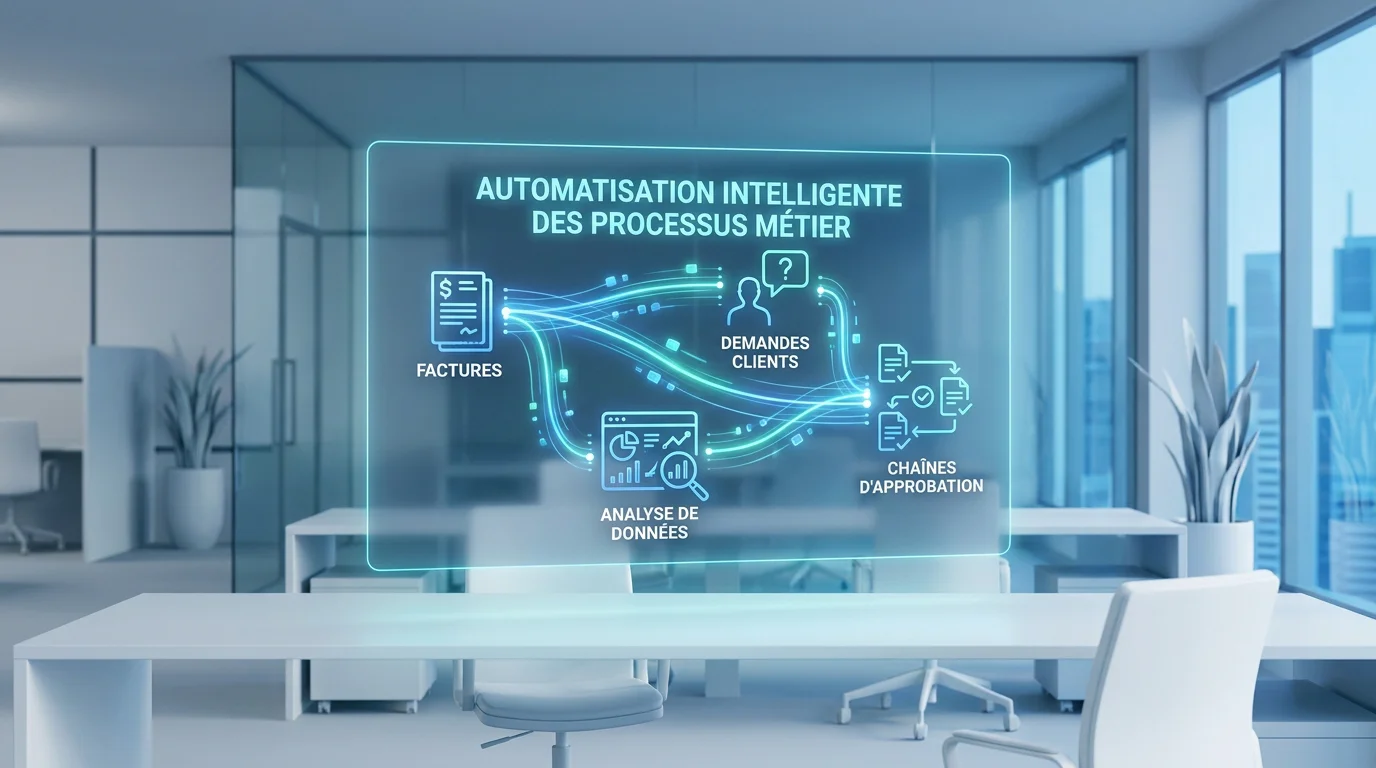
In 2026, AI is no longer justified by innovation, but by performance; companies that have taken the step toward industrialization are seeing measurable gains. Streamlining processes and increasing performance are the main reasons for adopting AI in business, and productivity gains are the primary argument for 74% of organizations. For SMEs and mid-market companies, the topic is no longer theoretical: it is about transforming repetitive tasks into growth levers, as demonstrated by numerous AI use cases for SMEs.
Yet, moving from intention to action remains a challenge. Business process automation with AI requires a solid methodological framework, the right technological choices, and human support. This article breaks down the technologies, concrete benefits, implementation steps, and pitfalls to avoid to ensure a successful transformation.
What Business Process Automation with AI Entails
AI-driven automation goes far beyond simple robotization. It combines machine learning, natural language processing, and decision-making capabilities to handle tasks previously reserved for humans. Unlike traditional systems that apply fixed rules, modern solutions reason, adapt, and improve as they process new data.
Concrètement, an intelligent automation system can automatically identify a document type (invoice, contract, purchase order), extract relevant data, and route it to the right person, even if formats vary from one vendor to another. This adaptability distinguishes AI from simple rule-based automation.
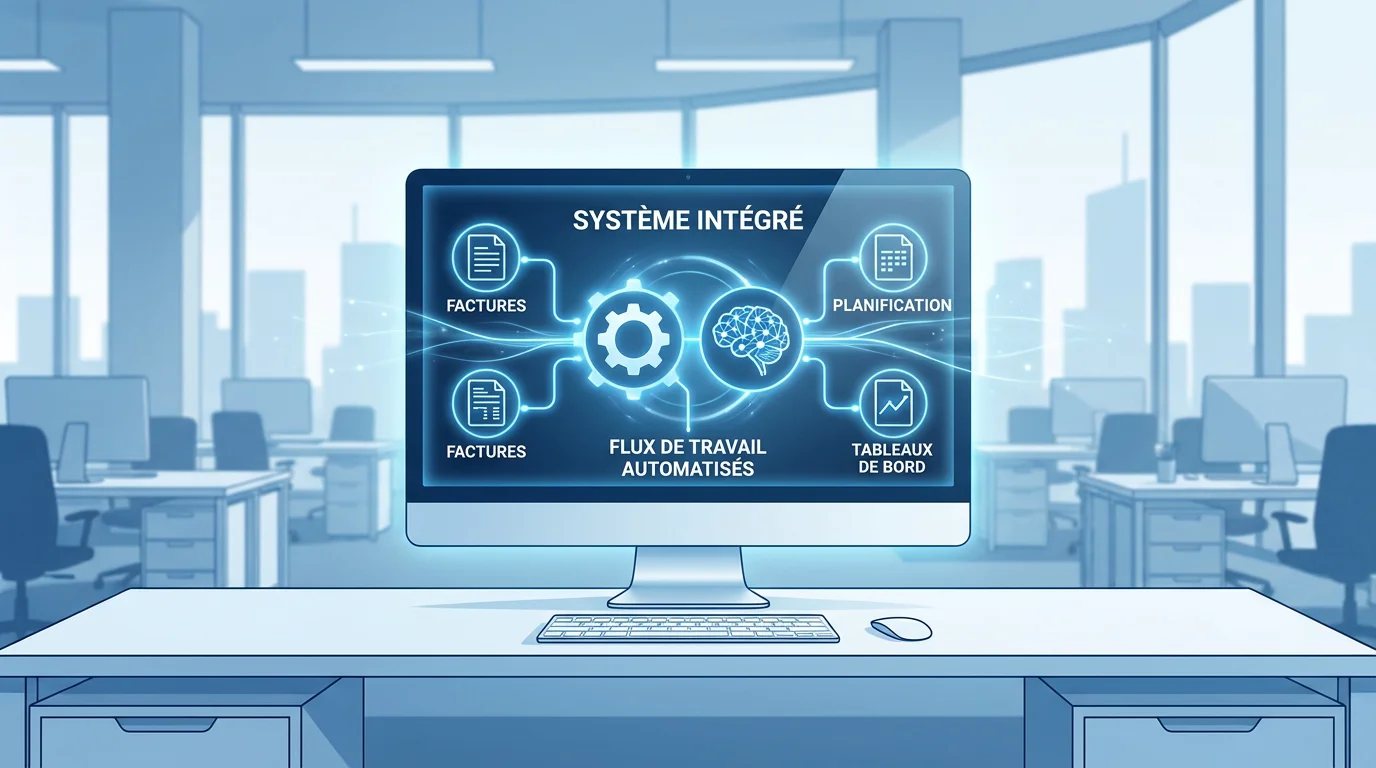
Key Technologies Driving This Transformation
Four technology families combine to automate business processes in an intelligent way.
Natural Language Processing (NLP)
NLP enables machines to understand, interpret, and respond to human language. It is used in automatic email classification, information extraction from unstructured documents, and customer support chatbots capable of handling complex requests.
Machine Learning (ML)
ML detects patterns in data, identifies trends, and makes decisions based on past experience. It powers intelligent document processing (IDP) systems that continuously learn and improve their accuracy over time.
AI-Enhanced RPA
Robotic Process Automation (RPA) leads with a 39% adoption rate. When coupled with AI, it goes beyond simple rule-based task execution to manage complex and variable workflows.
Agentic AI
In 2026, the paradigm is shifting toward systems capable of orchestrating complex sequences of actions: an AI agent can analyze a situation, define an objective, select the necessary tools, and adjust its strategy based on the results obtained. According to the latest projections, one-third of enterprise applications will use agentic AI to automate decision-making for approximately 15% of work tasks.
Concrete Benefits: Productivity, Cost, and Competitiveness
According to a European study reported by Bpifrance, organizations that have integrated AI into their key processes report productivity gains between 15% and 30%, depending on the sector. These figures translate into several dimensions.
Reducing errors and costs. Automating manual data entry, validation, and invoice reconciliation eliminates human errors that cause lost time and revenue. In manufacturing, AI systems predict and prevent breakdowns, thereby reducing production downtime.
Freeing up time for high-value tasks. According to a 2023 HubSpot survey, AI allows 84% of surveyed professionals to save time on manual tasks. 64% of them see this time savings as an opportunity to focus on more creative tasks.
Competitive advantage. Faster processes boost customer satisfaction and loyalty. Processing a quote or request in minutes, where a competitor takes several days, makes all the difference. For businesses wishing to digitize their SME in 2026, intelligent automation is an essential foundation.
Five Priority Processes to Automate
Which workflows should you target first to maximize return on investment? Here are the five areas where the impact is quickest and most measurable.
- Quote, invoice, and dunning cycle. Automatically generating quotes from CRM data, recurring invoicing, and scheduled payment reminders eliminate several hours of administrative work each week.
- Document management and compliance. AI classifies, extracts, and archives documents while ensuring full traceability. No more manually checking Excel sheets to guarantee compliance.
- Customer support and internal requests. AI assistants handle recurring questions, qualify requests, and route them to the right person 24/7.
- Reporting and data analysis. Automatic consolidation of data from multiple systems (ERP, CRM, business tools) provides up-to-date dashboards without manual data entry.
- Validation and approval workflows. Approval workflows (time off, purchases, expense reports) are automated with smart notifications and escalations.
The Productivity Paradox: Why Some Businesses Fail
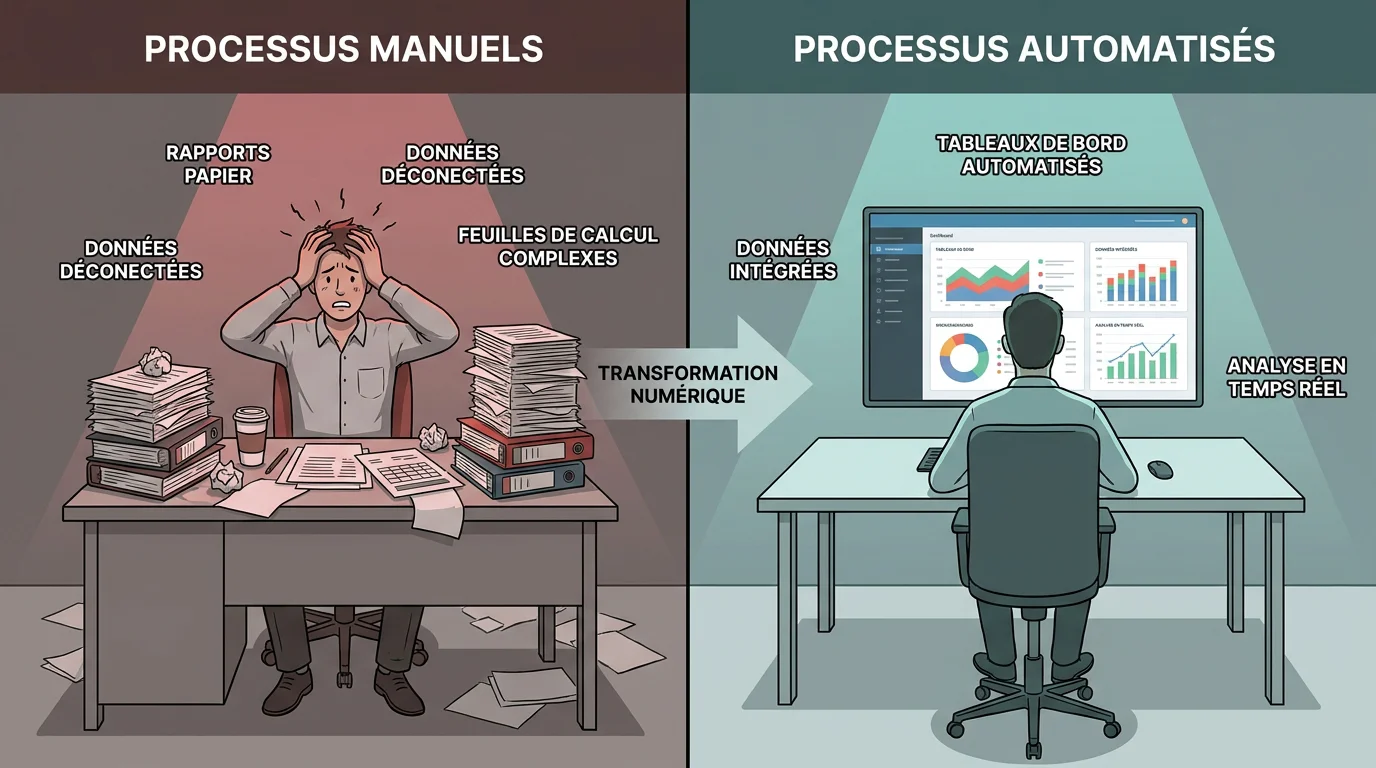
A 2026 study by the National Bureau of Economic Research involving 6,000 senior executives revealed that 89% of companies had seen no measurable impact of AI on their productivity. This seemingly contradictory result is explained by a frequent pitfall: layering AI tools on top of existing processes without redesigning them.
AI offers an average ROI of $3.70 for every dollar invested when implemented effectively. However, this average hides massive variance: organizations with clear AI strategies and redesigned workflows report significantly higher returns, while those that simply add AI tools to existing processes frequently see negative returns.
The lesson is clear: automation is not a technology project; it is an organizational project. Before implementing a tool, you must map your processes, identify bottlenecks, and redesign workflows. This is precisely what a custom approach allows, where software adapts to real workflows rather than the other way around.
Four-Step Methodology for Success
How can you avoid the pitfalls and achieve the promised gains? Here is a structured approach, proven in the field.
1. Audit and Map Your Processes
Identify repetitive, time-consuming, and low-value tasks. Measure time spent, error rates, and the associated costs. This mapping forms the basis of your roadmap.
2. Prioritize by ROI and Feasibility
Classify processes along two axes: potential impact (hours saved, errors avoided, customer satisfaction) and implementation complexity. Start with high-impact "quick wins" to demonstrate value rapidly.
3. Choose the Right Architecture
The choice between a standard ERP, custom software, or a combination of both depends on the specificity of your processes. An ERP covers standard workflows, but differentiating processes often require custom development. To evaluate these options, check out our guide on how to choose an ERP tailored to your processes.
4. Deploy, Measure, and Iterate
Launch a pilot on a restricted scope, measure the results (time saved, reduced errors, satisfaction), and adjust before deploying at scale. Machine learning improves performance over time, provided the system is fed with high-quality data.
Security, Compliance, and Change Management
Process automation through AI raises three legitimate concerns that every organization must anticipate.
Data protection and GDPR compliance. Business systems process sensitive information. The European regulatory framework imposes high standards regarding transparency and accountability; in 2026, this constraint becomes a competitive advantage, as companies capable of demonstrating controlled AI earn the trust of customers and partners. European hosting, data encryption, and auditable logs are prerequisites, not options.
Integration with legacy systems. Legacy systems often struggle with continuous data flows or real-time predictions. APIs, middleware, or dedicated connectors facilitate compatibility with existing CRMs, ERPs, and databases.
Team enablement and support. AI does not make jobs disappear: it transforms and evolves them; even in the professions most exposed to automation, the number of jobs continues to grow. In France, according to PwC's barometer, "AI-augmented" jobs grew by 252% between 2019 and 2024. Training your employees to master these tools is essential so that AI is perceived as a lever, not a threat.
Trends Shaping Automation in 2026
2026 marks a quiet but irreversible turning point; it is not a sudden technological disruption, but an organizational shift. Several structuring developments are emerging.
Agentic AI goes live. In France, AI agents are already being tested in customer service management, logistics planning, and administrative process automation. These autonomous systems carry out complex sequences of tasks with minimal human intervention.
The end of the prototype phase. For several years, AI lived under a prototype regime, with proofs of concept rarely deployed at enterprise scale; in 2026, this phase is coming to an end. Organizations are shifting from experimentation to industrialization.
Trust as a strategic asset. Trust is becoming a strategic asset: explainable, governed, and compliant AI strengthens the credibility of organizations in their markets.
Upskilling as an imperative. Professionals who master AI tools benefit on average from a 25% higher salary compared to those who do not, according to a compilation of recent studies. Investing in your teams' training is no longer optional.
Comparison of Automation Approaches
| Approach | Adaptability to Specific Processes | Implementation Timeframe | Code Ownership | Built-in GDPR Compliance |
|---|---|---|---|---|
| SapAngel (custom software + consulting) | High: built around your actual workflows | 3 months (fixed price) | 100% proprietary | Yes (European hosting, auditable logs) |
| Standard ERP (SAP, Dynamics 365) | Medium: requires configuration | 6 to 18 months | Publisher license | Depending on configuration |
| Specialized RPA tools | Limited to rule-based tasks | 1 to 3 months | Publisher license | Variable |
| No-code / low-code solutions | Moderate: simple processes | A few weeks | Platform-dependent | Variable |
Intelligent automation of your business processes with AI is no longer a luxury reserved for large corporations. The measurable gains (15% to 30% productivity increase, drastic reduction in errors, faster processing times) are accessible to any organization that adopts a structured approach. The determining success factor is not the technology itself, but the ability to redesign workflows before automating them, and to support teams through this transition. With a dedicated partner who understands your business, and custom software tailored to your actual workflows, you maximize return on investment while maintaining control over your data. To evaluate which processes to automate first in your organization, discover our solutions for CIOs and schedule an initial call.
Frequently Asked Questions
How long does it take to automate a business process with AI?
The timeframe depends on the complexity of the process. A simple workflow (reminders, invoice validation) can be automated in a few weeks. A more comprehensive project integrating multiple systems typically takes three to six months. At SapAngel, custom software is delivered in three months at a fixed price.
Is AI automation suitable for SMEs?
Yes. No-code tools and custom solutions make automation accessible without a large internal IT team. The key is to start with a targeted, high-impact process and progressively expand the scope.
What are the risks of AI process automation?
The primary risks are automating poorly designed processes (which amplifies inefficiencies), vendor lock-in, and team resistance to change. A methodological approach and a training strategy mitigate these risks.