


One in four SMEs now uses artificial intelligence every day in its operations. Yet, many leaders remain stuck on a simple question: where to start? Identifying the right AI use cases in business makes all the difference between a project that slips off track and an investment that quickly pays off. This is exactly what we detail in our analysis of our approach to AI adoption in business, designed for busy decision-makers.
The stakes are no longer theoretical. In France, according to Insee, 10% of companies with 10 or more employees reported using AI technology in 2024, up from 6% in 2023. The curve is accelerating, and concrete applications are multiplying across all professions, from customer service to finance. The key is choosing the ones that create measurable value for your organization.
Why AI Use Cases Are Exploding in 2026

Three forces are driving this adoption. First, simpler tools: assistants integrated into collaborative suites, AI modules in CRMs and ERPs, and no-code platforms. Second, the lower cost of entry. Finally, pressure on productivity is pushing teams to automate repetitive tasks.
The results speak for themselves. According to a McKinsey study, 90% of AI users say they save time, and 84% believe it boosts their creativity. PwC even notes that sectors most exposed to AI, like finance and tech, show productivity growth nearly five times higher than others.
A successful AI use case is never a technological gimmick. It is the answer to a specific business problem: an excessive delay, a recurring error, or a task that exhausts your teams. This framing is what separates profitable projects from short-lived experiments.
Automating Processes and the Back Office
This is the most fertile ground. Repetitive administrative tasks (data entry, filing, validation, follow-ups) lend themselves perfectly to intelligent automation. The return on investment is fast and easy to measure.
The numbers confirm this priority. Looking at the details of French projects, according to the 2026 Bpifrance report, 63% of deployments target internal process optimization: document processing, data classification, and administrative automation. These use cases combine high volumes with immediate gains.
A few concrete examples that frequently come up:
- Automated generation of quotes and invoices, with terms and price verification.
- Customer follow-ups triggered according to clear business rules.
- Data extraction from unstructured documents (contracts, purchase orders).
- Bank reconciliation and anomaly detection in accounting entries.
To go further in this area, we detail concrete methods in our expertise in business process automation, featuring quantified examples of weekly gains.
Improving Customer Relations and Customer Service
Customer relations account for a major share of projects. Chatbots and conversational assistants, available 24/7, handle routine requests and free up your agents for complex cases.
Here again, the data speaks for itself. According to the 2026 Bpifrance report, 48% of AI projects in France concern customer relations: chatbots, recommendations, and churn prediction. The goal is not to replace humans, but to handle requests faster and more accurately.
Among the most useful concrete applications of AI:
- 24/7 assistants connected to your internal knowledge base.
- Sentiment analysis on reviews and incoming messages.
- Ticket prioritization based on urgency and business criticality.
- Response assistance for your agents, who retain final validation.
A good AI assistant does not try to answer everything, but rather routes the customer to the right answer as quickly as possible, while keeping a human in the loop for sensitive decisions.
Selling and Personalizing with AI
On the sales front, AI refines targeting and shortens sales cycles. It qualifies accounts, segments personas, and personalizes approaches without manual entry in the CRM.
Mature marketing and sales use cases include predictive lead scoring, automated sales proposal generation, and product recommendations. These mechanisms focus sales efforts where impact is maximized and better protect margins through dynamic, compliant quotes.
Generative AI is now joining the toolkit: drafting email first drafts, summarizing meeting notes, and creating content tailored to customer preferences. The principle remains the same: AI produces a draft, and your teams maintain control over the angle and verification.
Managing ERP and Decision-Making with AI
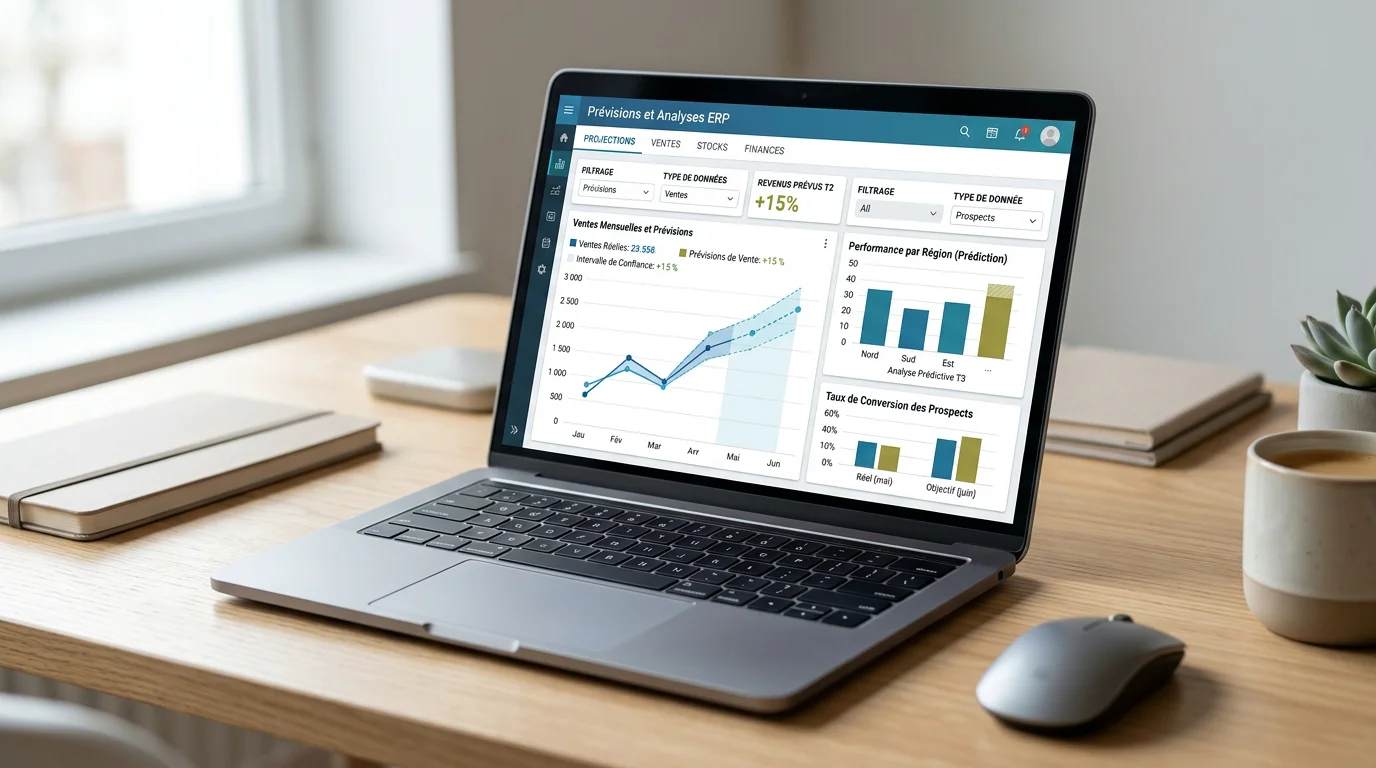
This is where an often underestimated advantage lies. Integrated into your ERP, AI transforms scattered data into concrete decisions: demand forecasting, inventory optimization, budget variance detection, and contextual alerts.
Conversational copilots are also changing the daily use of business tools. Users can query data in natural language, generate reports, and automate workflows without coding. The result: less administrative time and better system adoption by field teams.
The stakes are high because ERP projects remain risky: in our experience, 42% exceed their deadlines and 23% to 45% go over budget. Rigorous AI scoping makes these projects more reliable. We explore these mechanisms in our support for AI in ERP, applied to SAP and Dynamics 365 environments.
How to Choose and Deploy the Right Use Case
The golden rule: start small, with a proof of concept of low complexity and high value. You validate feasibility and ROI before scaling up. This approach minimizes risks and builds internal buy-in.
A simple roadmap works in most organizations:
- Map your repetitive and costly processes (support, sales, HR, finance).
- Select two to three use cases directly linked to performance.
- Define clear KPIs: time saved, error reduction, cost per ticket.
- Deploy a pilot on a limited scope, then scale up.
This discipline is accessible to businesses of all sizes. According to Hostinger, about 89% of small businesses already use AI tools for daily tasks like writing emails or analyzing data. AI is no longer reserved for large corporations.
The trend in France confirms this: according to LesAstucesIA, 42% of French SMEs had deployed at least one AI solution in 2026, and 91% of companies equipped notice a positive impact on their revenue. The main obstacle remains the lack of internal skills, cited by 61% of business leaders.
Comparison: Where Our Approach Stands
Not all AI solutions are created equal when it comes to your security, data ownership, and business integration constraints. Here is how the main families of options compare.
| Criterion | Generic AI Tools | Free / No-Code AI Solutions | Our Custom Approach |
|---|---|---|---|
| Adaptation to real workflows | Limited | Basic | Complete |
| Code and data ownership | Shared | Variable | 100% proprietary |
| Hosting in Europe (GDPR) | Not guaranteed | Rarely | Yes, auditable logs |
| SAP / Dynamics 365 Integration | Partial | No | Native |
| Dedicated support | Standard support | Community-based | Dedicated business expert |
Free or no-code tools are great for quickly testing an idea. As soon as you scale up, questions of data ownership, compliance, and ERP integration become crucial. This is precisely where we deliver value, with custom software delivered in three months at a fixed price.
Conclusion
The most profitable artificial intelligence use cases always start with a specific business problem, not a trend. Back-office automation, enhanced customer relations, sharper sales, and ERP management: each can generate a visible ROI as long as you start small and measure. Remember that 91% of equipped French companies already see a positive impact on their revenue. In 2026, the real risk is no longer AI, but waiting. With a dedicated expert who understands both the technology and your business, you secure every stage while keeping control over your data. To turn these opportunities into concrete results, discover our AI solution via a digital approach and let's scope your first project together.
Frequently Asked Questions
Which AI use case should you prioritize when starting out?
Start with a high-volume, repetitive, and time-consuming task, such as quote generation or sorting customer requests. The ROI is fast and easy to measure, making internal buy-in much smoother.
Is AI reserved for large corporations?
No. In 2026, 42% of French SMEs had already deployed at least one AI solution. No-code tools and custom software like ours make technology accessible to SMEs and mid-caps, with tailored support.
How do you ensure GDPR compliance for an AI project?
Prioritize European hosting, data encryption, and auditable logs. Complete code and data ownership also prevents dependence on an external vendor, which is key to long-term compliance.