


In 2025, 88% of organizations used AI in at least one business function, up from 78% in 2024 and 55% in 2023. This acceleration is now reaching the very core of management systems. Artificial intelligence in ERP is no longer just an experiment; it is a concrete driver of competitiveness, even for SMEs and mid-sized companies looking to streamline their operations without multiplying tools. If you are considering leveraging AI daily, understanding AI use cases for SMEs is an excellent starting point.
However, integrating AI into an ERP system isn't just about activating a module. It requires robust data governance, a suitable infrastructure, and rigorous business change management. Below, we detail the real benefits, use cases by business function, and success factors to make the most of this convergence in 2026.
Why AI in ERP Has Become a Strategic Imperative

The global artificial intelligence market was valued at $294.16 billion in 2025 and is expected to reach $375.93 billion in 2026, with a compound annual growth rate (CAGR) of 26.60%, according to Fortune Business Insights. This momentum is directly feeding into the ERP sector, where AI is transforming once-passive systems into decision-support platforms.
Three factors explain this convergence. First, the maturity of the cloud has simplified data access and provided the processing power needed for machine learning models. Second, the volume of data generated by businesses has exploded, providing the essential raw material for algorithms. Finally, the democratization of Large Language Models (LLMs) has lowered technical barriers.
For SMEs and mid-sized companies, the challenge is clear: reduce manual tasks, anticipate unforeseen events, and secure decision-making without hiring an army of data scientists. The AI-augmented ERP thus becomes a true operational copilot.
Intelligent Automation: Moving Beyond Repetitive Tasks
Traditional automation executes predefined rules. AI-powered automation adapts to exceptions, learns from historical data, and suggests contextual actions. The difference is significant: where a script fails when facing an atypical invoice, a Natural Language Processing (NLP) model extracts the data, matches it with the purchase order in the ERP, and triggers the validation workflow.
The actual gains measured in the field are compelling. Industry feedback indicates that AI frees up 20% to 40% of team time on administrative processes. Specifically, this covers:
- Contextual invoice validation (extraction, matching, and automatic accounting entries).
- Quote generation and tracking, complete with optimal price suggestions.
- Personalized payment reminders based on customer payment behavior.
- Automated expense categorization and compliance checks.
For companies still managing these workflows via scattered spreadsheets, transitioning to an ERP with AI capabilities represents a major qualitative leap. We support this transformation with a pragmatic approach; discover how to digitalize your SME in 2026 without risking project slippage.
Augmented Decision-Making: From Reacting to Anticipating
A traditional ERP tells you what happened. An AI-augmented ERP tells you what is likely to happen and what you should do about it. This shift from descriptive analysis to predictive and prescriptive analysis changes how leaders steer their business.
A few concrete applications illustrate this evolution:
- Demand forecasting: machine learning algorithms cross-reference sales history, seasonality, weather data, and market trends to refine projections.
- Cash flow optimization: AI analyzes customer payment behaviors and predicts delays, helping to adjust payment reminders and reduce Days Sales Outstanding (DSO).
- Predictive maintenance: by cross-referencing IoT sensor data with failure history recorded in the ERP, the system anticipates breakdowns before production stops.
In 2024, 10% of French companies with 10 or more employees reported using artificial intelligence technology, according to INSEE. This figure, though still modest, highlights the massive untapped potential, especially for mid-sized organizations that possess rich but underutilized data.
Use Cases by Business Function
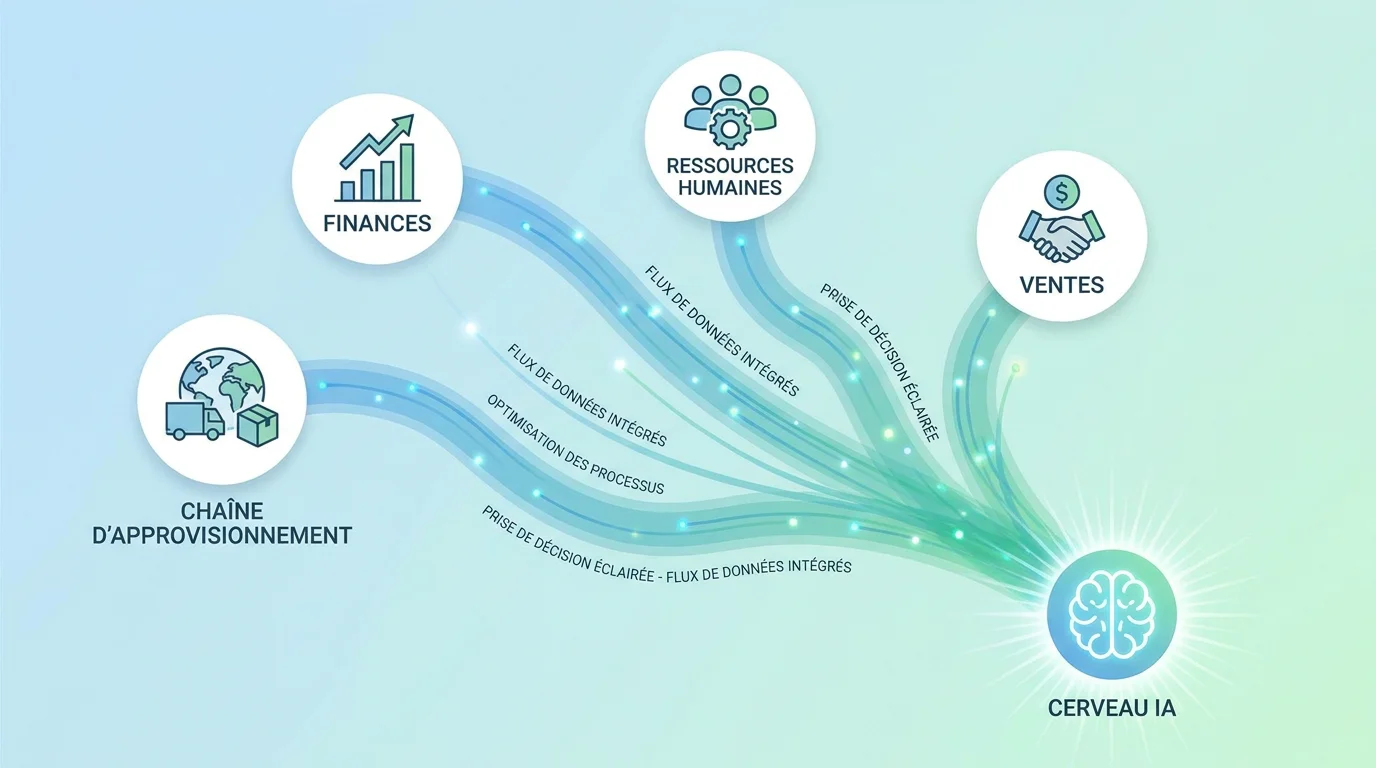
Integrating AI into an ERP is not limited to a single department. It irrigates the entire value chain. Here are the most impacted areas.
Finance & Accounting
Anomaly detection in financial transactions is one of the most mature use cases. Algorithms identify atypical patterns in real time (duplicates, unusual discrepancies, potential fraud) that the human eye might miss in a high volume of accounting lines. Predictive budgeting refines revenue and expense forecasts by relying on models trained on historical ERP data.
Supply Chain & Production
Inventory management directly benefits from machine learning. Industry feedback shows that AI can significantly reduce stockouts by integrating external variables (weather, local events, seasonal trends). Real-time production scheduling optimization, which takes into account orders, machine capacities, and raw material availability, completes the picture.
Human Resources
AI applied to ERP HR data makes it possible to detect weak signals of disengagement (decrease in activity, changes in connection behavior) and anticipate skill requirements. Predictive turnover analysis helps HR directors take action before employee departures become inevitable.
Customer Relations & Sales
Virtual assistants integrated with the ERP answer common customer questions (order tracking, billing) in natural language 24/7. AI can also recommend commercial actions by analyzing purchasing histories and renewal cycles.
SAP, Dynamics 365, and Market ERPs: Where Does AI Stand in 2026?
Major software publishers have accelerated the integration of AI into their platforms. SAP rolled out Joule, a conversational AI assistant integrated across its entire S/4HANA Cloud suite. Microsoft enriched Dynamics 365 with Copilot, which assists users with email writing, data analysis, and report generation directly from the CRM and ERP.
But software technology alone isn't enough. Value is created through configuration, adaptation to business processes, and data quality. This is precisely the role of an experienced integrator. Our expertise covers both our SAP ERP solution and Microsoft Dynamics 365, with a dual technological and functional competence that secures every deployment.
Prerequisites for a Successful AI Integration in Your ERP
Before activating any AI module, several key foundations must be established. Neglecting these prerequisites is the primary cause of project failures.
Data Quality & Governance
AI is only as good as the data feeding it. An ERP cluttered with duplicates, empty fields, or inconsistent naming conventions will yield faulty recommendations. The first step is auditing, cleaning, and structuring your data. The gap between individual AI usage (77%) and corporate adoption (44%) in France is striking, as highlighted by Digitiz; data quality largely explains this divide.
Cloud Infrastructure
AI models demand high processing power and real-time data access that only cloud (or hybrid) infrastructure can provide at a reasonable cost. The cloud segment dominates the AI market in 2026, representing 71.64% of market share in 2025. If your ERP is still running on an aging on-premises server, migrating to the cloud is a prerequisite.
Change Management
AI alters working methods. Teams must understand the reasoning behind algorithmic recommendations to use them wisely. A training plan tailored to business profiles (finance, logistics, HR) is essential. Without user buy-in, even the best model will remain unused.
Compliance & Security
The European Union adopted the AI Act to regulate the use of AI and ensure a responsible approach. In 2026, regulatory compliance (GDPR, AI Act) is not optional. Every AI module deployed within an ERP must respect the principles of transparency, traceability, and personal data protection. This is a critical selection criterion when choosing your integration partner.
Methodology: Where to Start?
A gradual, pragmatic approach yields the best results. Here is a four-step roadmap:
- Identify a high-impact, low-risk use case: automated invoice processing or cash flow forecasting are often excellent candidates for a first project.
- Audit your data: assess the quality, completeness, and consistency of the ERP data relevant to the chosen use case.
- Prototype and measure: deploy a pilot within a limited scope, define clear KPIs (time saved, errors avoided, forecast accuracy), and measure real ROI.
- Scale and expand: once the pilot is validated, roll out more broadly and explore new use cases by leveraging the enriched data.
This iterative approach limits risk and accelerates return on investment. It is especially relevant since, according to industry data, 42% of ERP projects run over schedule. Scoping the AI perimeter from the outset prevents weighing down an already complex project.
How to Choose the Right Partner to Integrate AI into Your ERP
Choosing the right integration partner is just as critical as choosing the software publisher. Several criteria deserve your attention:
| Criterion | Questions to ask | SapAngel |
|---|---|---|
| Dual expertise | Does the integrator master both the technology and the business processes? | 20+ years of technological and functional experience |
| Code ownership | Do you remain the owner of your custom code and data? | 100% ownership of code and data |
| GDPR Compliance | Where is the data hosted? Are access logs auditable? | Hosted in Europe, encryption, and auditable logs |
| Timeline & budget commitment | Does the partner commit to a fixed scope, timeline, and price? | Bespoke software delivered in 3 months at a fixed price |
| Ongoing support | Will you have a dedicated point of contact after deployment? | Dedicated expert point of contact |
The right partner does not just hook up an AI module. They help you choose the right ERP for your company, structure your data, and manage change over the long term.
Today, artificial intelligence in ERP systems represents one of the most accessible competitive advantages for SMEs, mid-sized businesses, and large enterprises. The numbers confirm it: a global AI market exceeding $375 billion in 2026, corporate adoption growing by over 10 percentage points annually, and measurable operational gains starting with the very first pilot project. The key is starting with a concrete use case, ensuring data quality, and teaming up with a partner that blends technical expertise with a deep understanding of your business challenges. To evaluate the AI opportunities for your ERP, contact our SAP and Dynamics 365 consulting team and schedule a 30-minute discovery call.
Frequently Asked Questions
What are the primary use cases for AI in an ERP?
The most common use cases are automated invoice processing, demand forecasting, and accounting anomaly detection. These three areas offer a quick return on investment because they rely on data already stored within the ERP.
Is AI in ERP accessible to SMEs?
Yes. AI features built into cloud ERPs (SAP, Dynamics 365) can be configured without heavy development. Tailored guidance, such as our SAP and Dynamics 365 consulting services, makes it possible to deploy an initial pilot in just a few weeks, even without an in-house data team.
What are the prerequisites for integrating AI into my existing ERP?
Three conditions are essential: clean, structured data; a cloud (or hybrid) infrastructure capable of handling processing workloads; and a change management plan to ensure teams adopt the new tools. Without these foundations, results will be disappointing.