


Automating a quote, summarizing a meeting, answering a client at 10 PM: these tasks are no longer science fiction. They are part of the daily routine for organizations that have taken the step toward AI adoption in business. The topic has moved from the lab to the office, and your competitors are already seizing the opportunity.
An enterprise AI assistant is software capable of understanding your requests and executing concrete actions based on your business data. The momentum is strong: in 2026, according to the CREDOC Digital Barometer, 48% of French people have already used generative AI, the fastest-adopted technology in 25 years of tracking. Now, this individual enthusiasm needs to be transformed into sustainable value for your organization.
What is an Enterprise AI Assistant?
An intelligent assistant is software equipped with machine learning and natural language processing capabilities. It understands your instructions, performs tasks, and improves with each interaction. Unlike raw generative AI, which remains passive without instructions, it acts as a digital right-hand partner connected to your tools.
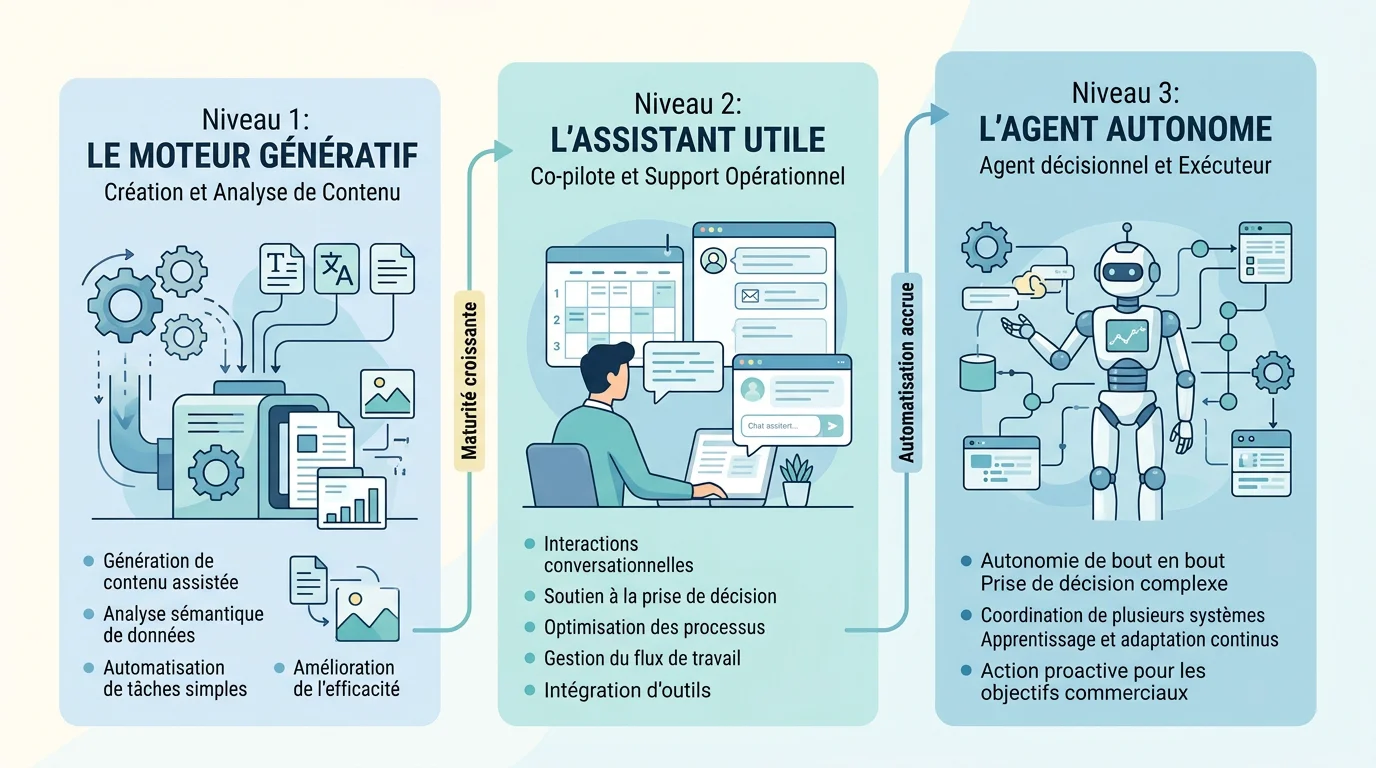
Three levels of maturity must be distinguished:
- Generative AI: the creative engine that produces text, code, or images from a prompt.
- The AI assistant: building on this engine, it interacts with you and executes concrete actions (writing an email, analyzing a spreadsheet).
- The AI agent: going a step further, it chains tasks together autonomously with minimal supervision.
This progression is crucial for your strategy. A conversational assistant is quick to install and reassures teams, whereas an autonomous agent requires more guardrails.
Where Does AI Adoption Stand in Businesses in 2026?
The numbers reveal a mixed landscape. According to Insee's ICT survey, 10% of French companies with 10 or more employees reported using AI technology in 2024, up from 6% in 2023. The gap widens with company size: 33% of businesses with 250 or more employees use it, compared to just 9% of those with fewer than 50 employees.
However, adoption is accelerating rapidly. According to Deloitte's State of AI study, the share of employees with access to AI tools grew from about 40% to nearly 60% in a single year. Access therefore extends far beyond just experts.
This gap between large corporations and SMEs represents an opportunity. Mid-sized companies that structure their use cases now are gaining a competitive edge. To define your priorities, our IT consulting helps you identify the processes where an assistant will deliver the most value.
What Are the Concrete Benefits for Your Organization?
The first benefit is time. An assistant processes emails, schedules meetings, inputs data, and drafts administrative documents in seconds. Your teams can refocus on high-value tasks.
The benefits are measurable. According to a 2025 McKinsey France study, SMEs that adopt AI record a 20% to 25% increase in productivity and a 15% to 20% reduction in operational costs within the first 18 months of deployment. Beyond saving time, these solutions reduce data entry errors and operate 24/7.
Concrete use cases span all business functions:
- Automating quotes and invoices: generation, follow-ups, and validations without manual intervention.
- 24/7 customer support: instant answers to recurring questions.
- Data analysis: summarizing long documents and providing data-driven recommendations.
- Recruitment: sorting and analyzing applications to identify the best candidates.
In this area, our business process automation with AI solutions transform repetitive tasks into reliable, trackable workflows, saving hours every week.

AI Assistant or Autonomous Agent: Which to Choose?
The distinction is more than just semantic. Today, the primary driver of adoption lies in copilotes—assistants that support employees without replacing them. Truly autonomous agents, capable of operating without supervision on complex tasks, remain rarely deployed.
Why this caution? Generative AI works probabilistically, not deterministically. To the exact same question, it can produce different answers. This behavior runs counter to standard digital tool expectations, where a reproducible result is required.
Rather than aiming for total automation, structure concrete use cases around copilots: they are simpler to deploy, adopt, and manage.
The right strategy is often to start with a supervised assistant, then expand its autonomy once trust is established and processes are refined.
How to Deploy a Profitable AI Assistant?
A poorly defined assistant ends up in the graveyard of pilot projects. Many initiatives launched in recent years never progressed beyond the experimental stage, due to a lack of coordination and clearly defined use cases.
The challenge in 2026 is no longer deciding whether to invest, but knowing where to invest and how to scale. As the State of AI study highlights, the real issue lies in organizations' ability to deploy AI sustainably, balancing governance, talent, and value creation. A step-by-step approach is essential:
- Map out your repetitive and costly processes (support, sales, HR, finance).
- Select two to three use cases linked to a specific financial indicator.
- Test on a limited scope before rolling out broadly.
- Train your teams to remove barriers and ensure buy-in.
- Measure ROI and continuously adjust.
Security and compliance are critical to success. European hosting, data encryption, and auditable logs guarantee GDPR compliance. Before launching, our digital performance audit measures your maturity and prioritizes high-impact projects.
Comparison of AI Assistant Approaches
The market is structuring around several solution families, each tailored to distinct needs. Here is how they stack up.
| Criterion | Generalist office assistant | Consumer agent platform | Custom SapAngel solution |
|---|---|---|---|
| Business customization | Limited to standard models | Configurable | Software tailored to your actual workflows |
| Ownership of code and data | Vendor | Vendor | 100% proprietary to you |
| Hosting and GDPR | Variable | Variable | European hosting, auditable logs |
| Support & guidance | Standard support | Self-service onboarding | Dedicated industry-expert advisor |
| Implementation time | Immediate but generic | Fast | 3-month fixed-price delivery |
Generalist solutions are fine to start with, but they make you dependent on a vendor and their licenses. A custom approach secures your data assets and fits your actual processes.
Conclusion
Adopting an intelligent assistant is no longer a matter of technological curiosity, but of competitiveness. Equipped SMEs gain 20% to 25% in productivity, provided they start with specific, measurable, and well-governed use cases. The real risk in 2026 is no longer AI itself, but the cost of inaction in an increasingly fast-paced market. Start small, measure, and then scale. With a dedicated advisor who understands your industry and delivers custom software that you own 100%, you can turn the promise of AI into concrete, lasting results. To identify your priorities and secure your project, take our digital performance audit and lay the groundwork for a profitable deployment.
Frequently Asked Questions
Is an AI assistant reserved for large enterprises?
No. Accessibility and falling model costs are opening up these capabilities to organizations of all sizes. This allows SMEs to compete with better-resourced organizations while remaining agile.
How long does it take to get a return on investment for an AI assistant?
According to French market observations, the average payback period is between 6 and 18 months depending on the scope. The key factor remains choosing use cases tied to a measurable financial indicator.
How can I guarantee my company's data security?
Prioritize European hosting, robust encryption, and auditable logs. Our custom solutions comply with GDPR and leave you 100% in ownership of your code and data.