


In 2026, most companies are testing autonomous agents, but less than a quarter manage to actually leverage them at scale. This gap between intention and production defines the maturity of the topic. To move beyond the prototype stage, you must understand what an enterprise AI agent truly is, how it differs from a chatbot, and how to integrate it into your existing systems—a topic we cover in detail in our analysis of AI in ERP.
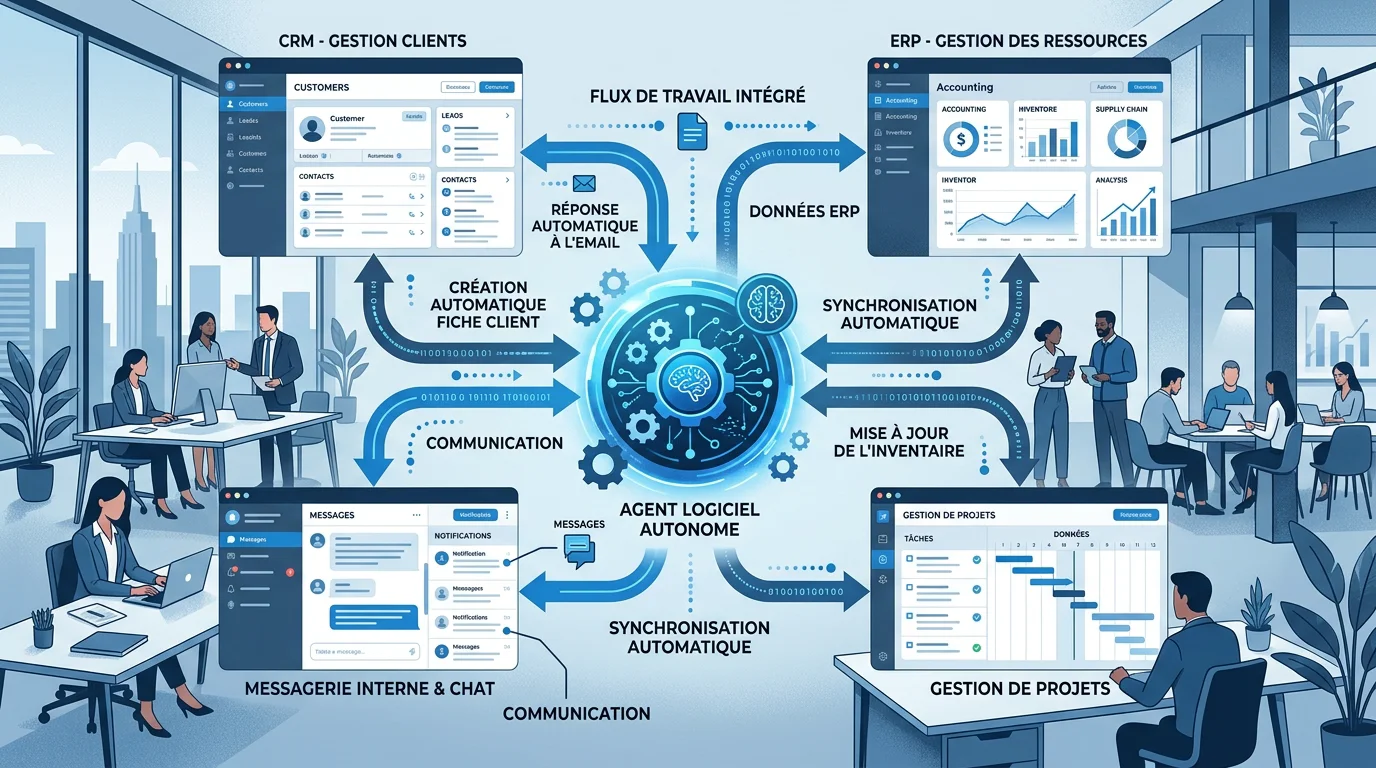
An AI agent is not just a conversational assistant. It is a software entity capable of planning a sequence of actions and executing them within a CRM, ERP, or messaging platform. This guided autonomy is a game-changer: according to data compiled by McKinsey, 88% of organizations already use AI in at least one business function, but very few derive measurable value from it.
What is an enterprise AI agent?
An AI agent is software capable of receiving an objective, designing a strategy, and managing sequences of actions until completion. While a language model simply generates text, an agent uses this text to make decisions and take action within real business systems.
Its operation is based on a three-step cycle. First, perception: the agent ingests signals, documents, structured data, or real-time streams. Second, reasoning: it plans the steps needed to reach the goal. Finally, action: it triggers calls to third-party applications via APIs. The feedback from the results feeds into a loop that adjusts the strategy.
This capacity for initiative sets the agent apart from traditional tools. It doesn't just make recommendations; it executes: creating a ticket, updating a customer profile, sending a personalized response. However, every action remains constrained by decision thresholds and exit rules defined by the organization.
AI Agent, AI Assistant, or Chatbot: What's the Difference?
Confusion between these three categories often holds projects back. Yet, they offer neither the same level of autonomy nor the same risk profile.
- The chatbot relies on scripts and a static knowledge base. It handles simple requests or manages an FAQ, but does not take action in business tools.
- The AI assistant excels at writing, summarizing, or rephrasing. It makes suggestions, but the user decides. Its regulatory exposure remains low.
- The AI agent combines conversation with tool-based action. It creates tickets, sends emails, updates a CRM, and hands over to a human if it gets stuck.
This execution power requires rigorous controls: action logs, permissions, and complete traceability. It is this agentic dimension, combining perception, reasoning, and action, that makes the enterprise AI agent a genuine lever for process automation.
Concrete Use Cases of AI Agents in Business
Where to start? 2026 data points to a few high-priority areas, chosen for their defined scope and measurable results.
Customer Relations and Support
This is the primary playground for agentic systems. Connected to knowledge bases and ticketing tools, an agent qualifies requests, answers common questions, and escalates complex cases. Customer support typically delivers the fastest and most predictable ROI.
Operations, Finance, and Back-Office
Linked to the ERP, agents verify data consistency, reconcile streams, or trigger alerts in case of discrepancies. In accounting, specialized agents read invoices, extract relevant data, and prepare approvals under human supervision. To automate these time-consuming repetitive tasks, our expertise in business process automation with AI helps structure these workflows from end to end.
Supply Chain and Predictive Management
In logistics, agents automate data entry, scheduling, and transport tracking. In predictive management, they forecast demand, optimize inventory, and support maintenance. Every action is logged and auditable—an essential requirement in a compliance-driven context.
Massive Adoption, Rare Value: The 2026 Paradox
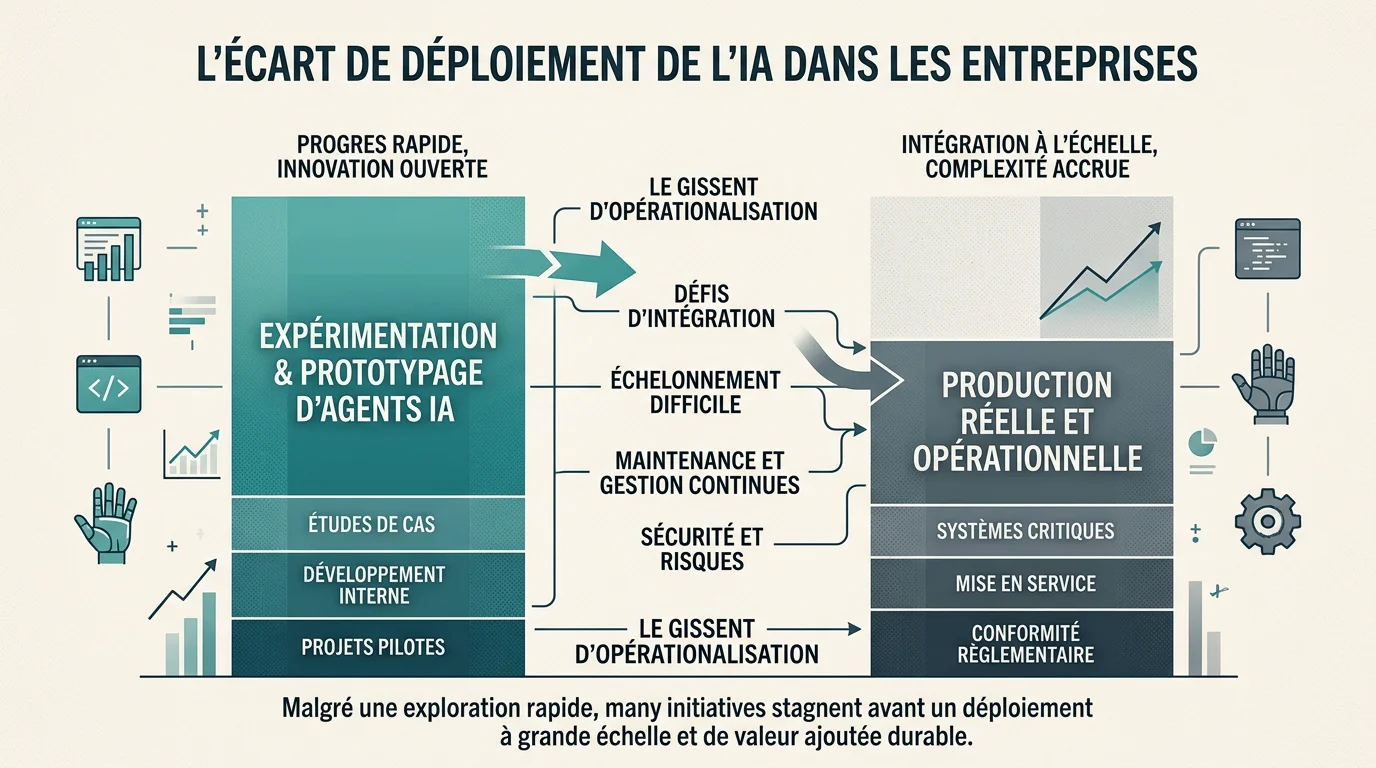
This is the most critical point to understand before making any investment. The adoption of AI agents is skyrocketing, but the value created remains highly concentrated. According to the Bpifrance report published in March 2026, 47% of French SMEs have launched at least one AI project, a figure that rises to 95% for companies with over 200 employees.
Yet, experimentation does not mean production. The same analysis shows that while 62% of companies are testing agents, only 23% have deployed them at scale in at least one business function. The gap is also widening in terms of value: a 2026 PwC study states that 74% of the economic value generated by AI is captured by just 20% of companies—a ratio that has remained unchanged for a year.
The difference does not lie in the technology. High-performing organizations redesign their workflows around AI instead of adding AI to existing processes. This is exactly the discipline we prioritize in our AI adoption methodology for businesses, focusing on results rather than proof-of-concept hype.
How to Deploy an AI Agent: The Methodology
Creating a reliable agent is a matter of software engineering, not prompt hacking. Four key steps structure a solid deployment.
- Define the use case. Choose a limited scope with high impact and a measurable result. Customer service or operational productivity often offer the shortest payback periods.
- Choose the architecture. A no-code tool quickly validates a simple use case. However, as soon as a workflow interruption has a financial impact, a custom, governed, and traceable architecture becomes essential.
- Integrate with business tools. The agent must be treated as a delegate acting on behalf of the user, with exactly the same permissions—no more, no less.
- Measure continuously. Action success rate, human escalation rate, cost per task: without this observability, it is impossible to guarantee long-term quality.
This integration requirement is why successful projects rely on a combination of technical and functional expertise. Our teams design custom software tailored to real workflows, with a dedicated contact, while you retain full ownership of the delivered code and data.
Security, GDPR, and Compliance: Key Watchpoints
The security of an agent does not depend on the quality of its model, but on the rigor of the surrounding architecture. The agent must be treated as a high-risk user: minimal permissions, access to governed tools, and logging of every action to enable a full audit.
The European regulatory framework is tightening. According to figures compiled for 2026, the EU AI Act comes into full effect on August 2, 2026, for high-risk systems, with fines of up to €35 million. The AI Act does not replace GDPR: the two frameworks work together, one protecting personal data, the other regulating the functioning and risk level of AI systems.
Three safeguards remain essential: fine-grained permission management, human validation for any critical or irreversible action, and end-to-end traceability. For organizations subject to these requirements, European data hosting and auditable logs are not optional, but a prerequisite.
Which Approach to Choose Based on Your Maturity?
Not all solutions offer the same level of governance or control over your data. The table below compares three major options for enterprise deployment.
| Criterion | No-code platform | Generalist vendor | SapAngel Support |
|---|---|---|---|
| Agent autonomy | Simple workflows | Standardized | Customized, adapted to real workflows |
| Code & data ownership | Partial | Vendor lock-in | 100% proprietary |
| Hosting | Variable | Often outside the EU | Europe, GDPR compliant |
| ERP Integration | Limited | Standard connectors | Expertise in SAP and Dynamics 365 |
| Support | Self-service | Generic support | Dedicated expert business contact |
For an SME or mid-sized business where an ERP project is critical, the key question is not just implementation speed, but long-term governance and traceability. A pragmatic, ROI-oriented approach delivered at a fixed price is a more secure path to scaling than a simple proof of concept.
Conclusion
The year 2026 confirms an undeniable fact: adopting an enterprise AI agent has become accessible, but deriving measurable value remains the exception. Remember, barely 23% of organizations leverage their agents at scale, and 74% of the value is concentrated within a minority. The difference is not about the tool, but the methodology: defined use cases, careful integration, governance, and continuous measurement. Start small with a high-impact process, then scale. With our dual technological and functional expertise, European hosting, and a dedicated contact, we turn these requirements into concrete results. To plan your project with confidence, discover our AI adoption services and secure every step.
Frequently Asked Questions
Can an AI agent replace an employee?
No. The agent handles repetitive, low-value tasks, but strategic decisions and sensitive situations remain human responsibilities. It acts as a support system, requiring human validation for critical actions.
How long does it take to deploy an AI agent?
A prototype can be validated in a few weeks, but a reliable production deployment requires more rigor. Our custom software is delivered in three months at a fixed price, with full ownership of the code and data remaining yours.
Is an AI agent GDPR compliant?
It can be, provided compliance is built-in by design: hosting in Europe, minimal permissions, auditable logging, and human validation. The AI Act adds further obligations depending on the system's risk level, alongside GDPR.