


The real risk in 2026 is no longer adopting AI too quickly, but deploying it without a clear methodology. While most companies already use it, the majority struggle to translate this usage into concrete gains. Understanding the drivers of a successful AI adoption in business has become a matter of competitiveness, not just technological curiosity.
The gap is widening between organizations capturing value and those falling behind. According to the Stanford AI Index 2026 report, 72% of organizations report using generative AI in at least one business function, compared to 33% in 2024. Generative AI in business is no longer an isolated experiment: it is becoming a permanent fixture in processes, provided it is properly structured and scaled with rigor.
Where does adoption stand in 2026?

When we talk about generative AI in business, we refer to the suite of tools capable of producing text, code, images, or analysis from natural language prompts. Their expansion has been meteoric. By 2025, 53% of the global population had already used a generative AI tool, just three years after the launch of ChatGPT.
On the corporate side, the trajectory is clear. Professional usage has become structured: according to a BDM survey conducted in 2026 among 807 digital professionals, 56.6% of respondents use AI daily in their workflows. Employer hesitation is also declining, falling from 10.3% in 2024 to 8.4% in 2026. The central question is no longer whether you should adopt these technologies, but how to govern their use.
Concrete Use Cases by Department
Generative AI does not transform every job function in the same way. It primarily impacts departments that process information. Here are the use cases generating the most value today:
- Customer service and support: automated responses, 24/7 virtual assistants, and personalized interactions.
- Marketing and communication: content generation and optimization, real-time customer feedback analysis.
- Sales: personalized outreach and customer follow-ups, freeing up time for building relationships.
- Finance and back-office: automation of quotes, invoices, payment reminders, and approvals.
- Software development: code generation and accelerated production cycles.
The most reliable gains are often hidden behind the scenes. It is precisely on these repetitive tasks that return on investment is achieved. To make these flows more reliable, we design business process automation with AI tailored to your actual workflows, rather than generic solutions disconnected from your reality.
The Maturity Paradox: Massive Adoption, Uneven Value
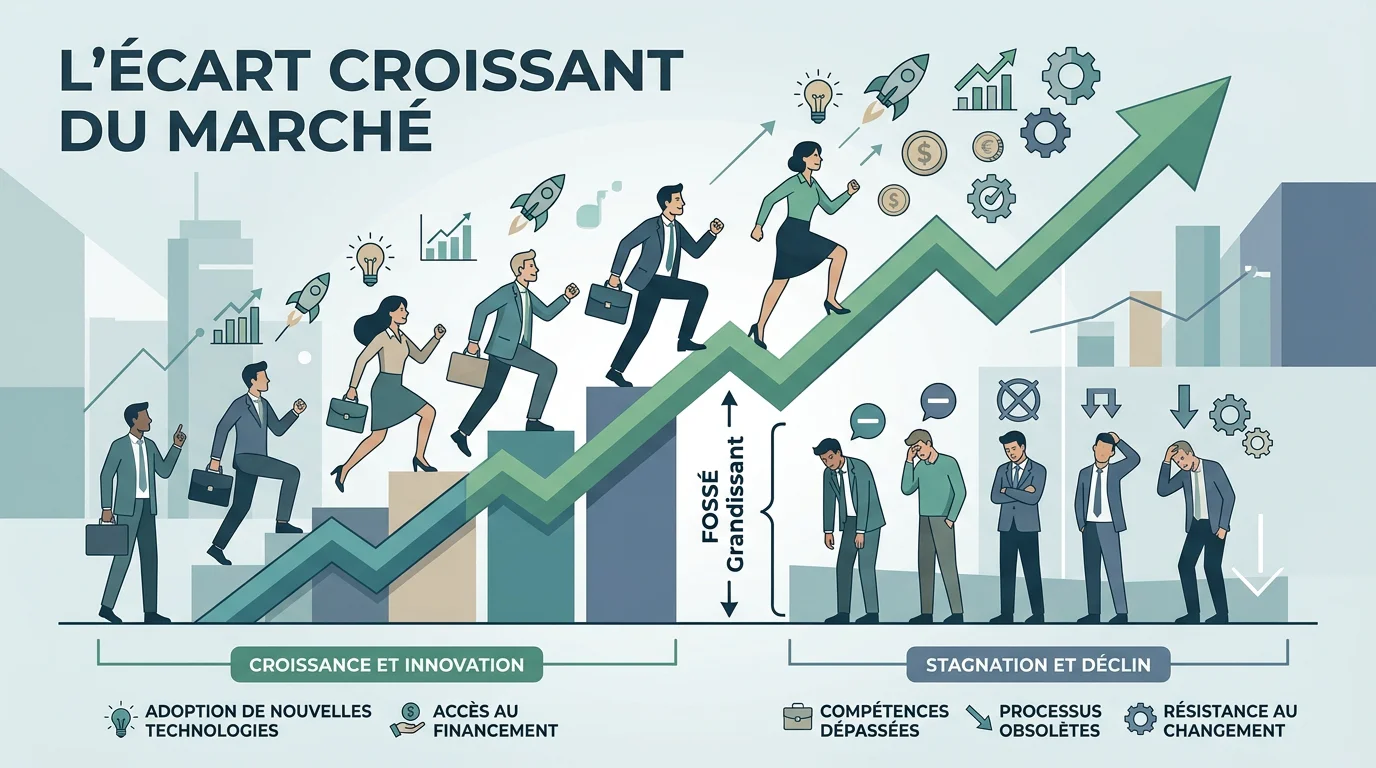
Here is the paradox defining 2026: everyone is using AI, but almost no one is extracting its full value. The concentration of benefits is spectacular. According to the PwC AI Performance Study 2026 referenced by Stanford, 74% of the economic value generated by AI is captured by just 20% of companies.
A study of 12,000 European companies cited in the Stanford report shows that AI boosts labor productivity by an average of 4%. However, this effect only materializes when deployment is accompanied by training. Without proper support, the tool remains underutilized. Three bottlenecks systematically recur: unsuitable data architectures, a lack of internal skills, and the absence of clear governance.
The lesson is simple: technology alone is not enough. Success depends on integration with existing systems, data quality, and human guidance.
Risks, Governance, and Compliance
Enthusiasm should not overshadow the risks. Data security and privacy are top concerns, as generative models require vast sources of information to function. Potential biases, intellectual property issues, and human oversight—indispensable before any final decision—add to the challenges.
The regulatory framework is tightening. According to compiled data on AI in France, the EU AI Act enters into full application on August 2, 2026, for high-risk systems, with fines of up to 35 million euros. GDPR compliance is therefore no longer optional. This is why we prioritize European hosting, encryption, and auditable logs. The table below compares a generic approach to a managed, custom solution:
| Criteria | Public AI Tools | Custom Software (Us) |
|---|---|---|
| Workflow Customization | Limited | Tailored to your specific needs |
| Hosting & GDPR | Variable | European hosting, GDPR compliant |
| Code and Data Ownership | No | 100% proprietary |
| Timeline & Cost | Unpredictable | 3-month delivery, fixed price |
A Market Accelerating Rapidly
Investments confirm this deep-rooted trend. Global enterprise AI spending reached $581.7 billion in 2025, representing a sharp year-over-year increase. The momentum continues to be driven by generative AI, which has become the primary method for deploying artificial intelligence.
The projections are striking. According to AI market figures, the global market revenue could exceed $500 billion by 2028, four times more than in 2023. For both SMEs and large enterprises, the cost of inaction is starting to outweigh the cost of controlled experimentation.
How to Succeed in Your Deployment
Moving from pilot to scale requires a structured methodology. Start by identifying high-impact, easy-to-measure use cases, rather than flashy but vague projects. Secure your data early on, train your teams, and appoint internal champions to spread best practices.
Generative AI can also be integrated into the heart of your management systems. A well-designed AI in the ERP automates data entry, secures data accuracy, and frees up your teams from time-consuming tasks. The key remains adoption support: a dedicated champion who understands your business turns a tool into a sustainable advantage.
Frequently Asked Questions
What is the difference between generative AI and predictive AI?
Generative AI creates new content (text, code, images) based on what it has learned. Predictive AI, on the other hand, relies on historical data to forecast future events or outcomes.
Is generative AI suitable for SMEs?
Yes, provided you target concrete use cases and secure your data. Our custom software, delivered in 3 months at a fixed price, allows SMEs and mid-market companies to automate repetitive tasks without depending on generic tools.
How to ensure GDPR compliance?
Prioritize European hosting, data encryption, and auditable logs. With the EU AI Act coming into full effect in August 2026, clear usage governance is now essential.
The key takeaway: in 2026, 74% of the value generated by AI is captured by a minority of businesses. The gap does not stem from technology itself, but from methodology, data quality, and human guidance. Adopting generative AI without a strategy is akin to investing without measuring. Conversely, a pragmatic, ROI-driven, and compliance-conscious approach turns these tools into a sustainable growth engine. This is exactly where our dual expertise—both technological and functional—makes a difference, securing every step of your project. To go further, discover how to make your workflows more reliable with our process automation with AI.