

Your teams are already using ChatGPT, Copilot, or Claude, often without any framework or approval. This shadow adoption exposes your organization to data leaks, erroneous decisions, and real regulatory risks. Governing these practices is no longer optional: it is a matter of corporate governance. To go further, discover our AI adoption support for organizations.
A company AI policy transforms oral best practices into written and enforceable guidelines. It specifies authorized tools, data that must not be inputted, and sanctions for non-compliance. According to the KPMG study of 356 French decision-makers in 2026, 86% of large companies have already adopted a responsible AI usage policy, sponsored by executive management. The trend is clear, but SMEs and mid-caps are still lagging behind.
Why an AI Usage Policy Is Essential in 2026

The phenomenon has a name: shadow AI. Your employees are adopting generative AI tools without informing their management. According to a Fidens analysis, in 2026, 68% of employees use these tools at work without formal approval. Every unmonitored prompt can contain customer data, proprietary code, or strategic information.
The consequences are real. An employee pasting a confidential agreement into a consumer assistant exposes the company to a GDPR breach and reputational damage. An AI policy provides a structured response to this disorder. It states what is allowed, what is forbidden, and how to proceed, while giving the company an analytical instrument for compliance and proof in the event of an audit.
The policy is also a sign of maturity. In 2025, a majority of B2B tenders already required documented AI governance. To manage these practices methodically, our IT consulting to frame AI helps align rules, tools, and business processes.
What the Regulatory Framework Says
No text explicitly makes an AI policy mandatory. However, three regulations make it necessary in practice. The European AI Act has imposed an AI literacy obligation on staff since February 2025 (Article 4). The GDPR requires "appropriate technical and organizational measures" (Article 32). The NIS2 Directive mandates documented digital risk governance.
The timeline is tightening. According to Leto, the full application of the AI Act will take effect on August 2, 2026, with reinforced obligations for high-risk systems such as recruitment or credit scoring. Sanctions can reach up to €35 million or 7% of global turnover for prohibited practices, and €15 million or 3% for non-compliant high-risk systems.
Regarding data protection, the CNIL has published a series of practical guides to develop and use AI in compliance with the GDPR. It reminds organizations that a Data Protection Impact Assessment (DPIA) is required whenever a use case presents high risks, particularly when processing sensitive data. The policy translates these requirements into readable daily guidelines for business teams.
The Eight Essential Components of an AI Policy
An effective policy is not a thirty-page legal document. It is a practical three to five-page guide, read and understood by everyone. Eight components are essential:
- Scope and audience: employees, freelancers, interns, and subcontractors accessing the information system.
- List of authorized and prohibited tools: a specific list, not a vague phrase about "fair use".
- Classification of allowable input data: what can and cannot be entered into an AI tool.
- Usage rules by business profile: sales, developers, and HR do not share the same risk levels.
- Output verification obligations: human review for any client deliverable or binding numbers.
- Incident reporting procedure: who to notify, within what timeframe, and using which form.
- Graduated sanctions: from formal warnings to termination for gross misconduct.
- Review and update process: at least once a year, ideally quarterly.
Write the policy in plain language and illustrate each rule with practical examples. A policy co-created with business teams is successfully applied; a top-down mandate remains a dead letter. To anchor these rules in your real workflows, our business process automation with AI integrates safeguards directly into everyday tools.
Classifying Data: The Green, Orange, Red Model
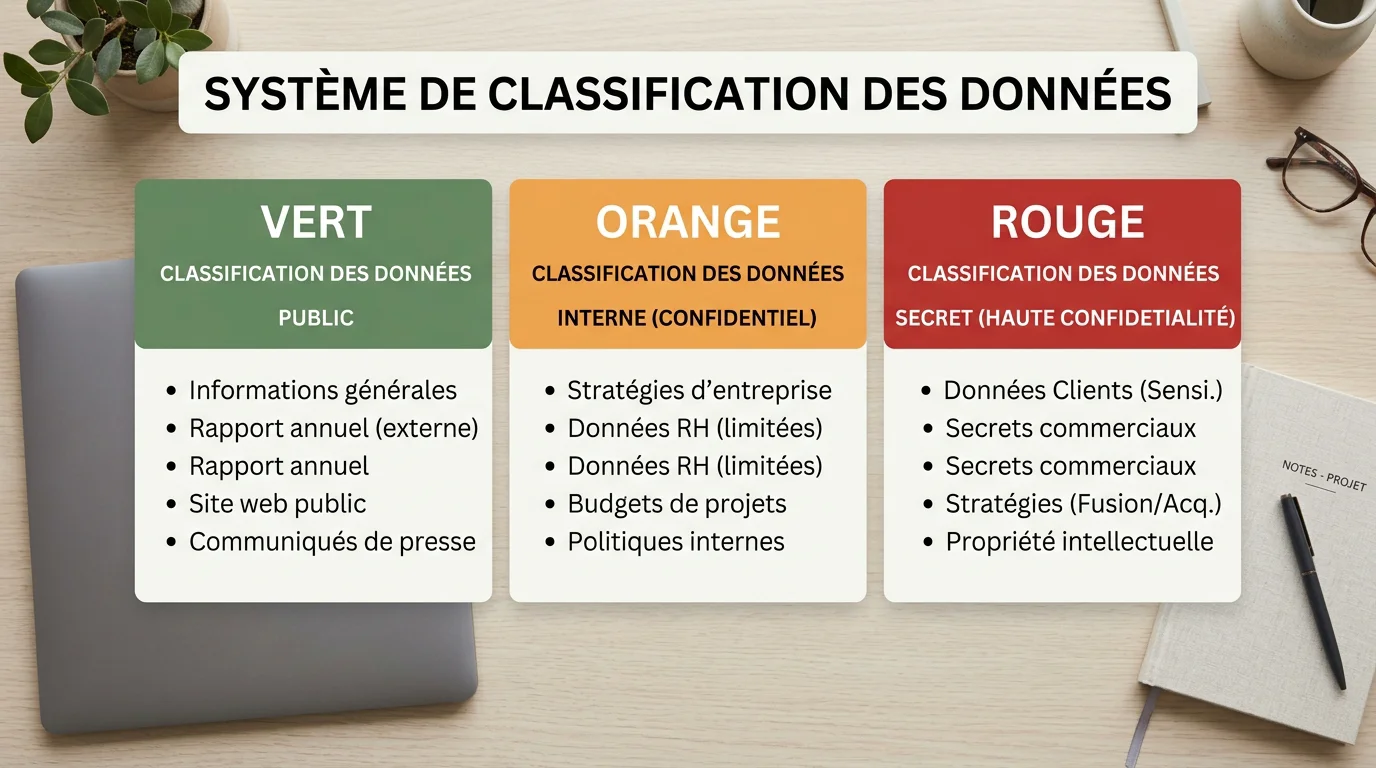
Data classification is the operational heart of the policy. The three-tier model is the most widely used in practice. It gives every employee a simple reflex before entering information.
- Green: public data, with no usage restrictions.
- Orange: non-sensitive internal data, authorized only on the company's official AI tools.
- Red: personal, financial, strategic data or proprietary code, the input of which is prohibited or restricted to a sovereign platform.
This framework assumes that official tools actually exist, with a signed Data Processing Agreement (DPA) from the publisher. A policy that bans personal accounts without offering a validated alternative drives usage underground. Security therefore depends on infrastructure as much as on regulations: European hosting, encryption, and auditable logs are key prerequisites for GDPR compliance.
Rolling Out and Sustaining the Policy
A policy is only as good as its implementation. The standard timeframe is four to six weeks for an SME and two to three months for a mid-market company. The process follows a clear logic: map actual usage, involve IT, legal, HR, and business lines, draft, obtain signatures, and then train. Individual signatures make the document legally binding; annexing it to the internal rules, after consulting the CSE, reinforces its authority.
The remaining task is choosing the right implementation approach. Here are three commonly considered options.
| Criterion | Copied Generic Policy | Law Firm | SapAngel Support |
|---|---|---|---|
| Adaptation to real processes | Low | Variable | Tailored, aligned with your workflows |
| Technical integration of safeguards | None | Limited | Automation and integrated tools |
| Ownership of code and data | N/A | N/A | 100% proprietary, European hosting |
| Ongoing monitoring and support | None | Ad hoc | Dedicated contact person, continuous support |
Beyond the document, governance must designate an AI champion and a steering committee. This is where our IT management of AI initiatives brings lasting value: a single point of contact who aligns the policy, the deployed tools, and business objectives, using a pragmatic and ROI-driven approach.
Common Mistakes to Avoid
The first mistake is to copy-paste a generic policy without analyzing internal usage. The document becomes inapplicable and loses all credibility. The second is writing an overly legalistic text that users don't understand. The third is ignoring freelancers and contractors, leaving a significant portion of the information system unmanaged.
Other common pitfalls include neglecting staff training, omitting sanctions entirely, and above all, leaving the policy static. Generative AI evolves every month; a document written in 2024 and never reviewed overlooks autonomous agents, hidden AI features in SaaS tools, and the latest regulatory requirements. Regular updates are non-negotiable.
Conclusion
Implementing an AI usage policy is not an administrative formality, but a strategic initiative that protects your organization and unleashes the productive use of AI. The most telling reminder is this figure: in 2026, 86% of large French companies have already adopted a policy, while most SMEs and mid-caps are still in the experimentation phase. Start by mapping your usage, classify your data, and write a short, clear, and co-created document. At SapAngel, our human-centric and ROI-driven approach transforms this regulatory constraint into a driver of trust and sustainable performance. To get a precise assessment of your usage and risks, try our digital performance audit.
Frequently Asked Questions
Is an AI policy mandatory for companies?
No text strictly mandates it. However, the AI Act, the GDPR, and the NIS2 Directive require you to document your AI governance, and a policy is the most effective tool to do so. Without one, a company is in implicit non-compliance.
How long does it take to roll out an AI policy?
Expect four to six weeks for an SME and two to three months for a mid-market company. The timeframe mostly depends on mapping usage and consulting stakeholders. Our IT management of AI initiatives helps accelerate and secure this process.
How long is an AI policy valid for?
An AI policy must be reviewed at least once a year, and ideally every quarter. Generative AI and its legal framework are evolving rapidly: a static document becomes obsolete in a few months and loses its legal standing.