


One in four companies in France now uses AI daily, but many still struggle to transition from experimentation to scale. Successfully integrating AI into your business isn't just about buying software: it is a transformation project that impacts your data, processes, and teams. To secure this approach without hiring a full technical team, many rely on our part-time CIO.
The gap is widening between organizations that structure their approach and those that remain on the sidelines. The global market confirms this acceleration: it was valued at 244 billion dollars in 2025, growing by 32% year-on-year. Understanding the steps, use cases, and pitfalls has therefore become a strategic priority for any leadership team.
Why AI Integration Has Become Essential
The question is no longer whether to adopt AI, but how to do so without losing focus. True business AI integration targets three concrete goals: freeing up time spent on repetitive tasks, making decision-making more reliable through data, and personalizing the customer relationship.
The benefits are measurable. Automation reduces data entry errors and accelerates the processing of invoices, quotes, or payment reminders. Predictive analysis anticipates demand and optimizes stock levels. Conversational assistants respond to customers 24/7. These gains explain why AI is now considered a pillar of digital transformation, on par with cybersecurity in most executive committees.

Where Businesses Really Stand in 2026
The landscape is contrasted. According to figures compiled from the Stanford AI Index 2026, 44% of French companies use at least one AI tool and 31% integrate it into their marketing strategy. However, a striking gap persists between individual employee usage and structured industrialization by organizations.
Among SMEs, the acceleration is clear. According to the Bpifrance 2026 report, 47% of French SMEs—nearly 300,000 businesses—have launched at least one AI project, a figure that rises to 95% for companies with over 200 employees. Size is no longer the determining factor: strategic discipline and clear objectives are.
This finding aligns with on-the-ground reality: many organizations have the tools but struggle to integrate them into daily operations. To dive deeper into this topic, we have detailed the key levers in our analysis of AI adoption in business.
Key Steps for a Successful Integration Project
An AI project is managed like any structural initiative: in phases, with measurable objectives. Here is the sequence we recommend.
- Needs scoping: Map out your repetitive and costly processes (support, sales, HR, finance) and identify bottlenecks.
- Maturity assessment: Evaluate the quality of your data, the state of your information systems, and your teams' readiness.
- Use case prioritization: Select two to three cases directly linked to performance (cost, productivity, customer satisfaction).
- Pilot projects: Test on a small scale to validate value before any large-scale deployment.
- Training and change management: Without upskilling, the tool will remain underutilized.
- Gradual deployment and governance: Scale up, secure data, and implement human-in-the-loop validation.
This step-by-step approach reduces the risk of project drift. This is especially critical given that ERP projects frequently exceed their timelines and budgets—a pitfall that initial scoping largely helps to avoid.
Concrete Use Cases by Business Function
AI finds operational applications in almost every business function. Here are some representative examples:
- Finance and administration: Automated scanning and entry of invoices, quote generation, accounting anomaly detection.
- Customer service: Chatbots capable of understanding natural language and handling requests 24/7.
- Marketing and sales: Message personalization, predictive campaign analysis, assisted sales proposals.
- Supply chain: Demand forecasting, inventory optimization, and predictive equipment maintenance.
- Human resources: Candidate screening and personalized training paths.
These use cases share a common denominator: they free teams from low-value-added tasks. The key lies in connecting these intelligent building blocks to your actual workflows, a topic we explore deeply in our expertise on business process automation.
Connecting AI to Your ERP: The Real Game-Changer
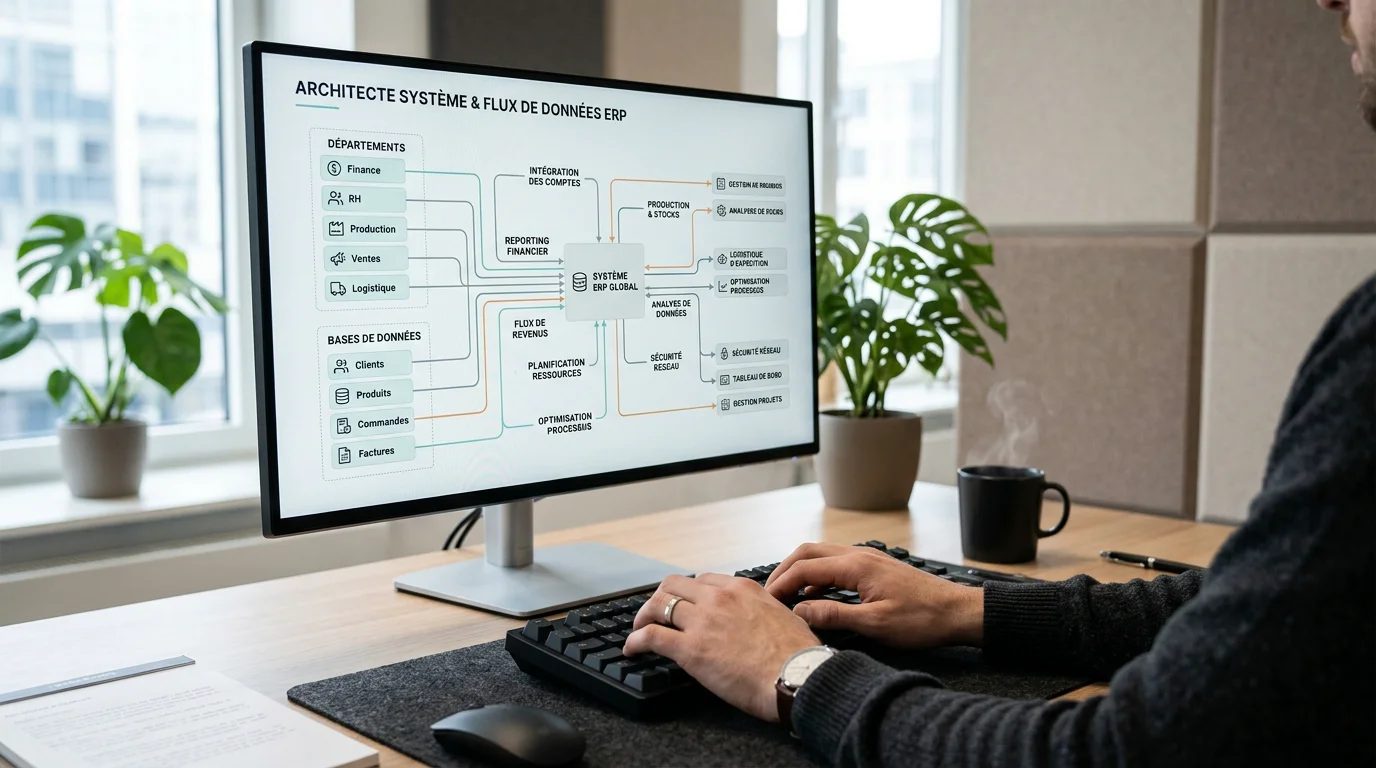
An isolated chatbot delivers limited value. The true ROI explodes when AI interacts with your core systems (ERP, CRM, management suites). Indeed, the Bpifrance report notes that 70% of SMEs started with an existing software solution rather than a custom project—a strategy that accelerates time-to-value.
Integrating AI into a SAP or Microsoft Dynamics 365 environment requires a dual expertise: both technological and functional. You must understand business processes just as much as data architecture. This is precisely where the difference lies between a promising pilot and a sustainable long-term deployment, with code and data that you remain fully in ownership of.
Challenges to Anticipate
Three obstacles systematically arise, and none of them are purely technical.
Data quality. An AI is only as good as its data. Auditing, cleaning, and governing your data is crucial to the success of any solution.
Security and compliance. Personal data protection, hosting, encryption, access traceability: these requirements must be designed from the ground up. In Europe, compliance with GDPR and the AI Act is non-negotiable.
The human factor. Fear of job loss and lack of training hinder adoption. Clear change management, supported by advocate managers, turns anxiety into buy-in. Technology alone is never enough.
Measuring the ROI of Your Integration
Managing without indicators is like flying blind. Define your KPIs from the launch: time saved on automated processes, automation rate, error reduction, employee adoption rate, and return on investment.
The results follow when the approach is structured. According to figures compiled from BPI France Le Lab, 91% of equipped companies report a positive impact on their revenue. The global acceleration is spectacular: McKinsey records 65% regular adoption of generative AI in 2026, compared to 33% in 2024—a doubling in twenty-four months.
However, note that ROI is concentrated in well-structured organizations, not the bulk of the market. A dashboard tracked over time, combined with clear governance, makes all the difference between a profitable investment and an incurred expense.
Comparison of Integration Approaches
| Approach | Code & Data Ownership | Workflow Adaptability | Support & Guidance |
|---|---|---|---|
| Our services (SapAngel) | 100% proprietary | Custom-built, delivered at a flat rate | Dedicated, continuous advisor |
| Generic SaaS vendor | Vendor and license lock-in | Standardized | Shared support |
| No-code/low-code tools | Varies by platform | Limited to templates provided | Self-service |
Each approach has its place depending on your maturity. For a critical project connected to your ERP, custom support sustainably secures the process.
Conclusion
Successfully integrating AI into your business no longer depends on your size or sector, but on your methodology. The numbers speak for themselves: with 91% of equipped companies seeing a positive impact on their revenue, inaction has become the real risk. Start small, measure, and then scale what works. Prioritize data quality, security, and team training just as much as the technology. Our strength lies in combining dual technical and functional expertise to deliver solutions that you fully control. To turn your ambitions into concrete results, discover our services to integrate AI with your SAP ERP system and secure your project today.
Frequently Asked Questions
How long does it take to integrate AI into a business?
A pilot project can deliver its first results in just a few weeks. A structured deployment connected to your core business systems is generally built in phases over several months, depending on complexity.
Do you need an in-house technical team to get started?
Not necessarily. Many SMEs lack in-house IT resources. A part-time CIO like ours allows you to scope and manage the project without hiring a full team.
Is AI reserved for large enterprises only?
No. In 2026, 47% of French SMEs have already launched at least one AI project. Accessible tools and targeted solutions make the technology relevant right from the initial stages of digital transformation.