


Companies are investing heavily in digital tools, but a clear-eyed look quickly reveals an uncomfortable truth: not everything can be digitalized. Before multiplying channels and automations, a digital performance audit helps measure what technology actually brings to the table—and what it degrades along the way. After all, a customer poorly served by a robot is still a lost customer.
Understanding the limits of digitalizing customer relations means admitting that automation can never fully replace the human connection. According to the Customer Service Observatory reported by Les Clés du Digital, satisfaction with chatbots is stagnating at 51%—a warning sign that should alert any organization tempted to delegate everything to machines.
What Technology Will Never Replace: The Human Connection

The first limit is human. A tool processes a request; it does not reassure an anxious customer. When dealing with a sensitive dispute, an emotional complaint, or a major purchase decision, human contact remains irreplaceable. The dehumanization of customer relations is the number one risk of poorly calibrated digitalization.
The paradox is real: the more a company automates, the more valuable every single human interaction becomes. The goal is therefore not to replace the advisor, but to free them from repetitive tasks so they can focus on listening and advising. This is precisely what is at stake in our approach to process automation: freeing up human time, not eliminating it.
A word of caution, however: automating a broken relationship only accelerates dissatisfaction. A bad digitalized process is still a bad process, just faster.
Chatbots and AI: How Far Can Automation Go?
Artificial intelligence has become a staple for customer-facing teams. According to a Salesforce study, 69% of customer service professionals say they use at least one form of AI, and some projections suggest a majority of interactions will be managed end-to-end by agentic AI by 2028. Yet massive adoption does not guarantee satisfaction.
Conversational tools excel at simple and recurring requests: order tracking, product availability, frequently asked questions. However, they fall short the moment a request becomes complex, ambiguous, or emotional. A chatbot caught in an infinite loop generates more frustration than a lack of response.
Moreover, trust remains fragile. Around half of consumers still feel uncomfortable with a fully autonomous purchase driven by AI. Technology must therefore remain bounded, transparent, and supervised. To avoid pitfalls, it is best to define each use case beforehand, as we detail in our post on AI adoption in business.
The golden rule: reserve AI for stable, high-volume user journeys, and hand exceptions over to humans. AI is cost-effective for repetition, never for unique cases.
Cost, Complexity, and Silos: Operational Limits
Digitalization is expensive, and often more so than expected. Large-scale projects frequently run over: in the ERP sector, around 42% of projects run late, and 23% to 45% blow past their budget. These figures illustrate a major limitation: poorly managed technology quickly becomes a money pit.
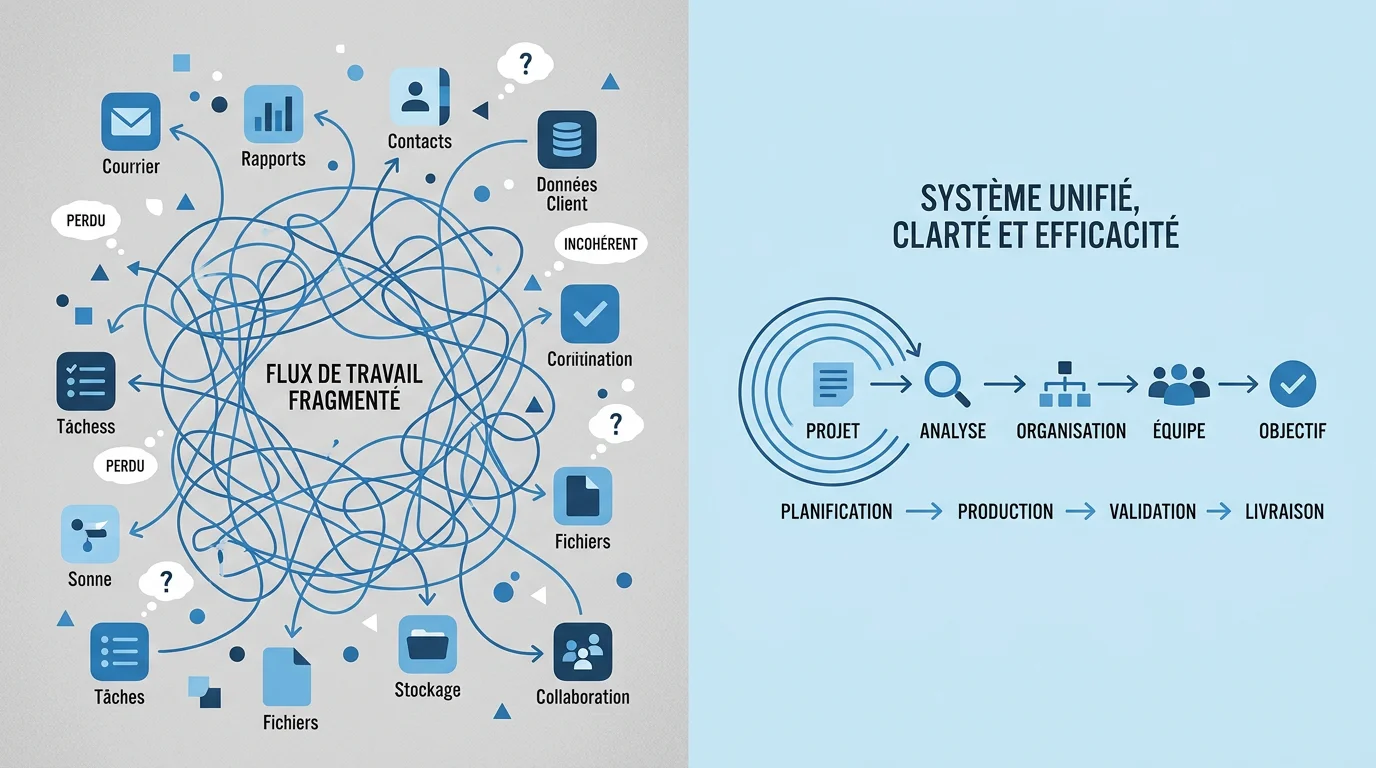
The second pitfall is tool silos. Piling on a CRM, a chatbot, a messaging tool, and three spreadsheets does not create a seamless customer relationship. Without integration, each channel works in isolation, the customer has to repeat their issue, and the experience deteriorates. Scattered data holds no value.
Lastly, off-the-shelf software often imposes its own logic, which is rarely aligned with your actual workflows. This is why we systematically compare options in our analysis of custom ERP vs. off-the-shelf ERP, to help you avoid vendor lock-in and heavy licensing fees.
Personal Data and GDPR: The Boundary of Trust
Digitalizing means collecting, storing, and leveraging more and more personal data. This material is valuable, but it is also a breaking point. One in two SMEs fears data loss or hacking—a concern that grows year after year.
Compliance with GDPR is not a peripheral administrative burden: it is a prerequisite for trust. A company that is transparent about how it uses customer data builds a sustainable competitive advantage. Conversely, a leak or misuse ruins years of relationship-building in just a few hours.
Security must therefore be designed in from the start, never as an afterthought. European hosting, encryption, access controls, and auditable logs: these safeguards are part of our core philosophy, because digital customer relations without security is just one more vulnerability.
Finding the Right Balance Between Digital and Human
The right question is not "should we digitalize?" but "what should we digitalize, and how far?" The benefits are real: according to an Ipsos study, 41% of French companies saw their revenue grow after their digital transformation. But these gains never happen by magic: they require rigorous planning.
The winning approach is hybrid: digital tools handle simple and repetitive tasks, while humans retain control over complex and emotional interactions. Here is how the three main options compare.
| Approach | Availability | Personalization | Cost Control | Business Fit |
|---|---|---|---|---|
| Fully Automated (AI, chatbots only) | 24/7 | Low | Good in the short term | Rigid |
| Fully Human (without tools) | Limited hours | High | Expensive at scale | Variable |
| Managed Hybrid Approach (SapAngel) | 24/7 + human escalation | High and targeted | Optimized and predictable | Customized |
In practical terms, we automate quotes, invoices, and follow-ups to free up hours every week, while reserving your teams for high-value interactions. A dedicated point of contact ensures continuity, and software tailored to your actual processes replaces silos with a unified customer view.
Conclusion
The limits of digitalizing customer relations are not reasons to give up, but points of vigilance. A chatbot satisfaction rate capping at 51% highlights an obvious fact: technology serves the relationship; it does not replace it. Dehumanization, hidden costs, silos, and data risks threaten any initiative conducted without a clear method. The answer lies in one word: balance. Automate what should be automated, protect data, and keep humans where they create value. It is this pragmatic, human, and results-oriented approach that transforms digital investment into actual growth. To assess your organization and prioritize your projects, test our simulator in just a few minutes.
Frequently Asked Questions
What are the main risks of poorly managed digitalization?
The major risks include the dehumanization of interactions, disproportionate costs, poorly coordinated channels, and neglected data security. Methodical management and dedicated support can help you avoid them.
Can AI completely replace a human customer service department?
No. AI efficiently handles simple, high-volume requests, but fails with complex or emotional cases. Furthermore, about half of consumers remain suspicious of total automation.
How can we reconcile automation with GDPR compliance?
By integrating security by design: European hosting, encryption, and auditable logs. Our custom solutions are designed to make you 100% owner of your data while fully complying with GDPR.