


Nearly 80% of IT leaders believe that data silos slow down their digital transformation. Yet, many organizations continue to pile up management software year after year. Consolider multiple ERPs into a single system then becomes a strategic decision. However, you still need to know how to choose the best ERP capable of supporting this unification.
This figure comes from Salesforce's 2024 Connectivity Benchmark Report, which also shows that 72% of IT leaders describe their infrastructure as overly interdependent. In other words, the multiplication of tools creates a costly tangle. The question is no longer whether to streamline, but how to do it without disrupting existing operations.
Why So Many Companies End Up with Multiple ERPs
The situation is almost always the same. A company grows, each department adopts its own tool, and the information system fragments. Wanting to replace multiple ERPs with a single one often happens after years of accumulation, when coordination becomes unmanageable.
This phenomenon is by no means accidental. According to IBM, data silos form when teams use their own tools without an integration strategy, trapping information in disparate systems. The consequences are concrete: duplicated data, redundant storage costs, and missed opportunities for cross-functional analysis.
Several warning signs should alert you:
- The same data is re-entered into two or three different software systems.
- Management reports require days of manual reconciliation.
- No one knows which version of a figure is correct.
- Each vendor invoices their own licensing and maintenance fees.
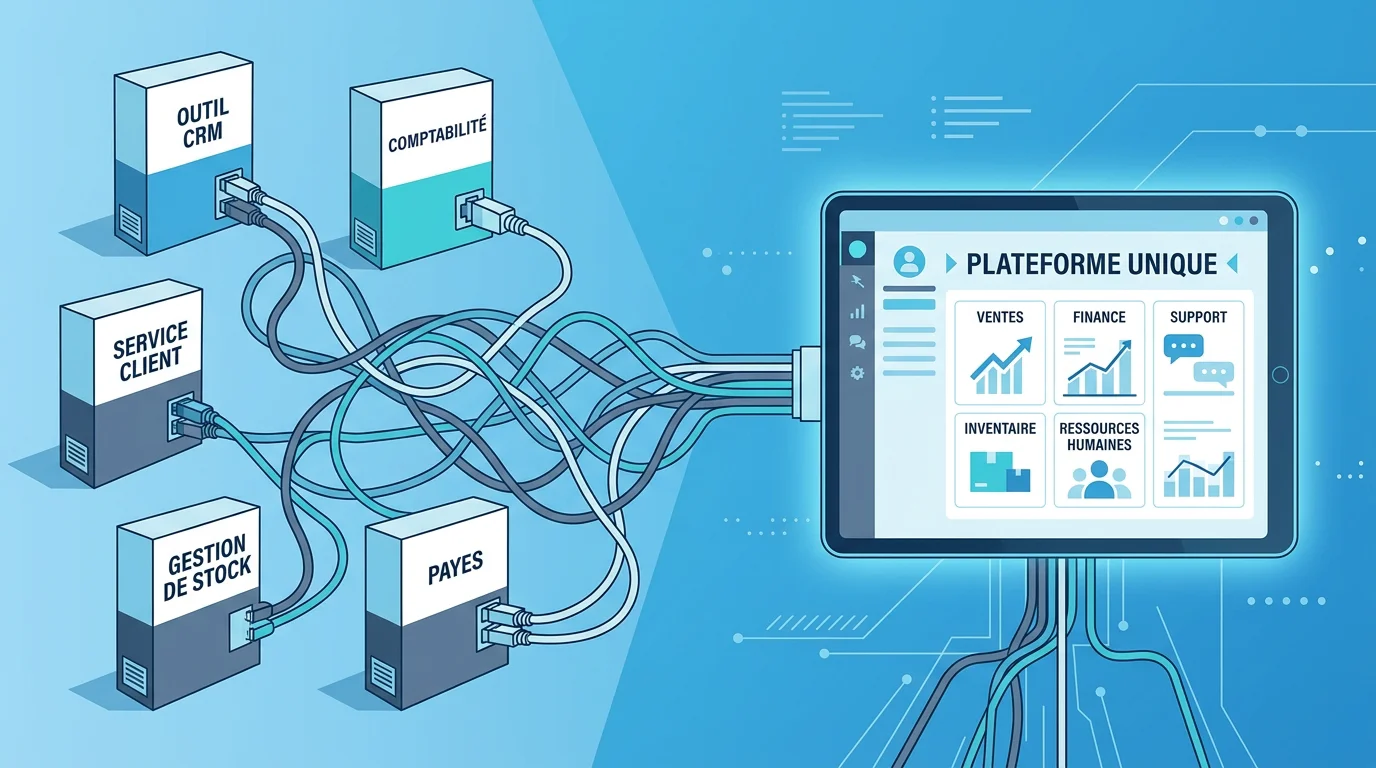
The Hidden Cost of Disconnected Systems
An isolated software works fine. The problem arises from putting them side-by-side. When applications don't talk to each other, teams spend hours manually transferring data and verifying inconsistent records.
These losses remain invisible day-to-day, but they add up. Every missing integration weakens the reliability of figures and slows down decisions. Worse, vendor lock-in and multiple licensing fees drive up the bill without improving the service delivered.
We regularly see this scenario with our clients. That is why our custom software centralizes actual workflows, automates quotes, invoices, and reminders, and eliminates time-consuming re-entry. The goal is simple: let your teams stop reconciling spreadsheets and focus on their core business.
The Concrete Benefits of a Unified System
Consolider means first recovering a single source of truth. A single repository, a single reliable data point, accessible in real time by all relevant departments.
This promise is well documented. According to CIO, the benefit of a unified platform lies in its ability to avoid piling up specialized tools that never quite speak the same language. The most practical advantage is not theoretical: it is an "audit trail," where every key metric connects directly back to its source entries.
The benefits observed after a successful unification are consistent:
- Real-time visibility into operations, margins, and cash flow.
- Automation of repetitive tasks, saving hours every week.
- Instant reporting instead of manual consolidations.
- Enhanced traceability and compliance, featuring auditable logs.
If you are running a growing business, our dedicated guide on ERP for SMEs details how to prioritize these benefits based on your company size.
Successful Migration: A Step-by-Step Methodology
Unifying does not mean tearing everything down at once. A well-managed project follows a clear progression, from scoping to final rollout.
- Define precise goals: profitability, reduction of data entry, compliance.
- Map existing processes, without trying to copy the old system.
- Clean the data before any migration: duplicates, formats, obsolete files.
- Deploy progressively, using a validated pilot phase before the full rollout.
- Measure results using time-savings and reliability metrics.
The human factor remains critical. Change management, training, and user involvement dictate adoption rates. We cover these steps in detail in our resource on implementing an ERP, featuring a dedicated expert who guides your teams throughout the journey.
Off-the-Shelf ERP vs. Custom Unified Solution?
Once the decision is made, two paths open up: adopting a generic off-the-shelf software package, or designing a platform tailored to your specific workflows. Each has its constraints, which we detail in our comparison Custom ERP vs. Off-the-Shelf ERP.

| Criterion | Multiple Juxtaposed ERPs | Single Off-the-Shelf ERP | Custom Unified Solution (Our Approach) |
|---|---|---|---|
| Licensing | Multiple and accumulated | One recurring license | None: 100% code ownership |
| Implementation Timeline | Endless, continuous stacking | Variable, often long | Delivery in 3 months at a fixed price |
| Adaptation to Processes | Partial, silos | Standardized | Aligned with your actual workflows |
| Data & Compliance | Dispersed | Vendor-dependent | Hosted in Europe, GDPR, auditable logs |
An off-the-shelf software package works well when your processes are standard. As soon as you have specific requirements, a custom platform avoids vendor lock-in and gives you complete ownership of your data.
How Long Does It Take and How Much Does It Cost?
ERP project duration has long been the primary obstacle. A study published in 1999 already noted that in 65% of cases, installation lasted more than a year, and often between one and three years. While the complexity hasn't disappeared, methodologies have evolved.
Today, two main drivers reduce these timelines: a tightly scoped project and expert guidance. Rather than aiming for a global transformation overnight, it is better to first address processes with a high impact on cash flow, compliance, or customer service.
On the budget side, a fixed price and rapid deliverables protect against scope creep. This is precisely the model we apply, with integrated AI assistants to generate quotes, analyze data, and ensure continuous support.
Conclusion
Faced with silos that hinder 80% of digital transformations, unifying multiple ERPs into a single system is no longer a luxury, but a key driver of competitiveness. Success comes down to three things: a clear goal, clean data, and human guidance. Choose a realistic scope, measure your gains, and progress step by step rather than taking risky giant leaps. Our strength lies in a dual expertise—technological and functional—driven by a dedicated point of contact who secures every stage of your project. To transform your fragmented system into a reliable platform, discover our ERP implementation support and start the conversation with our experts.
Frequently Asked Questions
How long does it take to unify multiple ERPs?
It depends on the scope. A targeted deployment focused on critical processes can be achieved in a few months. Our custom software solutions are delivered in 3 months at a fixed price.
Is there a risk of losing data during consolidation?
No, provided the data migration is properly prepared. Pre-cleaning duplicates and formatting is the key step to guarantee reliable data from day one.
Should you choose an off-the-shelf ERP or a custom solution?
Off-the-shelf software is suitable for standard processes. For specific needs, a custom solution avoids vendor lock-in and gives you ownership of your code and data.