
In 2025, around 25,000 job offers in Switzerland mentioned artificial intelligence skills, a record high. This surge illustrates a profound shift. AI is no longer just for technical roles; it is transforming the very way we recruit. Understanding AI-powered corporate recruitment is becoming a strategic reflex, just like mastering our corporate AI training program.
The Swiss labor market remains cautious, but employers highly value candidates equipped with AI skills. According to the PwC Switzerland barometer, AI skills are becoming a key recruitment criterion, even if their market share remains moderate. For SMEs, mid-caps, and large corporations, the challenge is twofold: recruiting rare talent and integrating AI into their own HR processes.
Why AI is Becoming Essential in Swiss Recruitment
The Swiss context is unique. The labor market is tight, talent shortages persist, and competition for qualified candidates remains fierce. In this environment, corporate AI recruitment emerges as a powerful tool for efficiency, not as a replacement for recruiters.
The numbers confirm this widespread adoption. According to an analysis by ICTjournal, some 25,000 job postings mentioned AI skills in 2025, roughly 9,000 more than the previous year. This is precisely what corporate AI recruitment in Switzerland is all about: capturing these rare skills while modernizing your own hiring methods.
However, caution remains key. Manpower data reported by La Télé shows a stable net employment outlook of 19% for the third quarter of 2026, which is relatively low. Employers are hiring selectively, but they highly value candidates with AI skills.
Practical Uses of AI in the Recruitment Process

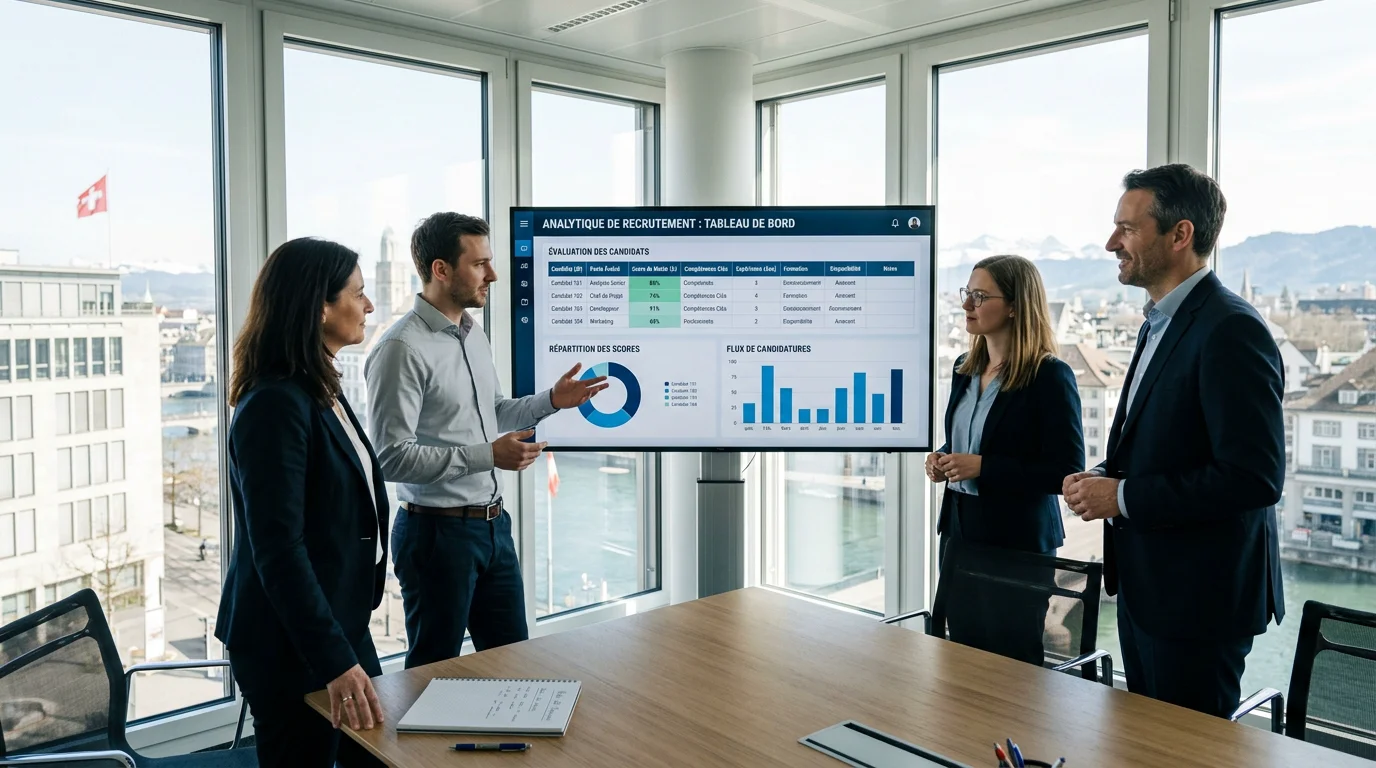
Where does AI actually make an impact in hiring? Mostly at the top of the funnel, where tasks are repetitive and time-consuming. Today’s most mature use cases cover several key stages:
- Automated resume screening and pre-selection based on objective criteria.
- Skills matching between job requirements and the talent pool.
- Prequalification and shortlisting optimization.
- Job description writing assisted by generative AI.
- Automated candidate communication for faster response times.
Generative AI also unlocks new HR use cases, from interview summarization to personalized messaging. These automations free up time spent on low-value-added tasks. To integrate them seamlessly into your existing workflows, our corporate AI agents connect to your qualification and tracking processes. The goal remains simple: respond quickly, accurately, and at the right time.
Measurable Benefits for Swiss Businesses
Faster recruitment and more relevant shortlists translate into concrete gains: shorter time-to-hire, better candidate quality, and an enhanced candidate experience. In a market where employer branding is critical, these improvements make a major difference.
The real bottleneck is not the tool, but the skills. According to a UBS study from May 2026, around 70% of Swiss companies struggle to recruit the talent they need. Internal training is therefore becoming an essential alternative to chasing hard-to-find candidates.
However, adoption is growing. A 2025 study by HEG Geneva and Oracle indicates that 53% of surveyed Swiss companies are already using some form of AI in their operations. Most of these deployments remain tactical rather than strategic. This is where our approach to business AI implementation helps transition from isolated tools to a structured, sustainable HR process.
Legal Framework, Bias, and Data Governance
In Switzerland, compliance is not optional. Candidate data processing falls under the Federal Act on Data Protection (revised FADP), and often the GDPR for companies operating in the European Union. Any AI solution applied to recruitment must integrate these requirements from the ground up.
Three governance challenges stand out: transparency of decision criteria, protection of personal data, and control over algorithmic bias. A poorly calibrated AI can reproduce or amplify discrimination. It is therefore essential to audit models, track decisions, and maintain exploitable logs.
The golden rule remains human oversight. AI prepares and informs, but the final decision belongs to the recruiter. Assessing soft skills, team culture, and long-term potential cannot be delegated to an algorithm.
Integrating AI into Your HR Processes with a Custom Solution
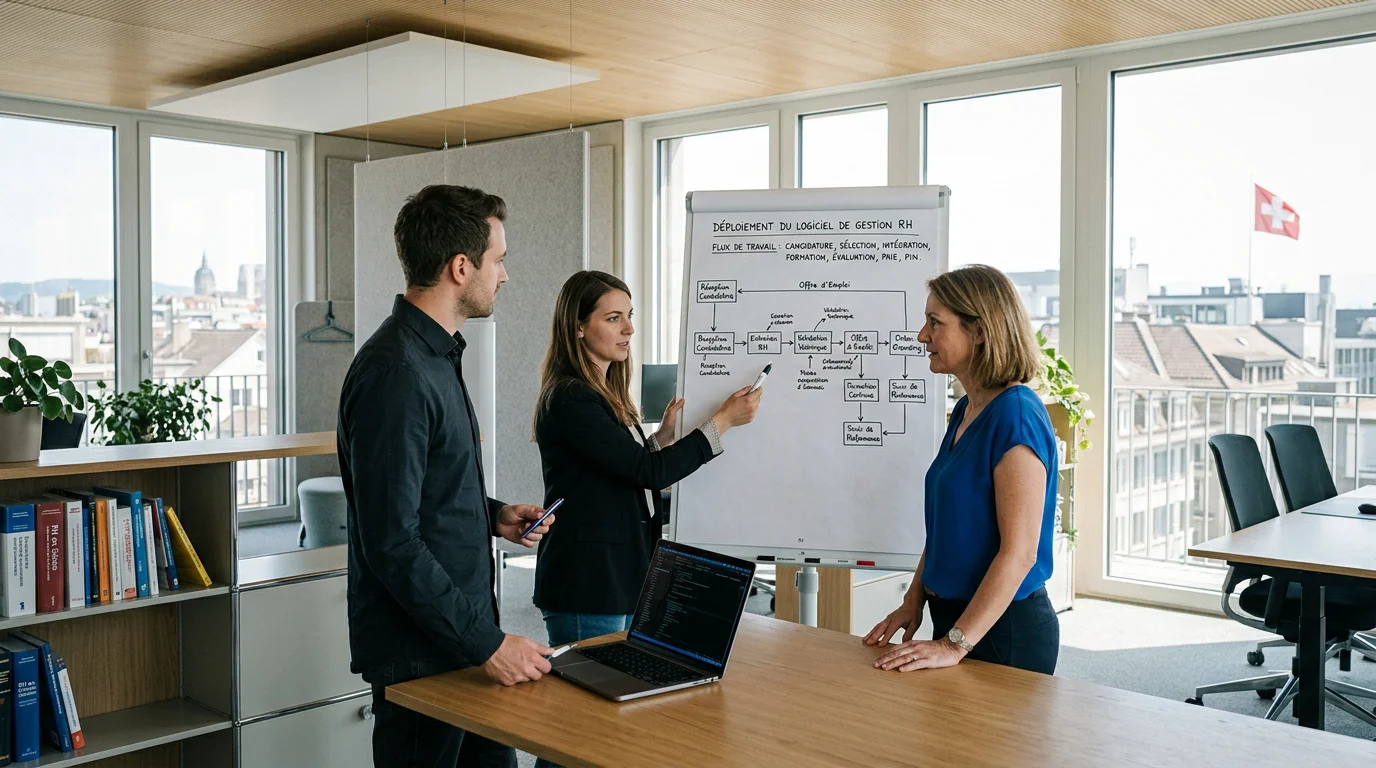
Many AI recruitment tools are generic. They impose their own models, licenses, and vendor lock-in. Yet, every organization has different HR workflows, rules, approvals, and internal systems.
We believe in the exact opposite. A software module designed specifically for your processes is adopted from day one, without unnecessary features. Automating lead qualification, document generation, or reporting should support your teams, not constrain them. With our corporate AI solution, you retain ownership of both the code and the data, with European hosting and GDPR compliance integrated from the scoping phase.
The following table compares the main approaches, based on the criteria we document in our projects.
| Criterion | Generic AI Platform | Our Custom SapAngel Approach |
|---|---|---|
| Customization | Standardized | Tailored, module by module |
| Data and Code Ownership | Vendor license | 100% proprietary |
| Deployment Timeframe | Variable | 3 months at a fixed price (Mind offer) |
| Compliance and Security | Vendor-dependent | European hosting, GDPR, auditable logs |
| Support | Standard support | Dedicated industry expert |
Best Practices for a Successful AI Recruitment Project
How can you deploy AI without project drift or disappointment? By taking clear, structured steps. Here is a simple framework to scope an AI-assisted HR project:
- Define a measurable target ROI before any development begins.
- Map out your recruitment processes and identify automatable tasks.
- Integrate FADP and GDPR compliance from the very beginning.
- Train your HR teams on the responsible use of these tools.
- Retain human validation for every single hiring decision.
This rigor explains why so many projects fail elsewhere. Globally, industry research shows that a majority of companies still struggle to demonstrate a measurable return on investment from AI. Precise scoping, agile project management, and a dedicated contact significantly reduce this risk.
AI Recruitment in Switzerland: Key Takeaways
Corporate AI recruitment is not a sudden revolution, but a methodical evolution. In Switzerland, it speeds up sourcing, streamlines the candidate experience, and improves hiring accuracy—provided you comply with the FADP, control algorithmic bias, and keep humans in control. Winning organizations do not just look for a tool. They build a structured, compliant HR process tailored to their actual workflows. It is this combination of technology, governance, and human judgment that makes the difference, today and in the years to come.
Take Action with SapAngel
Want to integrate AI into your hiring and HR processes without vendor lock-in or budget drift? The real challenge is not choosing a tool, but embedding it into your business workflows in full compliance. This is precisely the role we play for SMEs, mid-caps, and large groups in Switzerland.
With a fractional CIO, custom software delivered in three months at a fixed price, and a dedicated industry expert, we scope every project around a measurable target ROI, while you retain full ownership of your code and data. Book a 30-minute scoping session with our experts to define the best approach together.
Frequently Asked Questions
Will AI replace recruiters in Switzerland?
No, AI optimizes recruitment but does not replace the human touch. It automates screening, matching, and communication, while the final hiring decision remains with the recruiter. Assessing soft skills and team culture remains irreplaceable.
Which AI use cases are most useful for recruitment?
The most mature use cases are at the beginning of the process: automated resume screening, skills matching, and prequalification. Generative AI also helps write job descriptions and personalize candidate interactions. These automations significantly reduce time-to-hire.
How can data protection be maintained during AI-powered recruitment?
You must comply with the Swiss FADP and, where applicable, the GDPR from the tool's design phase. This requires criteria transparency, secure hosting, encryption, and auditable logs. Regularly auditing models also helps mitigate algorithmic bias.
Should we choose a generic tool or a custom solution?
It all depends on your HR workflows and compliance requirements. Generic platforms are fast to launch but impose their own boundaries. Our corporate AI solution lets you retain full ownership of your code and data, with a deployment built around your processes.
Why do Swiss companies struggle to recruit AI talent?
The demand for AI skills far exceeds the available supply in the market. A 2026 UBS study indicates that around 70% of Swiss companies struggle to hire the profiles they need. Internal training is therefore becoming a sustainable and complementary solution.