


A company can buy the best AI tools and get almost nothing out of them. It's a documented paradox: everyone adopts, almost no one fully leverages. This gap is less about technology and more about skills. Investing in enterprise AI training therefore becomes the variable separating organizations that save time from those accumulating unused licenses. To structure this upskilling, our support in AI training for enterprises helps connect every use case to a concrete business need.
The topic is no longer theoretical. Employee demand is skyrocketing, regulations are tightening, and the productivity gap between trained and untrained teams is widening. According to a McKinsey study, 90% of AI users state that it saves them time. But you still need to know how to use it.
Why training your teams in AI has become essential
Consumer adoption has exploded, but structured business use still lags behind. In France, according to INSEE, only 10% of enterprises with 10 or more employees reported using at least one AI technology in 2024. This number masks a massive disparity depending on corporate size.
The trend is accelerating sharply. In 2026, around 47% of French SMEs have launched at least one AI project, a share that reaches 95% among companies with over 200 employees. The challenge is no longer knowing whether AI is entering the organization, but how your teams will use it without losing focus.
This is where employee upskilling makes all the difference. A tool deployed without change management remains underutilized, turning a promising investment into a sleeping cost. Understanding the mechanisms of AI adoption in business helps anticipate human barriers before they stall the project.

The real obstacle isn't technology, it's skills
Here is the heart of the matter. Businesses are investing heavily in tools, but team adoption is not keeping up. According to industry data, while 98% of businesses invest in AI, only 51% of employees actually embrace it and agree to be trained.
The primary barrier to adoption is therefore neither budget nor technology, but change management. An AI perceived as a threat is avoided. An AI presented as an augmentation tool, with clear support, becomes a daily reflex.
This realization explains why user support is a key factor in most successful deployments. Training is not an optional phase at the end of a project: it conditions the entire ROI. In our projects, training integrates directly with business process automation with AI, turning every newly acquired skill into measurable time savings.
Which skills to develop by department
An effective training program doesn't treat every employee the same way. The needs of a CFO differ from those of an HR manager or a salesperson. Market catalogs segment programs by business function: management, project management, communications, legal, finance, or customer relations.
We can distinguish three main levels of artificial intelligence skills:
- General AI Literacy: understanding what generative AI is, its limits, and its risks, for all employees.
- Functional Use: mastering prompt engineering and department-specific tools (copywriting, data analysis, automated quoting).
- Management & Governance: scope usage, select profitable use cases, and oversee compliance for decision-makers.
This business-oriented approach avoids the trap of useless theoretical knowledge. The objective is always direct application in daily workplace tasks.
Structuring an effective AI training plan
How do you move from intent to action? A step-by-step approach limits the risk of losing focus. Many organizations fail by launching too many pilots without a path to scale, or by forgetting to link AI to clear business metrics.
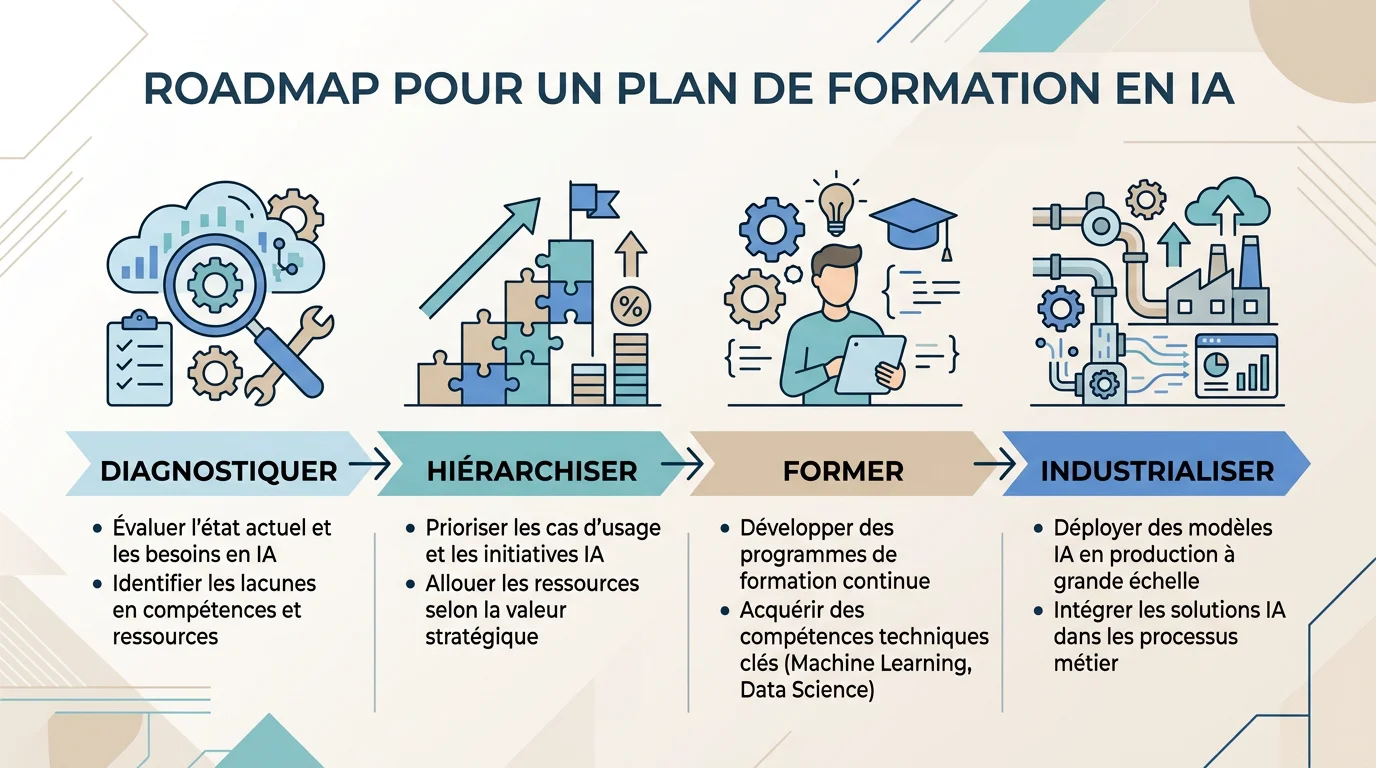
A pragmatic road map consists of four steps:
- Audit existing usages and actual needs by department.
- Prioritize a few high-impact, rapidly measurable use cases.
- Train teams on these concrete cases, not on abstract concepts.
- Scale by documenting best practices and identifying internal referents.
Before launching a full-scale deployment, it is useful to test different scenarios. You can use a simulator to prepare your AI deployment and estimate expected gains based on your processes. This scoping step reduces budget surprises.
Measuring the return on investment of training
The question always comes up in boardrooms: is training profitable? Recent data provides quantitative answers. According to PwC, every euro invested in AI training generates an average return of 4.50 euros.
The time saved is just as physical. Supported by OECD data, the same source points to up to 22 hours saved per month for a trained user. Internal demand is clear: 72% of employees say they want to be trained in AI—a pool of motivation that would be a shame to leave untapped.
However, careful not to confuse adoption with outcomes. Savings only truly materialize when training accompanies tool deployment. Without upskilling, AI remains an expensive gadget, regardless of the custom technical solution's quality.
Regulations, compliance, and governance in 2026
Training in AI isn't just about productivity. The legal framework now imposes a baseline of skills. Since 2025, European regulations have required a minimum level of AI literacy, with penalties applicable starting in August 2026 for non-compliant organizations.
This obligation turns training into a compliance issue, beyond a simple competitive advantage. Businesses must be able to demonstrate that their teams understand authorized usage, processed data, and audit methods for outputs.
Governance aligns here with data security. Who can use which tool? What information can be submitted to an AI? Answering these questions before deployment prevents many pitfalls. This is a point we consistently address in our IT consulting, linking training, security, and GDPR-compliant hosting.
Conclusion
The message from the figures is unambiguous: AI only creates value when teams know how to use it. With only 12% of French employees trained in 2026 compared to 72% expressing demand, the gap to close is immense—presenting a clear opportunity for organizations that take action now. The priority is not to stack up tools, but to build a role-specific AI training plan, tied to clear metrics and a solid compliance framework. Our strength lies exactly in combining this upskilling with human, pragmatic, and ROI-driven support, delivered by a dedicated expert who understands your processes. To scope your project with confidence, test our AI deployment simulator and measure your potential gains.
Frequently Asked Questions
How long does enterprise AI training last?
It depends on the target level. An AI awareness workshop can be done in a few hours, while an AI project manager track can span several weeks. The key is to match the duration with your team's actual use cases.
Are there technical prerequisites for AI training?
No, not for most role-specific user training. An introduction to generative AI doesn't require any coding skills. Only advanced training in data science or machine learning requires prior technical experience.
How do you ensure training produces concrete results?
By linking every module to a measurable use case and designating internal referents. This is our preferred approach: train on real-world tasks, then scale best practices with ongoing support instead of a single one-off session.