

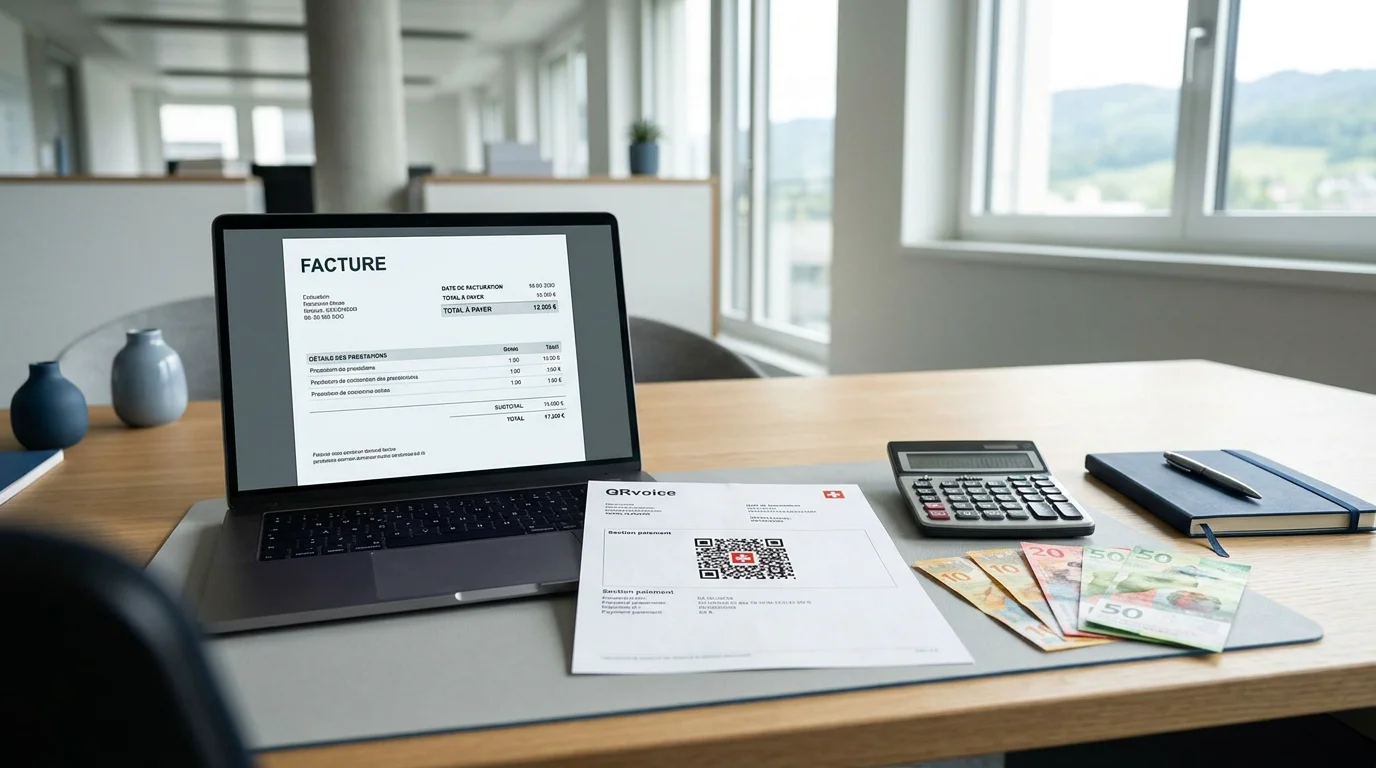
A non-compliant invoice can be rejected by the Federal Tax Administration (FTA), result in the loss of input tax deductions, and delay your payments by several weeks. Choosing compliant Swiss invoicing software is not just an administrative convenience—it is a legal and financial safeguard. For fiduciaries managing dozens of client mandates, this choice is also a matter of productivity, and our software solution for fiduciaries is designed to meet this exact requirement.
The Swiss framework rests on three pillars: the QR-bill, Switzerland-specific VAT rates, and a ten-year document retention obligation. According to a 2026 industry guide, any Swiss SME still issuing traditional payment slips is now non-compliant. Tools designed for other markets almost always fail on at least one of these points.
What Compliance Actually Means in Switzerland
This is precisely what the search for "compliant Swiss invoicing software" points to: a tool capable of generating documents accepted by banks, clients, and the tax administration without manual adjustments. Compliance is not a marketing label; it is a set of verifiable technical and legal requirements.
Four criteria make the difference between a truly Swiss tool and a generic solution:
- Native QR-bill support adhering to the Swiss Payments standard, with IBAN or QR-IBAN and structured references.
- Swiss VAT rates managed per line item, with clear reporting for the FTA.
- Legal record retention of documents for ten years, immutable and fully traceable.
- Data hosting and protection aligned with Swiss law and the new Federal Act on Data Protection (FADP).
A tool that checks these four boxes saves you from constant workarounds, such as generating QR codes elsewhere, manually recreating tax rates, or exporting files that your fiduciary cannot read. These issues translate directly into lost hours and high error risks every month.
The QR-Bill: A Non-Negotiable Foundation
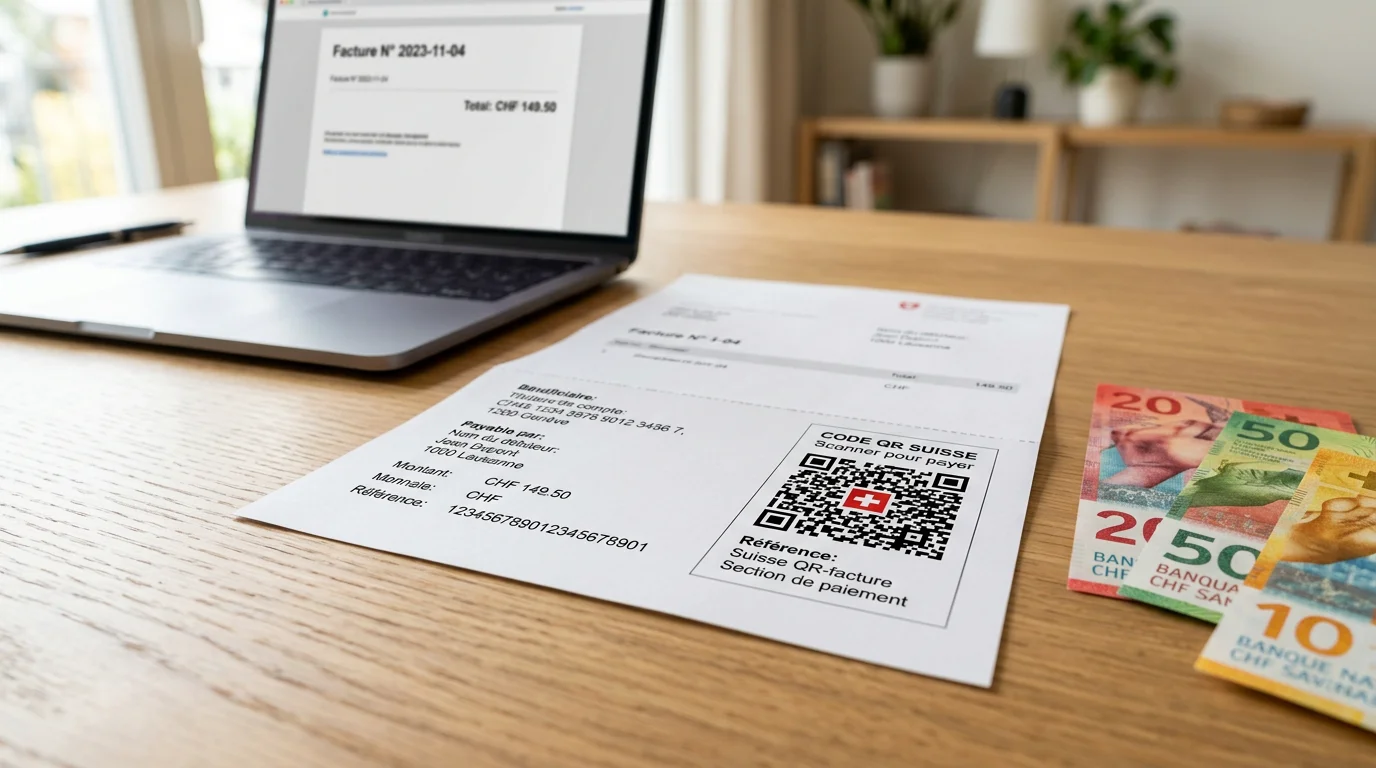
Since October 1, 2022, the QR-bill has been the standardized payment format in Switzerland. Traditional red and orange payment slips are no longer accepted by banks, making the native generation of the Swiss QR Code essential for any serious software.
The standard continues to evolve. According to the 2026 QR-bill rules, only structured type S addresses are now valid, and payments in Type K format are progressively rejected. In practice, writing an address in a single text field is no longer compliant: your tool must separate the street, number, postal code, and city into distinct fields.
A solid software solution also integrates bank reconciliation via camt.054 files, enabling automated matching of incoming payments. Furthermore, electronic invoices with QR codes are cleared faster than paper ones, representing a direct boost to your cash flow.
Swiss VAT: Rates, Thresholds, and FTA Reporting
VAT is the second area where foreign tools fail. Compliant software applies Swiss rates per line item: the standard rate of 8.1%, the reduced rate of 2.6%, and the special rate of 3.8% for accommodation. These rates have been in effect since January 1, 2024, and the once-considered increase has been postponed to 2028.
VAT liability becomes mandatory as soon as annual turnover reaches CHF 100,000. Below this threshold, you can invoice without VAT; beyond it, registration with the FTA and the disclosure of tax rates are mandatory. A frequently overlooked point: omitting mandatory disclosures exposes both parties. Under the Swiss VAT Act, an incomplete invoice can be rejected, triggering a retroactive tax assessment with a late payment interest of 4% per year.
The Business Identification Number (UID) and a structured breakdown of the VAT must appear on every document. To secure these checks, an ERP solution for SMEs with integrated invoice management centralizes master data and eliminates manual re-entry errors.
Data Retention, Traceability, and Protection
In Switzerland, Article 958f of the Code of Obligations requires the retention of invoices, receipts, and commercial documents for ten years in a legible and intact format. Cloud-based software with robust export features meets this requirement much more easily than a stack of paper in the basement, as noted in a 2026 SME guide.
The data dimension is growing in importance. The new Swiss Data Protection Act (FADP) increases your liabilities, and a recent compliance guide emphasizes archive integrity and storage location. Hosting in Switzerland or Europe with encryption has become a key selection criterion, particularly for sensitive customer mandates.
Another underlying trend is the rise of the Peppol network, as more and more Swiss public administrations require it for public contracts. Anticipating structured electronic invoicing will save you from a rushed migration when a major client or public tender mandates it.
Swiss Solution vs. International Tool: Why the Gap Is Widening

French or international SaaS solutions often look cheaper at first glance. In practice, they require manual workarounds: pasting QR codes onto PDFs, manually recreating VAT rates, unformatted reports for the FTA form, and exports that fiduciaries cannot process. The apparent savings quickly dissolve into lost hours and payment rejections.
The real issue is not just price, but independence and automation. Quotes, invoices, payment reminders, approvals, and reporting can run virtually unattended, freeing your teams from low-value tasks. We build custom software delivered in three months at a fixed price, with no licensing fees and no vendor lock-in, where you remain 100% owner of both code and data.
Artificial intelligence is accelerating this shift: quote generation, automated receipt reading, and request classification. To learn more, discover how to automate finance with AI at the service of invoicing and control. The objective remains a measurable ROI, not technology for its own sake.
Comparison: Standard Approach vs. Custom Solution
The table below compares two approaches to meeting Swiss requirements: a ready-to-use standard subscription and a custom-built solution tailored to your business.
| Criterion | Standard SaaS Solution | SapAngel Custom Solution |
|---|---|---|
| Swiss QR-bills and VAT | Yes, depending on the provider | Yes, integrated into the process |
| Code and data ownership | No (vendor lock-in) | Yes, 100% yours |
| Hosting and GDPR | Variable | In Europe, encrypted and GDPR compliant |
| AI Automation (quotes, reminders, reporting) | Limited | AI assistants integrated into workflows |
| Implementation timeframe | Fast but rigid | Custom in 3 months at a fixed price |
| Support | Generic support | Dedicated account manager, expert in your industry |
An SME that issues only a few invoices a month can get by with a lightweight subscription. However, as soon as processes grow more complex (multiple mandates, tool silos, lack of a single source of truth), a solution designed around a target ROI becomes highly advantageous.
Key Takeaways for Choosing Your Solution in Switzerland
A compliant Swiss invoicing software is evaluated on four concrete aspects: native QR-billing in the correct standard, Swiss VAT rates per line item, ten-year document retention, and securely hosted data. Check these criteria before any pricing discussion. Beyond compliance, evaluate the potential for automation and your independence from the provider—these factors will determine the time you actually save each month and the long-term robustness of your process.
Take Action with SapAngel
Do you want an invoicing setup that respects Swiss regulations without multiplying tools or relying on a single provider? We structure your digitalization journey with a dedicated partner, a clear scope, and a measurable ROI. Our approach combines consulting, automation, and custom-built software, with European hosting and total ownership of your code and data.
Delivered in three months at a fixed price, with no licenses and no lock-in: discover our software modules tailored for Swiss invoicing and map out your project in 30 minutes with an industry expert. You retain control, we drive the impact.
Frequently Asked Questions
Is the QR-bill mandatory in Switzerland?
Yes, since October 2022, the QR-bill has been the standardized payment format for Swiss and Liechtenstein bank accounts. Traditional red and orange slips are no longer accepted by banks. Since November 2025, only structured type S addresses are valid.
What VAT rates must Swiss software apply?
The rates in effect since 2024 are 8.1% for the standard rate, 2.6% for the reduced rate, and 3.8% for accommodation services. A proper tool applies them per line item and generates clear reporting for the FTA. The previously planned increase has been deferred to 2028.
How long must invoices be retained?
Article 958f of the Code of Obligations mandates a ten-year retention period in a legible and intact format. Cloud-based software with robust export tools makes it much easier to comply with this obligation. This applies to both paper and electronic invoices.
Is an international tool sufficient for Swiss invoicing?
Rarely without compromises, as these tools often lack native QR-billing, pre-configured Swiss VAT rates, and readable exports for fiduciaries. This leads to recurring manual tasks and non-compliance risks. A solution designed for Switzerland eliminates these pain points.
Should you choose standard software or a custom solution?
A standard subscription works well for low invoice volumes and simple requirements. As processes become more complex, a custom solution—such as our software delivered in three months at a fixed price—provides automation, independence, and full ownership of your data. The choice depends on your volume, your mandates, and your overall digitalization goals.