


In France, only a minority of companies are fully leveraging AI, while their competitors accelerate quarter after quarter. This gap is gradually turning into a lasting competitive divide. To understand how to take the leap without spreading yourself too thin, nothing beats real-world cases: that is exactly the focus of our Examples of AI adoption in business.
Every artificial intelligence business example addresses a specific business need: reducing repetitive tasks, speeding up decisions, or making processes more reliable. However, it is essential to distinguish between value-creating use cases and mere hype. According to INSEE figures, 10% of companies with 10 or more employees reported using at least one AI technology in 2024, up from 6% in 2023.
AI in Business in 2026: A Widening Gap
The landscape is moving at two speeds. Large corporations are industrializing AI, while smaller businesses are often still in the experimentation phase. According to the 2026 Bpifrance report, 47% of French SMEs have launched at least one AI project, a proportion that reaches 95% for companies with more than 200 employees.
This gap is primarily explained by resources and in-house skills. Many business leaders perceive AI as vital but lack a clear roadmap. Meanwhile, the market is not slowing down: it was valued at $244 billion in 2025, up 32% year-on-year, and is projected to exceed $500 billion by 2028.
The conclusion is simple. Waiting is more expensive than acting, provided you start with targeted, measurable use cases rather than sprawling, over-ambitious projects.
Ten Concrete Examples of AI in Business by Department

The most profitable applications are spread across different departments. Here are ten AI use cases observed in organizations, from back-office tasks to customer relations.
- 24/7 Customer Service: Conversational agents handle frequently asked questions, reduce response times, and relieve support teams.
- Personalized Marketing: Granular audience segmentation, lead scoring, and content generation tailored to each channel.
- Sales Prospecting: Automated qualification of target accounts and prioritization of high-potential opportunities.
- Fraud Detection: Real-time transaction analysis to spot anomalies and block suspicious payments.
- Recruitment: Resume pre-screening and interview summaries to refocus HR on the human element.
- Predictive Maintenance: Anticipating machine breakdowns using sensor data to limit production downtime.
- Logistics Optimization: Demand forecasting and route calculation to reduce inventory and lead times.
- Content Creation: Assisted drafting of emails, meeting minutes, and sales collateral.
- Data Analysis: Predictive dashboards that explain variances and project future trends.
- Cybersecurity: Alert correlation, shifting from a reactive to a predictive posture.
None of these applications replace your teams. They augment them, absorbing low-value tasks to free up time for critical thinking and building relationships.
Automating Repetitive Tasks: The Most Immediate Benefit
Quotes, invoices, payment reminders, approvals: these processes consume hours every week. Intelligent automation makes them more reliable and faster, with a return on investment often achieved within a few months. This is frequently the best starting point for a first win.
The benefits are proven. A McKinsey study cited in an overview of 2026 statistics shows that 90% of users report saving time thanks to AI, and 85% focus more on important tasks. The most highly exposed sectors are expected to see productivity growth nearly five times higher than others.
To translate these figures into concrete results for your business, we design business process automation tailored to your actual workflows. The objective remains constant: eliminate manual entry, reduce errors, and give valuable time back to your employees.
Integrating AI into your ERP for Real-Time Decision Making
One often-underestimated example involves the core of the information system. Connected to the ERP, AI transforms a simple management tool into a decision-making co-pilot: cash flow forecasting, inventory alerts, budget scenarios, and reports generated in natural language.
Structured companies are moving fast in this area. According to a Microsoft France study from February 2026, 42% of companies formally deploy AI in marketing and 36% in sales. On the enterprise side, the KPMG barometer notes that two-thirds now know how to measure the ROI of their AI projects, compared to just one-third a year earlier.
Yet, it is crucial to prevent these projects from veering off course, as is too often the case with ERP deployments. Our experts secure AI integration in ERP systems on both SAP and Microsoft Dynamics 365, with strict requirements for traceability and GDPR compliance at every step.
Successful Integration: From Example to Measured ROI
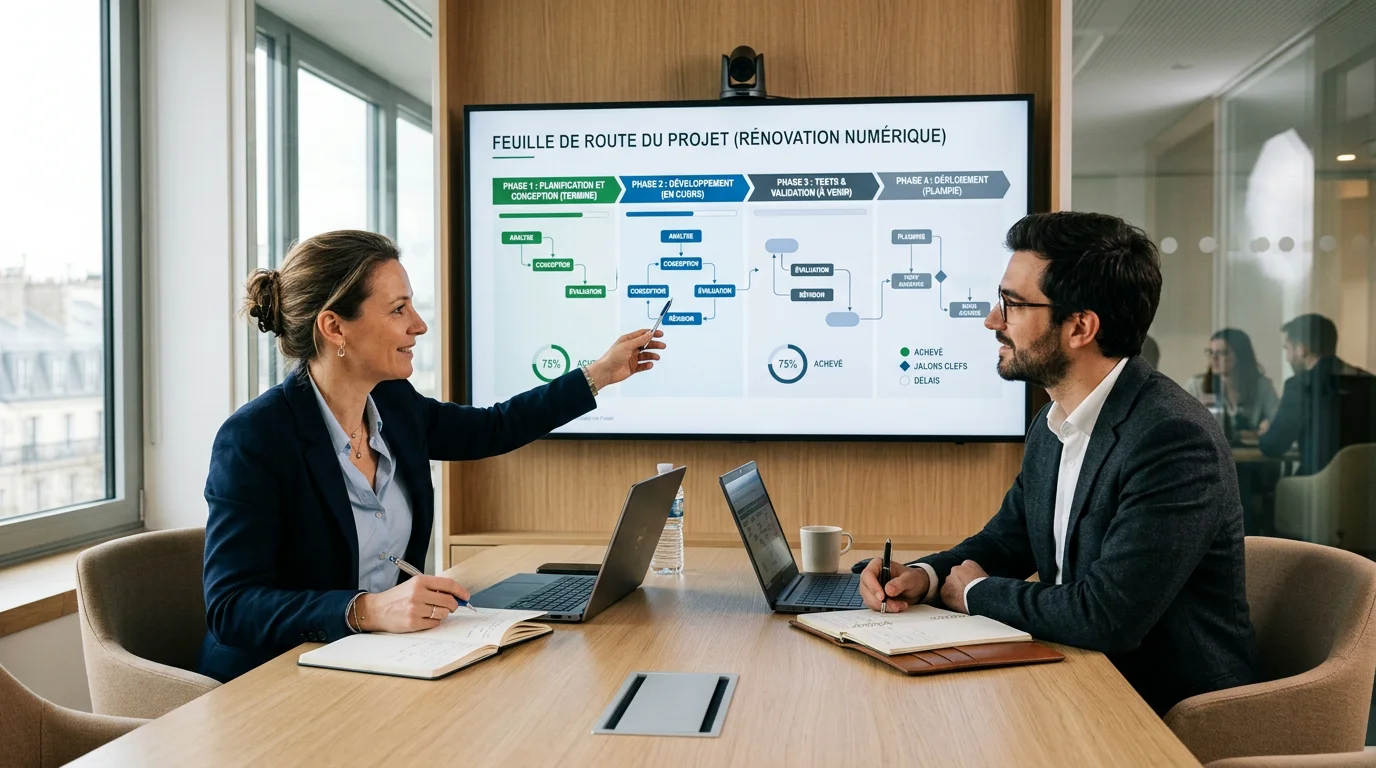
Moving from a great example to actual business gains depends less on the technology than on the methodology. Adoption remains highly uneven across industries. INSEE data analyzed in 2026 shows a 42% adoption rate in information and communication, compared to 5% or less in transport and construction.
Three key levers make the difference between an abandoned pilot and a profitable deployment:
- Define a narrow scope: one process, one financial indicator, a short timeline.
- Train the teams: adoption depends primarily on people, not models.
- Ensure governance: European hosting, encryption, and auditable logs to maintain compliance.
This is precisely our approach. With our IT department services to deploy AI, you benefit from a dedicated expert who understands your industry and links each project to a measurable result, without excessive vendor lock-in.
Which Approach Should You Choose for Your Business?
Three paths are available to you to integrate AI. The table below compares their main features.
| Approach | Implementation timeline | Ownership of code and data | Support & Guidance |
|---|---|---|---|
| Off-the-shelf SaaS tools | Immediate | Limited, data hosted by the vendor | Low or standardized |
| 100% in-house development | Long and uncertain | Total, but heavy burden on teams | Do-it-yourself |
| SapAngel (custom + IT department) | Delivery in 3 months at a fixed price | 100% proprietary, hosted in Europe | Dedicated expert in your industry |
Ready-to-use tools are suitable for testing an idea quickly. As soon as a use case becomes strategic, ownership of code and data, along with continuous support, become critical factors in securing ROI.
Conclusion
There is no shortage of examples: from customer service and automation to ERP, finance, or production, every department can find its use case. However, there is still a clear gap between the 95% of large enterprises actively engaged and the majority of SMEs still in the trial phase. The best approach is to choose a concrete AI in business example aligned with a financial KPI, and then deploy it cleanly before scaling up. This discipline, more than the technology itself, is what separates real gains from abandoned projects. By combining custom software, SAP and Microsoft Dynamics 365 expertise, and a dedicated industry expert, we turn these use cases into sustainable results. To identify yours, try our AI simulator for your project and get an initial estimate.
Frequently Asked Questions
What is the best first AI example to deploy?
Automating a repetitive and costly process, such as quotes or payment reminders, often offers the fastest return. It is measurable, low-risk, and paves the way for more advanced use cases.
Is AI reserved only for large enterprises?
No. In 2026, 47% of French SMEs have already launched an AI project. Targeted solutions, like the ones we design on a custom basis, allow you to start small while retaining full control over your data.
How do you measure the ROI of an AI project?
Link each project to a specific metric: time saved, costs avoided, conversion rate, or customer satisfaction. A narrow scope and regular monitoring make this evaluation much easier.