


A supply chain managed with spreadsheets and email exchanges quickly reaches its limits: picking errors, stockouts, delivery delays. Digitalizing these processes is becoming a competitive necessity, and that is precisely the role of logistics software. For transport activities, our solution dedicated to the transport sector is a prime example of this tailored tooling approach.
This goes beyond a simple technical matter. According to Mordor Intelligence, the digital logistics market is set to reach $55.57 billion in 2026 and is expected to almost triple by 2031. In Switzerland and France alike, SMEs and large corporations are accelerating the adoption of these tools to gain visibility, reliability, and competitiveness. The challenge lies in choosing the right building block for the right need.
What is logistics management software?
A logistics management tool is a digital solution designed to control and automate storage, transport, and distribution operations. It centralizes supply chain data to maximize efficiency while reducing operational costs and errors.
In reality, talking about a single tool is reductive. There is no single solution, but rather a family of complementary applications: inventory management, shipment tracking, route planning, and dock scheduling. Each addresses a specific step in the goods' journey, from receiving to final delivery. These blocks increasingly integrate with existing information systems to streamline data exchange.
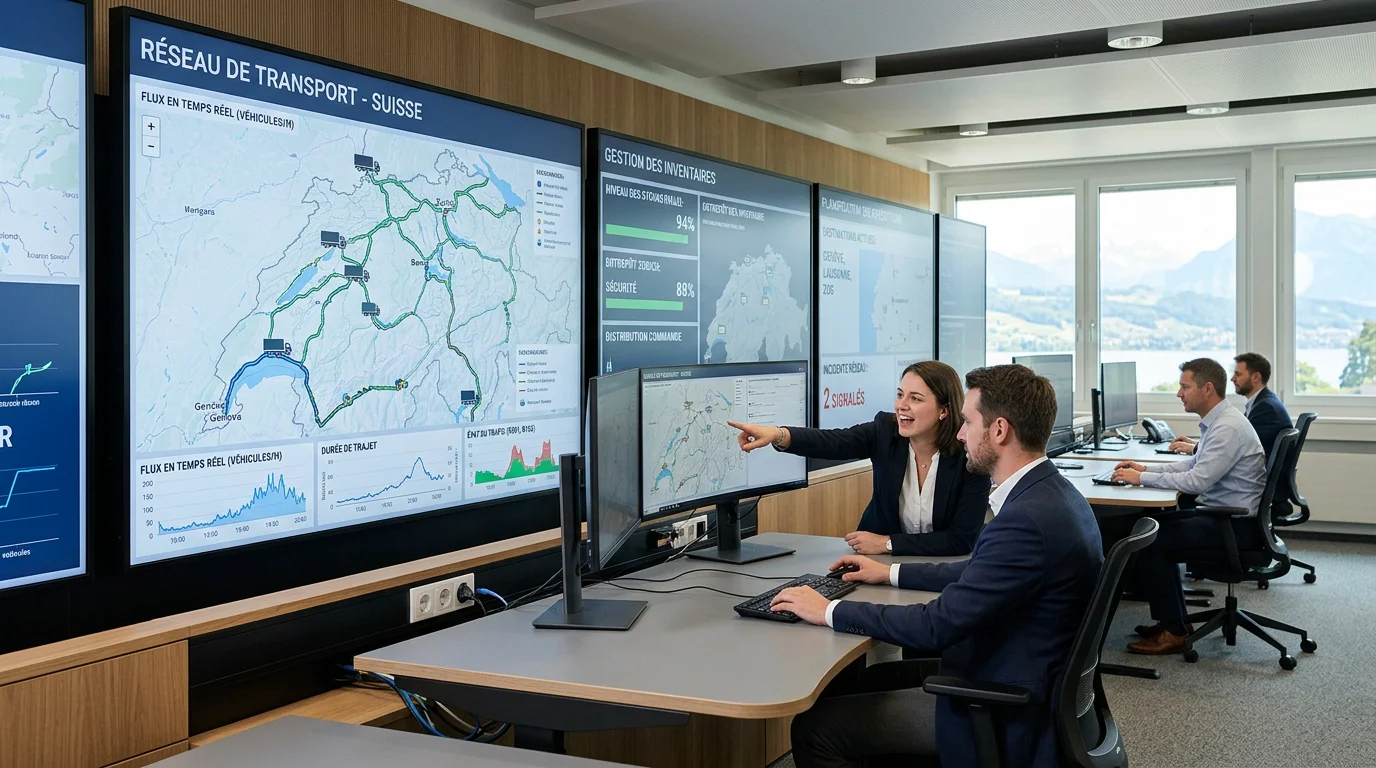
The main families of logistics software
Understanding the different tool categories is the first step before launching any project. Each acronym covers a distinct functional scope, and the classic mistake is wanting a single software to do everything.
- WMS (Warehouse Management System): inventory management and warehouse operations, from picking to shipping.
- TMS (Transport Management System): route planning, carrier selection, and shipment tracking.
- YMS (Yard Management System): yard and loading dock management, carrier appointment scheduling.
- APS (Advanced Planning System): demand forecasting and procurement optimization.
- OMS (Order Management System): order lifecycle orchestration, from cart to delivery.
- ERP (Enterprise Resource Planning): integrated system linking logistics, accounting, purchasing, and production on a single database.
These solutions do not compete; they complement each other. A distributor will often combine a WMS for the warehouse and a TMS for transport, all connected to a central ERP. To understand the latter's pivotal role, you can consult our comparison of the best logistics ERP.
What concrete benefits can you expect?
The promise of a supply chain management tool is measured in tangible gains. Companies that have integrated predictive analysis models report significant logistics cost reductions. According to data from Mordor Intelligence, embedding predictive models to fine-tune replenishment, carrier selection, and dock scheduling generates 18% to 25% savings in logistics costs.
Beyond costs, visibility is the most sought-after benefit. Better end-to-end traceability helps anticipate stockouts and improve delivery time reliability. According to a study shared by RAJA, 67% of supply chain directors consider end-to-end visibility as an essential contribution of transport digitalization.
The key drivers of a successful project can be summarized as follows:
- Automation of repetitive tasks (data entry, reminders, reporting) and reduction of manual errors.
- Inventory optimization to prevent both overstocking and stockouts.
- Improved customer satisfaction thanks to more reliable deliveries.
- Reduction of the ecological footprint through optimized routing and load capacity.
In our approach, this automation logic translates into quotes, invoices, and validation workflows that are handled automatically, freeing your teams from time-consuming manual data entry.
A rapidly growing market in 2026
The figures confirm a fundamental trend. Fortune Business Insights values the global logistics software market at $17.47 billion in 2026, up from $16.24 billion in 2025, with an expected annual growth rate of 7.75% through 2034. The shift to the cloud is accelerating this expansion.
In Europe, the trend is identical. Xerfi estimates the global supply chain software market at over €30 billion, driven by digital transformation, cloud adoption, and the rise of artificial intelligence. The research firm highlights the presence of international software vendors alongside recognized French players, in an intensely competitive environment.
For Swiss SMEs engaged in their digital transformation, this mature market offers a wide choice, but also a risk of over-engineering. Not every business needs a platform designed for multinationals.
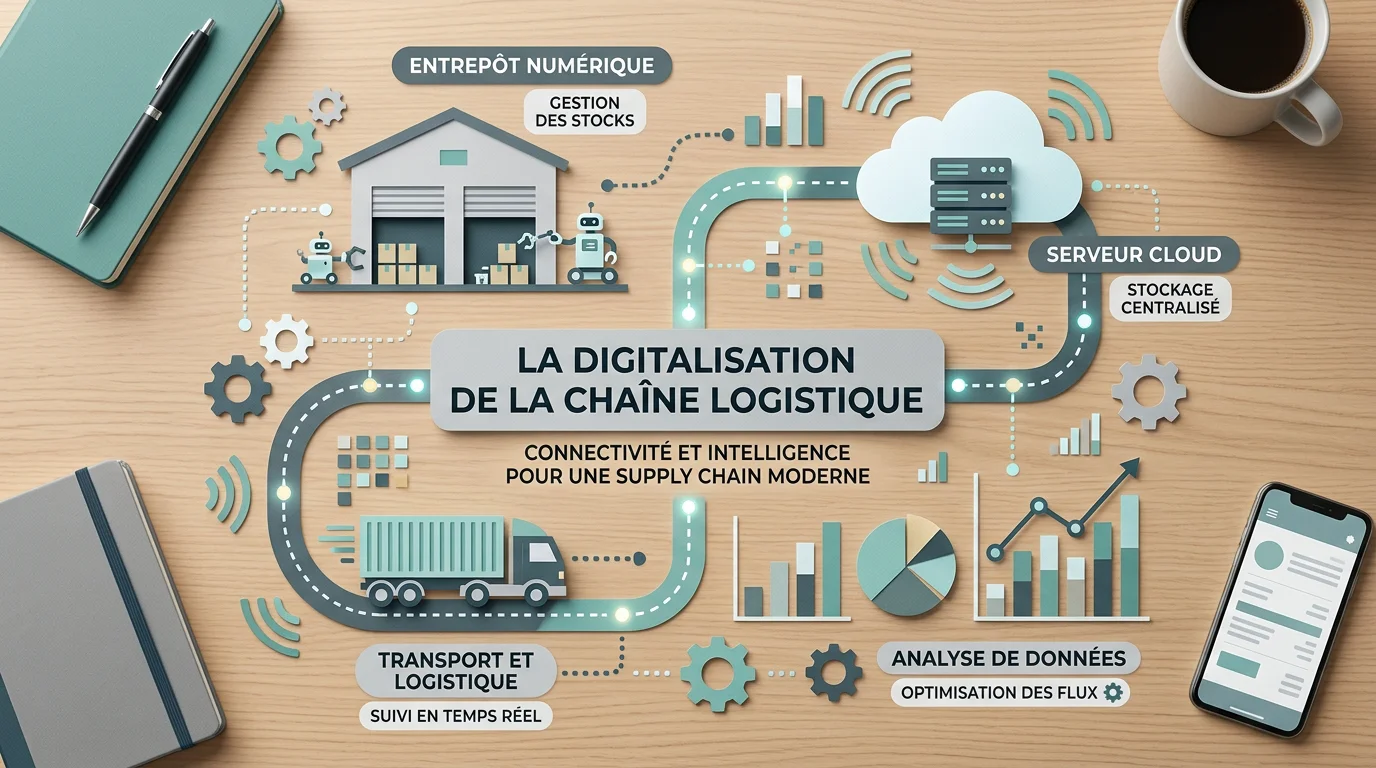
AI and cloud: the drivers of transformation
Two technologies are reshaping the sector. Artificial intelligence helps anticipate demand, optimize route planning, and manage inventory with unprecedented accuracy. It automates processes and increases responsiveness to demand fluctuations.
The cloud, for its part, has established itself as the dominant deployment model. Its scalability, controlled costs, and real-time access to data from multiple sites make it the foundation of modern architectures. This convergence of AI, IoT, and cloud is accelerating adoption across all company sizes, while also raising cybersecurity and compliance challenges.
This is a point we place at the core of every project scoping phase: hosting in Europe, data encryption, GDPR compliance, and auditable logs. Security is not an option added at the end of a project, but a prerequisite integrated by design.
How to choose your logistics software
There is no single "best" tool: it all depends on your priorities. Before comparing solutions, identify your primary need (inventory, transport, forecasting) and check the user experience, industry compatibility, and support quality. Off-the-shelf software often forces unnecessary features, a lengthy integration process, and vendor lock-in.
The table below compares two main structured approaches against our custom software offering.
| Criterion | Proprietary generic ERP | Open-source solution | Our Mind offer (custom) |
|---|---|---|---|
| Implementation time | Several months to years | Variable, internal resources required | 3 months at a fixed price |
| License | Recurring subscription | Free, integration costs to be expected | No license, no lock-in |
| Code and data ownership | Vendor | Shared / community-based | 100% yours |
| Features | Standardized, often bloated | To be developed | Only the necessary modules |
SMEs in the sector often find that a modular approach offers the best balance between cost and adoption. Our SME ERP use case details how to structure such a project without mobilizing a full-time IT department.
Custom vs. generic: deciding based on ROI
Many projects fail not from a lack of technology, but from a lack of proper scoping. Timeline and budget overruns often stem from poorly defined requirements and generalist integrators with split focus. The core question remains the same: what return on investment are you targeting?
That is why we scope every project around a measurable target ROI (productivity gains, cost reductions, process reliability) with a dedicated industry expert supporting you at every stage. Our "you validate, we deploy" approach ensures software designed module by module, adopted from day one, with complete ownership of both code and data.
Conclusion
Logistics software is no longer a luxury reserved for large corporations: it is a competitive lever accessible to both Swiss SMEs and mid-market companies. With a global market estimated at $17.47 billion in 2026 and logistics savings of up to 25%, the question is no longer whether to digitalize, but how to do so without budget overruns. The key lies in properly scoped requirements, a secure architecture, and a solution tailored to your actual workflows—no more, no less. This is exactly what a custom solution delivered in three months at a fixed price provides, with you retaining full ownership. To identify the most suitable approach for your context, try our software solution simulator.
Frequently Asked Questions
What is the difference between a TMS and a WMS?
A TMS manages and optimizes goods transport: routes, carriers, and shipment tracking. A WMS controls inventory and internal warehouse flows. The two are complementary, covering external and internal operations.
Is an ERP enough to manage all logistics for an SME?
An ERP covers overall management (inventory, orders, accounting) on a single database. For complex warehouse or transport operations, it can be complemented by a WMS or TMS. Our custom offering allows you to assemble only the specific modules you actually need.
How long does a logistics digitalization project take?
This varies from a few weeks for an audit or training to several months for full integration. Our custom software Mind is delivered in three months at a fixed price—a controlled timeline achieved through rigorous upfront scoping.